Four-Wheel Counterbalance Electric Forklift Load Charts: Reading Derated Capacity at Your Actual Lift Height and Load Centre
News 11/11/2026
A load chart on a four-wheel counterbalance electric forklift tells you the maximum weight the truck can lift under a specific set of conditions — not a single fixed number you can apply everywhere. The rated capacity printed on the data plate usually assumes a defined load centre and a defined lift height, often with a standard carriage and fork setup. Once your real load sits farther from the fork face or rises above the height used in the rating, the safe capacity drops. Reading that derating correctly is the difference between a compliant lift and an unstable one.
This guide explains how to interpret a capacity chart, how load centre and lift height interact, and which site conditions you should confirm before choosing a truck configuration. It applies to four-wheel counterbalance electric forklifts, including lithium-battery models. Different forklift types use different stability principles, so a chart from another truck category does not transfer to a counterbalance machine.
What the Rated Capacity Plate Actually Tells You
The capacity plate is a summary of a stability calculation, not a guarantee that the truck will handle that weight in every posture. A typical plate lists a rated capacity at a stated load centre, and sometimes a second figure at a larger load centre. It may also reference the mast type, carriage, fork length and any attachment fitted at the time of rating.
Three details matter most when you read the plate:
- Load centre. The horizontal distance from the vertical face of the forks to the centre of gravity of the load. A standard rating often uses a load centre of 500 mm or 600 mm, but you should confirm the figure on your own plate rather than assume it.
- Lift height reference. Some plates state capacity at a specific height or note that capacity is reduced above a certain point. Where a full chart is supplied, read the value at your real lift height.
- Attachment status. Adding a side-shifter, clamp, rotator or extension changes both the load centre and the truck’s own centre of gravity, so the original rating no longer applies unchanged.
If any of these details are missing or illegible, treat the plate as incomplete and ask the supplier to confirm the rating configuration in writing.
How Load Centre and Lift Height Reduce Capacity
Capacity derating follows from leverage. A load whose centre of gravity sits farther forward creates a larger overturning moment about the front axle. Raising the load also shifts the combined centre of gravity and, on many trucks, reduces the margin available before the rear wheels lose contact with the ground. The chart expresses the resulting safe limits.
Load centre: the horizontal variable
Long loads, pallets loaded unevenly, or loads that overhang the fork tips all move the centre of gravity forward. If your plate rates 2,000 kg at a 500 mm load centre, a load whose centre sits at 600 mm cannot be treated as a 2,000 kg lift. The correct figure is whatever the chart states at 600 mm — and that figure is lower. The same logic applies to deep pallets, drums and bundled material.
Estimating load centre is not always straightforward. For a uniformly packed pallet, the centre is roughly at the middle of the load depth. For irregular loads, the centre may sit well off the geometric middle. When you cannot establish it confidently, measure or ask the supplier to help you assess the configuration.
Lift height: the vertical variable
Many charts present capacity as a function of lift height, with capacity stepping down at defined heights. The practical consequence is that a load you can lift to shoulder height may exceed the limit at full mast extension. If your operation regularly lifts to racking at 4 m or higher, read the chart at that height, not at the ground-level figure.
Mast type affects how height enters the calculation. A two-stage mast and a three-stage mast have different structures and different residual capacities at height. Confirm which mast your truck carries and use the chart that matches it.
Reading a Derated Capacity Chart: A Worked Method
The following sequence is a general reading method. It does not replace the manufacturer’s chart supplied with your specific truck.
- Establish the real load centre. Measure load depth and identify where the centre of gravity sits. Add any forward offset introduced by an attachment.
- Establish the real lift height. Use the height at which the load is carried and placed, including the extra height needed to clear racking beams.
- Locate the intersection. Find the row or curve matching your load centre and read the capacity at your lift height.
- Compare with the actual load weight. Include the pallet, packaging and any residual material. A load that is close to the limit deserves a second check.
- Check the attachment allowance. If an attachment is fitted, apply the derating the supplier specifies. Do not reuse the bare-carriage figure.
- Record the result. Note the permitted capacity on the job instruction so operators do not rely on memory.
A simple comparison helps illustrate the principle without inventing numbers. Suppose a chart gives one capacity at a 500 mm load centre and a lower capacity at 600 mm, and a further reduction at a higher lift height. The binding limit is the lowest figure that applies to your combination of load centre and height. Whichever variable is worse governs the lift.
Conditions the chart does not cover
A capacity chart assumes a level, firm surface and a truck in specified condition. It does not account for:
- Slopes, ramps or dock plates that tilt the truck
- Soft ground, gravel or damaged flooring
- Dynamic forces from travelling, braking, lowering or swinging a load
- Wind acting on large, light loads carried at height
- Worn tyres, incorrect tyre specification or damaged mast components
Where these conditions exist, the chart figure is an upper bound, not a target. Reduce the load or change the handling method, and consult the supplier about whether the application suits a counterbalance truck at all.
Matching Site Conditions to a Counterbalance Electric Forklift
Reading the chart is one half of the decision; confirming the site is the other. The points below are the ones most often missed when a buyer compares different forklift types or configurations.
Load weight and load centre
Collect the heaviest loads you actually handle, not the average. Note the pallet depth and whether loads vary in density. A truck rated highly at a short load centre may be unsuitable if your loads are deep.
Lift height and mast choice
State the highest shelf or stack height and the clearance needed above it. Free lift matters where you work inside containers or under low doorways. Confirm the mast type against these needs.
Aisle width and turning
Four-wheel counterbalance trucks need more aisle space than some other designs. Measure the narrowest aisle and the turning area at each end. If space is tight, discuss it openly rather than assuming the truck will fit.
Floor, slope and outdoor use
Check floor loading, surface condition and any ramps. Confirm whether the truck will work outdoors and in what weather. Tyre choice and chassis protection should follow from these answers.
Shift pattern and charging
Record shift length, intensity and whether the truck is shared. Lithium-battery models can be opportunity-charged during breaks where the charging infrastructure and supplier guidance allow, but the practical schedule depends on your duty cycle and charger availability. Ask the supplier to confirm what your pattern requires.
Attachments and special handling
If you need an attachment, raise it early. It changes the capacity rating, and retrofitting later can leave you with a truck that cannot do the job it was bought for.
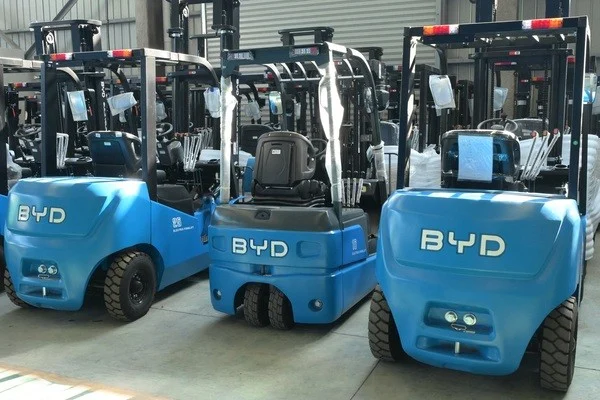
When you request a quotation for a four-wheel counterbalance electric forklift, provide the load weights, load centres, lift heights, aisle dimensions, floor conditions and shift pattern. These details let the supplier match a model and configuration to your chart limits instead of quoting a headline capacity that will not hold at height.
Frequently Asked Questions
Is the capacity on the data plate the same as the capacity at full lift height?
Not necessarily. The plate often states capacity at a defined load centre and may reference a height. Where capacity reduces with height, you must read the chart at your actual lift height. Treat the plate figure as a starting point and confirm the derated value.
Can I lift the rated load if my pallet is deeper than the stated load centre?
No. A deeper load moves the centre of gravity forward and reduces the safe capacity. Use the chart value at your real load centre, which will be lower than the rating at the standard load centre.
Does adding a side-shifter change the load chart?
Yes. An attachment adds weight and forward offset, so the capacity rating changes. Ask the supplier for the derated figure that applies with the attachment fitted, and update the job instruction accordingly.
Why do different forklift types have different capacity behaviour?
Each type uses a different structure and stability principle. A four-wheel counterbalance truck relies on its chassis and counterweight to balance a load on the forks, so load centre and lift height act directly on stability. Other designs place the load or the operator differently, which is why their charts cannot be substituted. When comparing options, confirm the chart that matches the truck type you are considering.
What should I do if my load is close to the chart limit?
Recheck the load weight, load centre and lift height, and confirm the attachment configuration. If the margin is small, reduce the load, split it, or discuss a higher-capacity configuration with the supplier. Do not rely on operator judgement alone.