Battery Voltage, Charger Siting, and Shift Patterns: Specifying a Four-Wheel Counterbalance Electric Forklift Around Your Power Infrastructure
News 31/10/2026
Choosing among the different forklift types available starts with the work itself, but the decision rarely ends there. On a four-wheel counterbalance electric forklift, the battery, the charger location, and the shift schedule form one connected system. A truck that fits the aisle and the load can still disappoint if its battery voltage does not match the charger you already own, if the charger sits too far from where trucks park, or if the shift pattern leaves no realistic window to recharge. This guide explains how those three factors interact and how to specify around them.
Why Power Infrastructure Should Drive the Specification
Most buyers begin with capacity and lift height, which is correct. Power infrastructure then acts as a constraint on which configurations remain practical. Voltage determines charger compatibility and cable and connector requirements. Charger siting determines whether opportunity charging is realistic and how much time trucks spend travelling to and from a charging point. Shift patterns determine how much energy each truck must draw in a working day and whether one battery can cover it.
Treat these as design inputs rather than afterthoughts. When a site already has charging hardware, the question becomes which truck configuration matches it. When the site is new, the charging plan can be designed alongside the truck order. Either way, confirm the actual values with the manufacturer’s technical documentation rather than assuming that similar-looking trucks share the same electrical characteristics.
Voltage, Charging, and Shift Patterns: Matching the Truck to the Working Day
Battery voltage and charger compatibility
Common traction battery voltages on counterbalance electric trucks include 48 V, 80 V, and higher classes on larger models. The exact voltage, battery capacity in ampere-hours, connector type, and charging profile must come from the supplier’s data sheet. Voltage matters because chargers are built to a specific output range and connector standard. A charger sized and configured one way will not necessarily serve a truck with a different pack.
Ask the supplier to confirm the battery chemistry, nominal voltage, capacity, and the charger specification that matches it. If you intend to keep existing chargers, record their output voltage, current, connector type, and any communication protocol they use. Mismatches here are one of the most avoidable sources of delay in a forklift project.
Charger siting and the cost of distance
Where chargers sit affects productivity more than many buyers expect. Every trip to a charger consumes operating time and adds traffic to shared aisles. Practical siting questions include:
- Is the charging area close to where trucks actually finish tasks, not just near the building entrance?
- Is there ventilation, and does the area meet the electrical and fire-safety requirements that apply on your site?
- Can a truck park safely while charging without blocking pedestrian routes or loading zones?
- Is there enough space to connect and disconnect cables without stretching them across traffic?
- Does the layout allow more than one truck to charge at once if the fleet grows?
Opportunity charging, where trucks top up during natural breaks, depends on chargers being within easy reach of the work area. If the only charger is in a distant corner, drivers will tend to run packs down and charge in long blocks, which places more strain on scheduling. The right answer depends on your building, so plan the layout with the electrical and safety requirements in mind rather than copying another site’s arrangement.
Shift patterns and the charging window
Shift structure determines the energy budget. A single-shift operation with a long overnight pause can often recharge between shifts. Two or three shifts with short changeovers leave less room, and continuous operation may require battery swapping, multiple packs, or a charging strategy built around short frequent top-ups.
To assess this honestly, collect the following before requesting a configuration:
- Number of shifts per day and their length, including breaks
- Estimated operating hours per truck per shift
- Typical load weight and lift height, since these affect energy draw
- Whether trucks can charge during breaks or only between shifts
- Available charging positions and their distance from the main work area
These inputs let the supplier discuss battery capacity and charging approach against your actual duty cycle. Without them, any recommendation is a guess. Note also that load weight, lift height, and travel distance influence energy consumption, so a truck that is adequate on light short-cycle work may need a different configuration on heavier duty.
An illustrative scenario, not a case study
Consider a hypothetical warehouse running two shifts with a 30-minute changeover and a charging bay beside the dispatch area. Trucks handle mixed pallets at moderate lift heights. In this situation, a sensible starting point is to check whether the supplier’s recommended battery capacity covers a full shift plus part of the next, and whether the charger output allows a meaningful top-up during the changeover. If the charger is far from dispatch or the changeover is too short to connect and disconnect safely, the plan needs adjusting before the truck is ordered. The numbers must come from the supplier’s data and your own time study, not from this example.
Practical Specification Steps and Questions to Settle Early
Work through the following sequence before confirming a configuration. It keeps the electrical side aligned with the mechanical side.
- Document the duty cycle: shifts, hours, loads, lift heights, and travel distances.
- Survey existing charging equipment and record voltage, current, connector type, and condition.
- Map candidate charging locations against work areas, traffic routes, and safety requirements.
- Ask the supplier to confirm battery voltage, capacity, chemistry, and the matching charger specification from their technical documentation.
- Check whether the proposed charging window is realistic given shift breaks and charger distance.
- Confirm who is responsible for electrical installation and inspection, and what local requirements apply.
- Agree acceptance checks, such as verifying that the delivered truck and charger match the agreed specification.
Two further points are worth raising with any supplier. First, ask how the recommended configuration changes if the fleet grows or the shift pattern shifts. Second, ask what information they need from you to give a reliable recommendation. A supplier who asks detailed questions about your operation is easier to trust than one who quotes a standard package without checking the electrical fit.
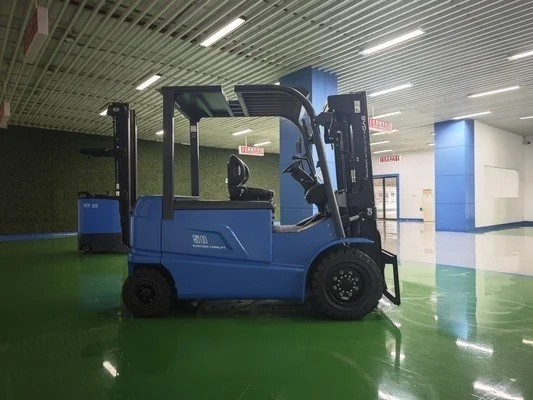
If you are comparing different forklift types, remember that the four-wheel counterbalance electric forklift is a general-purpose choice across many loading, unloading, and transfer tasks, but its suitability still depends on load, lift height, load centre, aisle width, floor and ramp conditions, shift pattern, and charging arrangements. Where those conditions fall outside a counterbalance truck’s practical range, a different machine may be the better fit, and that should be discussed openly rather than forced into the wrong category.
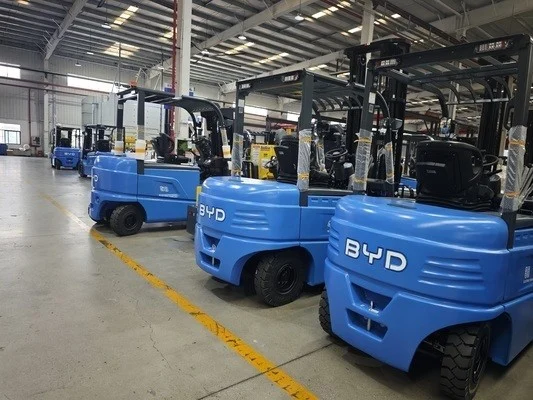
When you are ready to move from general guidance to a specific configuration, share your actual operating conditions, required load capacity, and lift height with our team. We can then discuss the selection and configuration of BYD four-wheel counterbalance electric forklifts, including lithium battery options, against the technical information available.
Frequently Asked Questions
Can I use my existing charger with a new forklift?
Only if the charger’s output voltage, current, connector type, and charging profile match the new battery. These details must be confirmed against the supplier’s technical documentation. Never assume compatibility from appearance or brand alone.
How close should the charger be to the work area?
Close enough that charging fits naturally into breaks without long travel, while still meeting ventilation, electrical, and fire-safety requirements and keeping pedestrian routes clear. The right distance depends on your building layout and shift structure, so assess it with a site plan rather than a fixed rule.
Does a three-shift operation always need battery swapping?
Not necessarily. It depends on the energy each truck consumes, the battery capacity the supplier specifies, and how much charging time the schedule allows. Short frequent top-ups may be enough in some operations, while others may need swapping or additional packs. This should be assessed from your duty cycle data.
What information should I prepare before requesting a quote?
Prepare shift length and count, operating hours per truck, typical loads, lift heights, travel distances, existing charger details, and candidate charging locations. These let the supplier propose a configuration grounded in your operation instead of a generic package.