Electric Forklift Procurement Guide: Confirming Four-Wheel Counterbalance Load Capacity and Lift Height Against Factory Handling Tasks
News 10/11/2026
Buying an electric forklift for factory work starts with two numbers that are easy to state and hard to verify: rated load capacity and lift height. Both appear on every data sheet, yet neither tells you on its own whether a four-wheel counterbalance electric forklift will handle your actual handling tasks. Capacity is tied to a load center and a lift height, and lift height affects what remains stable at the top of the mast. This procurement guide explains what to confirm before you request a quotation, which technical documents to ask a supplier to provide, and how to check a delivered unit against the task it was bought to perform.
What the Capacity and Lift Height Figures Actually Mean
A counterbalance truck stays upright because its counterweight balances the load on the forks. The rated capacity therefore describes a specific condition, not a universal limit. Manufacturers normally publish capacity at a stated load center, often 500 mm or 600 mm, and at a stated lift height. When either changes, the safe capacity can change too.
Load center is part of the rating
The load center is the horizontal distance from the vertical face of the forks to the center of gravity of the load. A pallet whose weight sits further out reduces the capacity the truck can safely handle. This matters in factories that move wide loads, long items, or pallets loaded unevenly. Ask what load center the published rating assumes, then measure your own loads rather than relying on the pallet footprint alone.
Lift height and residual capacity
Many trucks lose capacity as the carriage rises, and the data sheet should show this through a derating curve or a capacity table at several heights. If your racking requires lifting to a high level, confirm the capacity available at that height, not only at ground level. A truck rated at a given load at low lift may not carry the same load to the top beam.
Attachments change the calculation
Clamps, rotators, push-pull units, and other attachments add weight and move the load center forward. Their effect should be reflected in a revised capacity rating supplied with the attachment. Do not assume the base truck rating still applies.
Collecting the Task Data You Need Before Requesting a Quote
Suppliers can only propose a suitable configuration when they understand the work. Gathering the following information before you contact them reduces back-and-forth and makes quotations comparable.
- Load weight: the heaviest load, the typical load, and how often the heaviest occurs.
- Load dimensions and center of gravity: pallet size, overhang, and whether loads are stable or shift.
- Required lift height: the highest shelf or rack beam the forks must reach, plus clearance needed to enter and withdraw.
- Travel and handling cycle: distance per trip, number of trips per shift, and whether the truck also loads or unloads trailers.
- Aisle and door widths: the narrowest point on the route, including racking aisles and doorway clearances.
- Floor and ramps: surface condition, inclines, dock plates, and any thresholds.
- Shift pattern and charging: hours of operation, break times, and where and when batteries can be charged or swapped.
- Environment: dust, moisture, temperature range, and any special area restrictions.
For a hypothetical application, consider a factory that receives palletized components and moves them to assembly-line staging. If the heaviest pallet is 1,200 kg and the highest put-away position is 4.5 m, the supplier needs both figures together, along with the load center of those pallets. A truck that handles 1,200 kg at a low lift height may be rated lower at 4.5 m, so the quotation should state the capacity available at the working height.
Match the truck type to the task
A four-wheel counterbalance electric forklift is a common general-purpose choice in factories because it can lift loads to racking, travel between areas, and load trailers. Whether it suits your operation depends on the factors above. Narrow aisles, very high racking, or purely horizontal pallet movement may point toward different equipment, and those alternatives have their own space and height requirements. Discuss the route and rack layout openly so the recommendation reflects real constraints.
Documents to Request and Checks to Make on Delivery
A quotation should be supported by documents you can review. Request the model’s technical data sheet, the capacity chart showing load center and lift height, and the attachment capacity rating if an attachment is included. Confirm the battery type, voltage, and charger specification, and ask how charging time fits your shift pattern. Where the supplier offers a site survey, use it to verify aisle widths and overhead obstructions rather than relying on drawings alone.
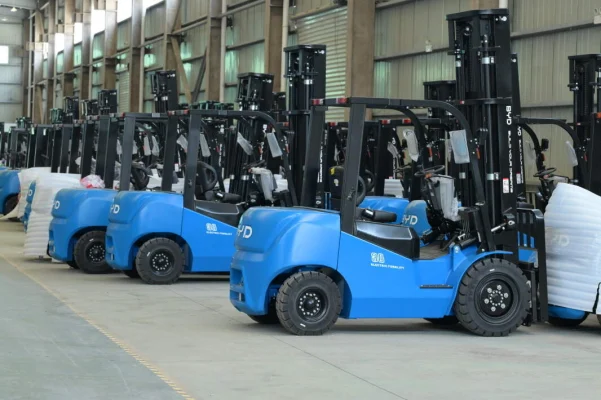
On delivery, compare the nameplate and data plate against the ordered specification: model, rated capacity, load center, lift height, battery, and attachment. Check that the mast reaches the required height and that the truck can enter and withdraw from the racking with a representative load. Confirm the charger and any safety devices are present and that operators receive familiarization with the controls. Keep the capacity chart available to supervisors so that loads are not pushed beyond the rated condition.
Common procurement mistakes
- Comparing only the headline capacity figure and ignoring the load center and lift height at which it applies.
- Ordering lift height equal to the top shelf without allowing clearance to enter and remove the pallet.
- Forgetting that attachments reduce capacity.
- Choosing a truck without confirming charging arrangements match the shift schedule.
- Failing to recheck the specification against the delivery documents.
Frequently Asked Questions
Is rated capacity the maximum weight the forklift can lift?
It is the maximum weight the manufacturer rates at a stated load center and lift height. Moving the load center outward or lifting higher can reduce the safe capacity. Use the capacity chart supplied with the truck rather than the headline number alone.
How much lift height should I specify?
Specify the highest point the forks must reach plus the clearance needed to enter and withdraw the pallet safely. Include any overhead obstructions along the route. Confirm that the truck retains adequate capacity at that height.
Can one forklift cover several factory areas?
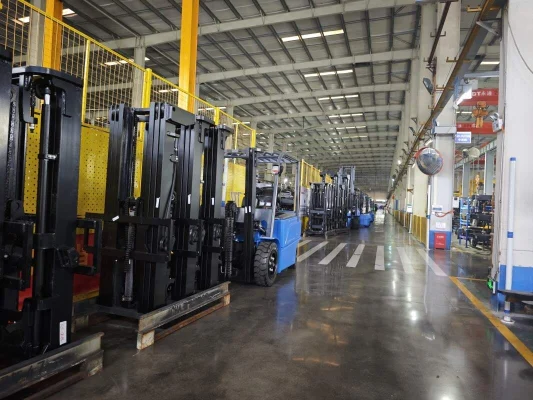
Often it can, provided the truck meets the most demanding combination of load, height, and aisle width across those areas. Check each route separately, because the narrowest aisle or the heaviest load at the highest lift sets the requirement.
What should I ask a supplier before accepting a quotation?
Ask for the technical data sheet, the capacity chart, the attachment rating if applicable, battery and charger details, and the delivery and acceptance procedure. Confirm how the proposed configuration matches the load, lift height, and shift data you provided.
To move a procurement decision forward, prepare the load, height, aisle, and charging details described above and share them with the supplier. That information lets the supplier confirm whether a four-wheel counterbalance electric forklift configuration meets your factory handling tasks and identify any parameter that still needs verification.