Electric Forklift Purchase Planning: Verifying Four-Wheel Counterbalance Load Charts Against Peak Factory Handling Demands
News 08/11/2026
Peak factory handling is rarely a steady-state problem. A four-wheel counterbalance electric forklift may handle routine pallet moves comfortably all shift, then face a concentrated push at trailer loading, line-side replenishment, or end-of-month dispatch. Purchase planning fails most often when the load chart is read at its headline capacity and the peak demand is never translated into the same terms. This guide explains how to read a load chart, convert peak handling demands into verifiable requirements, and build an inquiry package that lets a supplier respond with a configuration you can actually check.
Why the Headline Capacity Is Not the Working Capacity
A counterbalance forklift stays upright because the counterweight balances the load around the drive axle. That balance depends on how far the load center sits from the fork face. Rated capacity is normally stated at a defined load center and lift height, and it falls as either increases. Two consequences matter during procurement:
- Load center shifts with the real load. A pallet whose weight sits toward the fork tips demands more from the truck than the same weight seated against the carriage. Attachments, long loads, and non-standard pallet depths all move the effective center.
- Capacity derates with lift height. The chart shows lower capacities at higher elevations. If peak work includes putting away to a high rack level, the relevant number is the capacity at that height, not at floor level.
Ask the supplier to state the load center and lift height that apply to each capacity figure, and confirm whether the figures refer to a standard carriage or an attachment. Without those qualifiers, a capacity number cannot be compared with a peak demand.
Translating Peak Factory Handling Demands into Load Chart Terms
Peak demand is a combination of weight, geometry, height, and rate. Before contacting a supplier, document each distinct handling task rather than averaging them into one number.
Step 1: List the peak tasks, not the average shift
Identify the moments when the operation is most demanding: inbound trailer unloading, high-bay put-away, block stacking, or a short dispatch window. Record what is lifted, how high, and how far the load extends from the fork face. A task list of four to eight entries is usually enough to expose the binding constraint.
Step 2: Record the four variables that govern capacity
| Variable | What to measure | Why it matters |
|---|---|---|
| Load weight | Heaviest verified load, including packaging and any attachment | Sets the starting point against rated capacity |
| Load center | Distance from fork face to the load’s center of gravity | Capacity derates as this distance grows |
| Lift height | Maximum height at which the heaviest load is handled | Chart capacity falls at greater heights |
| Throughput | Moves per peak hour and travel distance | Influences battery and charging planning, not just capacity |
Weigh representative loads rather than relying on nominal pallet weights. Where a load cannot be weighed, state that it is an estimate and plan a verification step before acceptance.
Step 3: Compare each task against the chart
For every peak task, locate the capacity at the actual load center and lift height. The task is within the chart only if the verified load weight is at or below that figure, with a margin you define. Document the margin explicitly; a task that sits exactly at the limit leaves no room for load variation, wear, or an uneven floor.
Step 4: Check the site conditions the chart does not show
Load charts describe capacity, not suitability. Confirm aisle width against the truck’s dimensions, floor condition and any ramps or gradients, door and rack clearances, and the number of shifts the battery must cover. These conditions determine whether a compliant capacity is also a workable configuration.
Documents and Clarifications to Request Before Quotation
A quotation is only useful if it can be checked against the task list. Request the following with any proposal, and treat missing items as open questions rather than assumptions:
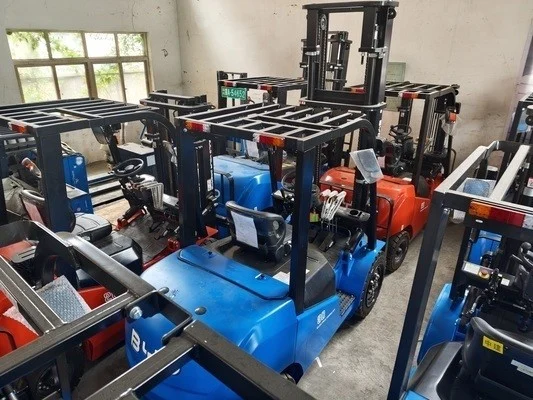
- The load chart with load center, lift height, and attachment conditions stated.
- Battery type, capacity, and charging method, plus the claimed duty per charge and the conditions behind that claim.
- Mast type and collapsed and extended heights, checked against doorways and rack clearances.
- Truck dimensions, turning radius, and service weight, checked against aisle and floor limits.
- Attachment specifications if one is proposed, since attachments change both capacity and geometry.
- Warranty terms, service coverage, spare parts availability, and delivery lead time.
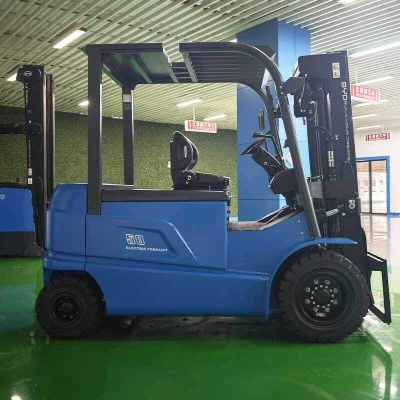
Where a supplier cannot provide a figure, ask what test condition would produce it. For a four-wheel counterbalance electric forklift intended to cover peak factory handling, the configuration should be traceable to your task list rather than to a generic model description. Buyers evaluating an electric forklift for factory use should also confirm charging infrastructure, ventilation, and the electrical capacity available at the charging location.
Acceptance checks when the truck arrives
Verify the delivered configuration against the agreed specification: capacity plate and load chart, battery and charger details, mast and attachment, and dimensions. Plan a supervised trial with representative loads at peak height before signing off, and record the results against the original task list. This turns the load chart comparison into an auditable acceptance step.
Frequently Asked Questions
Can a truck rated above my heaviest load still be unsuitable?
Yes. If the heaviest load sits at a long load center or is lifted to a height where the chart derates capacity, the effective limit may fall below the load. Aisle width, floor condition, and duty cycle can also rule out an otherwise capable configuration.
How should I handle loads that vary between pallets?
Plan against the heaviest verified load in the peak task and state the variation in your inquiry. If weights are uncertain, agree a weighing or sampling step before acceptance rather than relying on nominal figures.
What if my supplier provides only a single capacity number?
Ask for the load center and lift height behind that number, and request the full chart. A single figure without conditions cannot be compared with peak handling demands, so treat it as incomplete information.
Does peak throughput affect the purchase decision?
It can. Moves per peak hour and travel distance influence how much energy the truck uses between charging opportunities. Share those figures with the supplier so battery and charging arrangements can be matched to the shift pattern.