Electric Forklift Procurement: Verifying Four-Wheel Counterbalance Specifications Against Real Factory Load Handling Tasks
News 03/11/2026
An electric forklift purchase often goes wrong at the point where a specification sheet meets a real load. A four-wheel counterbalance electric forklift may be rated correctly and still fail to perform the task it was bought to do, because the rating assumes conditions that the factory floor does not match. The practical answer is to treat procurement as a verification exercise: convert each load handling task into measurable requirements, then confirm every requirement against the manufacturer’s technical data and a demonstration on your own loads.
This guide covers the documents and parameters to collect, the checks that most often expose a mismatch, and the acceptance points worth writing into an order. It applies to four-wheel counterbalance electric trucks, including lithium-battery models.
Turn Each Load Handling Task into a Written Requirement
Begin with the work, not the truck. Walk the route and record what actually happens. A procurement checklist built from observed tasks is far more useful than a generic specification template, because it exposes conflicts early — a heavy load that must also lift high, or a wide attachment that must pass a narrow aisle.
Record the following task by task:
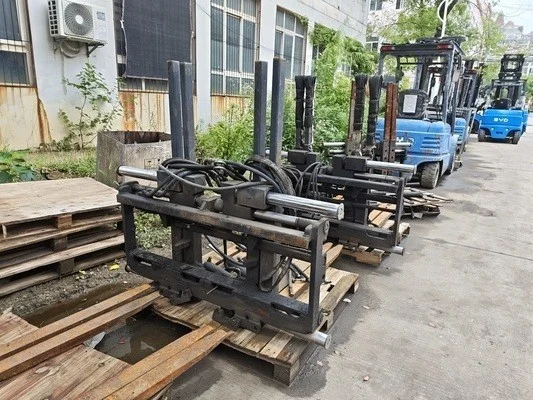
- Load: weight, dimensions, centre of gravity, and whether the load is stable or shifting. Note any attachment such as a clamp or push-pull, since attachments move the load centre forward and reduce usable capacity.
- Lift: the height at which the forks must be when carrying, not only the maximum lift height. Also note free lift needs if the truck works inside a container or low-clearance area.
- Route: aisle width, door and gateway clearances, floor surface and condition, ramp gradients, and any thresholds or dock plates.
- Cycle: distance travelled, number of lifts per hour, shift length, and whether the truck is shared or dedicated.
- Environment: indoor or outdoor, dust, moisture, cold-store temperatures, and any flammable atmosphere that would require specific equipment.
Where a figure cannot be measured, mark it as an estimate to be confirmed. Estimates are acceptable as a starting point but should not become the basis of an order.
Specifications to Verify Before You Request a Quotation
With the task list complete, compare it against the manufacturer’s published data. The aim is to identify which parameters are decisive and which are secondary, so that the quotation request asks precise questions.
Rated capacity and load centre
Rated capacity is always stated at a specific load centre distance. If your real load centre is farther forward than the rated figure — common with wide loads or attachments — the capacity available at that height is lower than the headline number. Ask the supplier to confirm capacity at your actual load centre and lift height, not just the nominal rating.
Mast and lift height
Confirm the mast type, the maximum lift height, the lowered height, and the overhead guard height. Check that the collapsed mast still passes doorways on the route. Residual capacity falls as lift height increases, so a truck rated for the load at ground level may not be rated for it at the top of the racking.
Dimensions, turning radius and aisle width
Four-wheel counterbalance trucks generally need more turning space than three-wheel designs, so aisle width deserves explicit checking. Ask for the outside turning radius and the right-angle stacking aisle dimension, then compare them with the narrowest point on your route. Include clearance between the load and the racking.
Battery and charging
Lithium battery models change the charging routine rather than removing the need to plan it. Establish the usable energy per shift, the charger type and input power available, where charging will take place, and whether opportunity charging between shifts is intended. Confirm the charging equipment and any ventilation or electrical requirements with the supplier.
Tyres, floor and gradients
Tyre type should match the surface: smooth floors, rough yards and wet areas place different demands. Check the rated gradient the truck can climb with your load, and confirm floor loading in upper floors or mezzanines if the truck will operate there.
Quotation, Demonstration and Acceptance Points
A quotation is only comparable if every supplier prices the same scope. Ask each supplier to state the truck model, battery type and capacity, charger, mast specification, attachment, tyre type, warranty terms, and what is excluded. Request the technical datasheet that the figures come from, and keep it with the quotation.
Where practical, arrange a demonstration using loads representative of your heaviest and most awkward tasks, on your own floor or a comparable surface. A demonstration on a clean showroom floor with a neat pallet tells you little about a ramp, a worn joint, or an off-centre load.
Write acceptance points into the order. Useful items include:
- Delivered configuration matches the agreed datasheet, including mast and attachment.
- Capacity at the stated load centre and lift height is confirmed in writing.
- Operator training and handover documentation are included.
- Charging equipment is installed and commissioned, with the electrical requirements agreed in advance.
- Inspection and service intervals are defined, along with who performs them.
As a hypothetical example, a factory moving dense pallets into double-stack racking might find that the truck rated for the pallet weight at floor level is not rated for that weight at the upper beam. The purchase decision then turns on whether a higher-capacity model, a different load centre assumption, or a change to the racking layout is the better answer. That comparison should be made before the order, not after delivery.
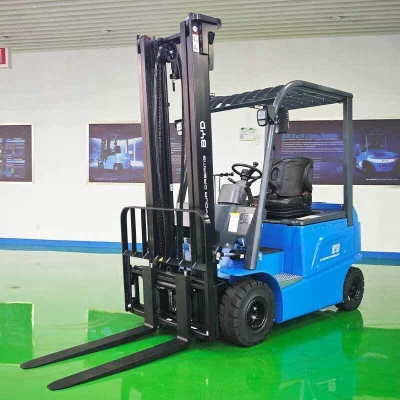
If you are comparing options, share your actual loads, lift heights, aisle widths and shift pattern with the supplier so that the four-wheel counterbalance electric forklift configuration can be matched to the tasks. Confirm every figure against the manufacturer’s technical data, and treat any number that cannot be traced to a datasheet as unverified.
Frequently Asked Questions
Is rated capacity the weight the truck can lift at any height?
No. Rated capacity is tied to a stated load centre and usually to a specific lift height. Capacity available at greater heights or with a forward-shifted load centre is lower. Ask the supplier to confirm the figure that applies to your task.
How much aisle width should be allowed?
The figure depends on the truck’s dimensions, its turning radius, the load size and the stacking geometry. Obtain the right-angle stacking aisle dimension from the datasheet and add clearance for operator error and load overhang, then compare it with the narrowest point on the route.
What should a quotation include to be comparable?
Model, battery type and capacity, charger, mast, attachment, tyres, warranty, delivery, training and exclusions. Without the same scope, prices cannot be meaningfully compared.
Can a demonstration replace a site trial?
A demonstration on a representative surface with representative loads is useful evidence, but it is not the same as sustained operation across shifts. Where the task is critical, agree a trial period and define how success will be measured before the truck is accepted.