Electric Forklift UK Procurement: Defining Load Centre And Mast Derating When Handling Coil Or Drum Loads
News 05/11/2026
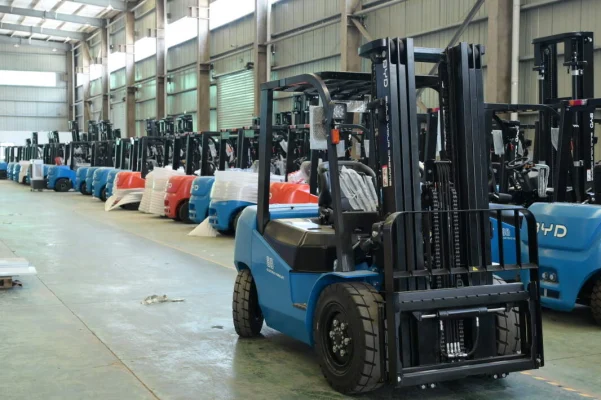
Coil and drum loads concentrate weight away from the fork backrest, and that offset changes what a four-wheel counterbalance electric forklift can safely lift. When buyers in the UK specify an electric forklift, the rated capacity on the data plate is only valid at the stated load centre and mast configuration. Procurement teams should therefore treat load centre and mast derating as specification inputs, not as afterthoughts discovered at commissioning.
This guide sets out the information to collect before requesting a quotation, the parameters to confirm with the supplier, and the checks to apply at acceptance. It applies to four-wheel counterbalance electric forklifts, including lithium battery models. Figures quoted here are illustrative only; actual values must come from the manufacturer’s technical documentation.
Why Coil and Drum Loads Change the Capacity Question
A standard rating assumes the load sits close to the carriage, with its centre of gravity at a defined distance from the fork face. Coils and drums rarely behave that way. A coil lying horizontally on the forks may have its centre well forward of the backrest, and a drum handled by a clamp or a dedicated attachment adds both forward offset and attachment weight.
Two effects follow. First, the effective load centre moves outward, reducing the capacity the truck can handle at that centre. Second, any attachment adds weight and shifts the combined centre of gravity further forward. The result is a derated capacity that must be calculated from the mast chart, not assumed from the headline rating.
In practice, the procurement question becomes: at the actual load centre and with the intended attachment, what can this truck lift to the required height, and what does the manufacturer’s chart say about that combination?
Data to Collect Before You Request a Quotation
Suppliers cannot size a truck responsibly without load geometry. Gather the following before approaching any vendor, including this site’s four-wheel counterbalance electric forklift range.
- Load mass: maximum and typical weight of coils or drums, stated separately from packaging.
- Load dimensions: coil outer diameter, width and bore; drum diameter, height and rim details.
- Centre of gravity position: distance from the fork face to the load centre, measured or estimated from the actual load.
- Handling method: bare forks, clamp, drum handler or other attachment, with attachment weight and its own load centre shift.
- Lift height: the height at which the load must be handled, plus any free-lift requirement.
- Mast and carriage details: whether a side-shift or fork positioner is needed, since these add weight forward of the carriage.
- Operating environment: aisle width, floor condition, gradients, indoor or outdoor use, and shift pattern.
- Charging arrangements: available charging window and power supply, which affect battery and charger specification.
Where the load centre cannot be measured directly, describe the load in enough detail that the supplier can calculate it. Guessing here is the most common source of later capacity disputes.
Reading a Mast Derating Chart
Mast derating charts show capacity at different load centres and lift heights. A typical chart lists rated capacity at a nominal centre, then reduces it as the centre moves outward and as lift height increases. The exact format varies by manufacturer, so ask for the chart that applies to the specific mast and carriage offered.
| Parameter to confirm | Why it matters | What to request |
|---|---|---|
| Rated capacity and nominal load centre | Establishes the baseline the chart is built on | Data plate rating and the centre it assumes |
| Capacity at your actual load centre | Determines whether the coil or drum can be lifted | Chart extract covering your centre and height |
| Attachment weight and offset | Reduces net capacity further | Attachment specification and combined rating |
| Mast type and lift height | Higher masts generally reduce capacity | Chart rows matching the offered mast |
| Residual capacity at maximum height | Confirms the worst-case handling point | Stated capacity at the highest required lift |
Ask the supplier to mark the intended duty point on the chart and confirm it in writing. If the chart does not cover the combination, the specification is incomplete.
Attachments and Their Effect on Rated Capacity
Clamps and drum handlers are not neutral additions. They add weight ahead of the carriage and move the combined centre of gravity forward, so the truck’s net capacity falls. The supplier should provide a revised rating that accounts for the attachment, or state clearly that the combination has not been assessed. Do not accept a verbal assurance that the truck will “manage” the load without a documented figure.
Acceptance Checks and Common Procurement Mistakes
At delivery, verify that the truck matches the agreed specification. Check the data plate against the quotation, confirm the mast and attachment fitted are those specified, and compare the supplied derating chart with the duty point agreed during procurement. Confirm that operator training covers the actual load centre and attachment in use, not just the headline rating.
Common mistakes include specifying capacity at the nominal load centre while handling coils at a wider offset, omitting attachment weight from the calculation, and assuming that a higher lift height carries the same capacity as a low lift. Another frequent error is buying on headline capacity alone without requesting the chart extract. Each of these can leave a truck that is legally and physically unsuited to the task.
Where the required combination falls outside the manufacturer’s published ratings, the honest answer is that a different truck or handling method is needed. This site supplies four-wheel counterbalance electric forklifts; if your coil or drum duty requires a different category of equipment, that should be discussed openly rather than forced into an unsuitable specification.
Frequently Asked Questions
Does a lithium battery change the load centre calculation?
Battery type affects counterweight and truck configuration, but the capacity question is still answered by the mast derating chart supplied with the specific truck. Ask the supplier to confirm the rating that applies to the battery configuration offered.
Can I use the data plate rating when handling a coil on bare forks?
Only if the coil’s centre of gravity sits at the load centre stated on the plate. Coils usually sit further forward, so the applicable capacity is the chart value at your actual centre, not the headline figure.
What should I do if the supplier cannot provide a derating chart?
Treat the specification as unconfirmed. Without a chart covering your load centre, lift height and attachment, there is no documented basis to confirm the truck can handle the load safely.
How do I state my requirements when requesting a quotation?
Provide load mass, dimensions, centre of gravity position, handling method, lift height, aisle and floor conditions, and shift pattern. These details let the supplier select a four-wheel counterbalance electric forklift configuration and confirm capacity against the relevant chart.