Factory Electric Forklift Site Assessment: Verifying Floor Bearing Capacity and Wheel Load Before Specifying a Four-Wheel Counterbalance Model
News 12/11/2026
An electric forklift site assessment answers one question before any model is quoted: can this floor, and the slab beneath it, carry the loads a four-wheel counterbalance electric forklift will impose? Buyers often compare rated capacity and lift height while leaving floor data to a later stage. That order is risky. Rated capacity describes what the mast and hydraulics can lift; it says nothing about the point loads a loaded truck transfers through its wheels to a concrete slab, a mezzanine, or a joint between two pours.
This guide covers what to measure, which documents to collect, and how to compare those findings against a supplier’s data sheet. It applies to factories planning a new counterbalance truck or replacing a smaller unit. Where site-specific numbers are needed, they must come from the building’s structural documentation or a qualified structural assessment, not from general rules of thumb.
Why the Floor Check Comes Before the Model Shortlist
Wheel loads rise sharply when a truck is loaded and when the mast is extended. A four-wheel counterbalance design concentrates much of that load on the front axle, and the steer axle carries the counterweight. Both axles matter, but the front wheels usually govern the slab check. If the floor cannot support the loaded truck, a larger battery or a higher-capacity model makes the problem worse, not better.
Floor capacity also constrains where the truck can travel. A slab that is adequate inside a main aisle may be inadequate on a mezzanine, near a loading dock edge, over a basement, or across an expansion joint. Mapping these zones early avoids specifying a truck that can work in one bay but cannot reach the storage area.
The practical sequence is: define the duty, collect floor and route data, obtain wheel-load figures from the supplier, then confirm the slab is adequate. Only then does it make sense to finalise battery, mast, and attachment choices.
Site Data to Collect Before Contacting a Supplier
A useful assessment starts with measurements the buyer controls. The list below is a working checklist; not every item applies to every factory, but missing items usually cause delays later.
- Slab information: construction drawings, design load notes, slab thickness, reinforcement details, and any post-tensioning. If drawings are unavailable, a structural engineer should assess the slab.
- Route map: aisles the truck will use, door thresholds, ramps, dock levellers, mezzanine edges, trench covers, and expansion joints.
- Surface condition: visible cracking, spalling, patched areas, and joint condition. These affect how wheel loads distribute.
- Duty cycle: loads moved per shift, typical travel distance, lift height, and shift pattern.
- Load details: unit load weight, pallet or stillage type, load centre, and whether loads are stable or shift during travel.
- Clearances: aisle width, overhead obstructions, door height, and turning space at aisle ends.
- Charging location: available space, ventilation, and electrical supply, since battery charging arrangements affect where the truck can be parked and staged.
Photographs of the route, taken at floor level, are often more useful than a description. They show joints, patches, and transitions that a written summary can miss.
Reading Wheel Load Data the Right Way
Wheel load is not the same as rated capacity. A supplier’s data sheet may list rated capacity, load centre, and axle loads under defined conditions. Those conditions matter. Load centre, mast type, lift height, and any attachment all shift the load distribution.
Ask the supplier to confirm the following against the exact configuration you are considering:
- Rated capacity and the load centre at which it applies.
- Empty and loaded axle loads, stated separately.
- Whether figures include a standard fork carriage or an attachment.
- The lift height and mast type those figures assume.
- Any reduction in capacity at the lift height you actually need.
Do not convert rated capacity into a floor pressure figure yourself. Tyre type, contact area, and load distribution all affect the result, and a structural engineer should perform the slab check using the supplier’s axle load data. Where the supplier cannot provide axle loads for a specific configuration, treat the assessment as incomplete rather than estimating.
A simple comparison table to structure the review
The table below is a template. Populate it from the supplier’s technical documentation and the building’s structural notes; do not fill it with assumed values.
| Item | Source | What to Confirm |
|---|---|---|
| Rated capacity | Supplier data sheet | Load centre and lift height it applies to |
| Loaded front axle load | Supplier data sheet | Configuration-specific, with attachment noted |
| Loaded rear axle load | Supplier data sheet | Including counterweight |
| Slab design load | Structural drawings or engineer | Allowable point load and any restrictions |
| Route restrictions | Site survey | Mezzanine, joints, dock edges, ramps |
Matching the Assessment to a Four-Wheel Counterbalance Specification
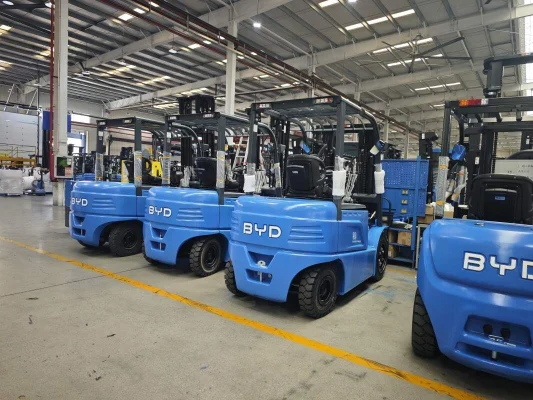
Once floor and route data are in hand, the specification conversation becomes concrete. This site supplies four-wheel counterbalance electric forklifts, including lithium battery models, so the discussion can stay focused on that configuration rather than drifting into other truck types.
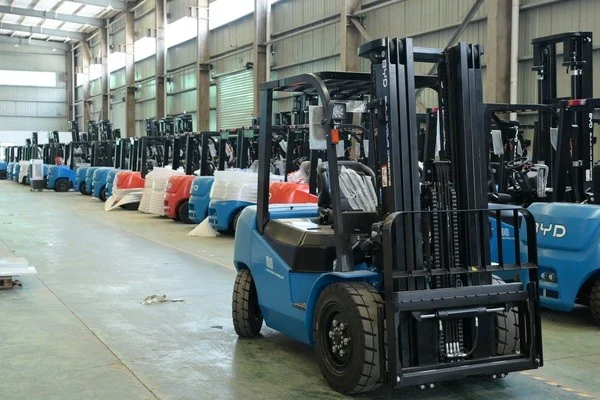
Share the following with the supplier: maximum unit load weight, required lift height, load centre, aisle width, floor surface and slope conditions, shift pattern, and charging arrangements. These inputs determine which capacity class and mast configuration are worth quoting. The supplier can then provide axle load figures and dimensional data for the candidate model, which the structural engineer can check against the slab.
Pay attention to the less obvious constraints. A ramp changes the load distribution and the traction demand. A dock leveller introduces a transition that may concentrate load. A mezzanine may have a posted weight limit that applies to the total truck and load, not just the payload. None of these can be resolved from a brochure; each needs site-specific confirmation.
If the slab proves inadequate in a specific zone, options include rerouting the truck, reinforcing or protecting the slab, or reducing the load carried through that zone. Choosing a smaller truck is sometimes presented as a fix, but it may not suit the duty cycle. The right answer depends on the structural findings and the operational requirement together.
Common errors that undermine the assessment
- Using rated capacity as a proxy for floor load.
- Checking only the main aisle and ignoring mezzanines, dock edges, and joints.
- Supplying the supplier with a target model rather than the actual duty and site data.
- Accepting axle load figures that were calculated for a different mast, attachment, or load centre.
- Leaving the structural check until after the truck is ordered.
Frequently Asked Questions
Can a four-wheel counterbalance electric forklift operate on an upper floor?
It can, but only if the structural assessment confirms the floor can carry the loaded truck’s axle loads and the route restrictions are acceptable. Upper floors often have posted load limits and may include mezzanines or lightweight sections. Obtain the structural data before shortlisting any model.
Does a lithium battery change the floor load?
Battery type affects weight and weight distribution, and therefore axle loads. A lithium battery model may differ from a lead-acid equivalent in this respect. Ask the supplier for axle load figures specific to the battery configuration being quoted, then pass those figures to the structural engineer.
What if the building drawings are missing?
Commission a structural assessment of the slab and route. Visual inspection alone cannot establish allowable load, especially where reinforcement, slab thickness, or post-tensioning is unknown. Treat the assessment as a prerequisite, not an optional extra.
How do aisle width and floor condition interact with the floor check?
They are separate constraints that both affect feasibility. Aisle width determines whether the truck can manoeuvre; floor condition affects how loads distribute at joints, patches, and transitions. A route that is wide enough but crosses a deteriorated joint still needs structural review.
What information should accompany a request for a quotation?
Provide unit load weight, load centre, required lift height, aisle dimensions, floor and route details including slopes and mezzanines, shift pattern, and charging arrangements. This lets the supplier quote a configuration whose axle loads can be checked against the building, rather than a generic model that may not fit the site.
The assessment is complete when the structural findings, the route restrictions, and the supplier’s configuration-specific axle load data agree. Until then, any specification is provisional.