How Many Types of Forklift Are There: Matching Load Center and Lift Height Ratings to Four-Wheel Counterbalance Electric Forklift Configurations
News 31/10/2026
There is no single official number of forklift types. Counts vary because manufacturers, safety standards, and dealers classify trucks by power source, operator position, tire type, mast design, and duty. What matters more than the total is which class fits your load, your racking, and your aisle. This article answers the counting question briefly, then focuses on the practical part: how load center and lift height ratings shape a four-wheel counterbalance electric forklift configuration, and what to check before you buy.
How Forklift Types Are Usually Counted
Most industry lists group trucks along a few axes. A power-source split separates internal combustion (diesel, LPG, gasoline) from electric (lead-acid or lithium-ion battery). An operator-position split separates sit-down from stand-on. A design split covers counterbalance trucks, reach trucks, order pickers, pallet trucks, tow tractors, and automated guided vehicles. A tire split covers cushion and pneumatic. Combine these axes and the count climbs quickly, which is why published figures differ.
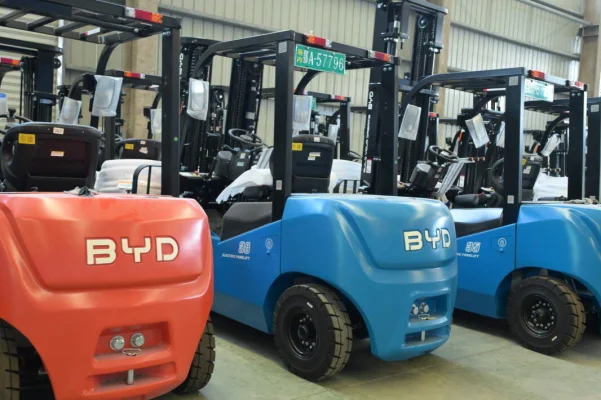
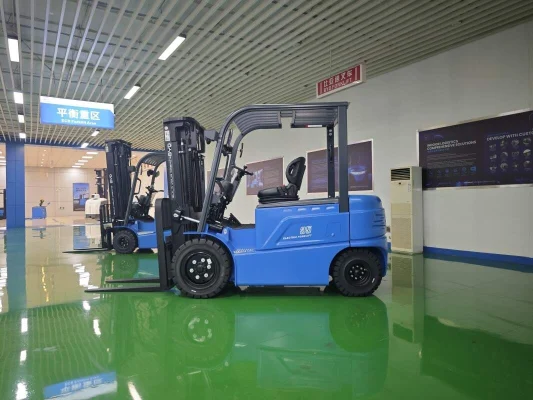
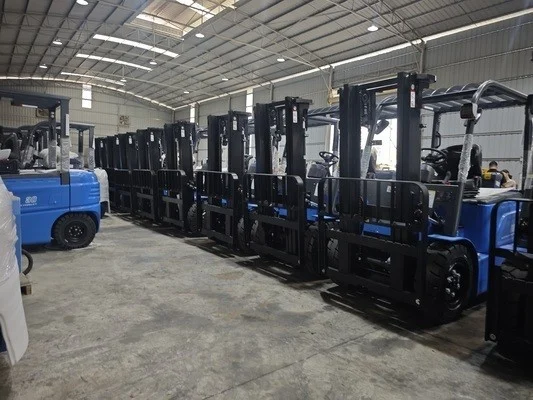
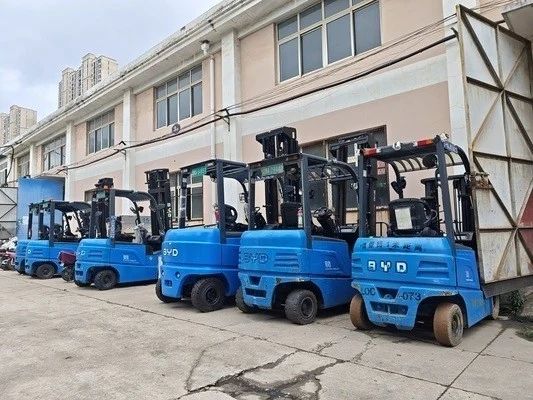
For general factory handling, loading, and warehouse transfer, the four-wheel counterbalance electric forklift is a common general-purpose choice. It carries a load ahead of the front axle and uses the chassis and counterweight to balance it. That geometry is simple, but it makes two ratings decisive: load center and lift height. Both appear on the data plate, and both change what the truck can safely handle.
Load Center and Lift Height: The Two Ratings That Decide the Configuration
Rated capacity is not a single fixed number. It is stated at a specific load center and a specific lift height, usually with a standard fork carriage and no attachment. Move away from those conditions and the safe capacity changes.
What load center means
Load center is the horizontal distance from the vertical face of the forks to the center of gravity of the load. A standard pallet loaded evenly often sits close to a nominal load center, but a deep load, an offset load, or a load that overhangs the fork tips shifts the center of gravity outward. The further out the center of gravity, the lower the capacity at which the truck remains stable.
This is why two pallets of equal weight can require different trucks. A compact, evenly stacked pallet and a long, front-heavy crate are not the same job, even on the same scale. When you request a configuration, state the actual load dimensions and how the load sits on the forks, not just the total weight.
What lift height rating means
Lift height is the height to which the forks can raise the load. Capacity is typically rated at a stated lift height, and residual capacity often decreases as the mast raises the load. Mast type, free lift, collapsed height, and overhead guard clearance all interact with your racking and doorways. A truck that fits an aisle at floor level may not clear a low door frame or a sprinkler line once the mast is raised.
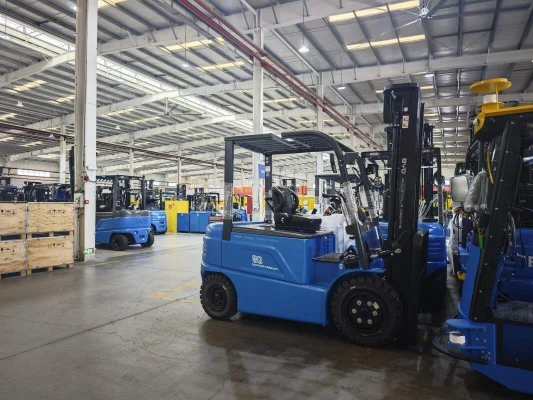
Ask the supplier to confirm capacity at your real lift height, not only at the nominal rating. If your racking has multiple beam levels, identify the highest level you will actually serve and the load center at that level.
Building a Four-Wheel Counterbalance Electric Forklift Specification
The following parameters affect real performance in a general warehouse or factory. Each item lists why it matters, how to verify it, and where trade-offs appear. Specific values must come from the manufacturer’s technical data; this article does not assume them.
Rated capacity and residual capacity
Why it matters: The rated figure is a starting point, not a guarantee at every height and load shape.
How to verify: Request the capacity chart showing capacity at your load center and your maximum lift height, with the attachment you plan to use.
Trade-off: A larger nominal capacity may come with a heavier chassis and a larger footprint, which affects aisle width and floor loading.
Mast, free lift, and overhead clearance
Why it matters: Mast choice controls lift height, collapsed height, and visibility.
How to verify: Confirm collapsed mast height against doorways and trailer entries, and extended height against sprinklers and roof trusses.
Trade-off: More free lift can help in low-clearance areas but may reduce capacity or change the mast profile.
Battery, charging, and shift pattern
Why it matters: Available run time depends on battery capacity, duty cycle, and charging arrangements.
How to verify: Ask the supplier to confirm battery voltage and capacity, charger type, charging time, and whether opportunity charging fits your breaks and shifts.
Trade-off: More battery capacity can add weight and cost; charging infrastructure must match your electrical supply and parking area.
Aisle width, turning radius, and floor conditions
Why it matters: A four-wheel counterbalance truck needs enough aisle to turn and enough floor strength to carry the combined truck and load weight.
How to verify: Measure the narrowest aisle, the tightest turn, door widths, and floor flatness. Confirm the truck’s turning radius and dimensions from the data sheet.
Trade-off: A more compact truck may suit tight aisles, but confirm it still meets your capacity and lift requirements.
Attachments and their effect on capacity
Why it matters: Side shifters, clamps, and other attachments move the load forward and add weight, which reduces residual capacity.
How to verify: Ask the supplier to confirm the capacity rating with the exact attachment fitted.
Trade-off: Attachments can improve handling but may require a larger truck to keep the same usable capacity.
| Parameter | Why It Matters | What to Confirm with the Supplier | Standard or Optional |
|---|---|---|---|
| Load center | Shifts safe capacity as the load’s center of gravity moves outward | Capacity chart at your actual load dimensions | Rated value is standard; chart is supplied on request |
| Lift height | Determines racking access and residual capacity | Capacity at your highest beam level and mast type | Mast selection depends on configuration |
| Battery and charger | Affects run time and shift planning | Battery capacity, charging time, charging method | Varies by model; confirm with supplier |
| Aisle and turning radius | Determines whether the truck can maneuver in your layout | Dimensions and turning radius from the data sheet | Model-dependent |
| Attachment | Reduces residual capacity and changes load position | Capacity rating with the exact attachment fitted | Optional; confirm compatibility |
Choosing a Configuration: A Step-by-Step Approach
Start with the load, not the truck. Record the maximum weight, the load’s dimensions, and how the center of gravity sits on the forks. Next, map the route: the narrowest aisle, the highest rack beam, door heights, ramps, and floor condition. Then define the shift: how many hours the truck runs, how many pallets move, and when charging can happen.
With those facts, ask the supplier to propose a four-wheel counterbalance electric forklift configuration and to show the capacity chart at your load center and lift height. Compare the proposed dimensions against your measured aisles and clearances. Confirm the battery and charging plan against your electrical supply and parking area. Finally, ask what changes if your loads grow or your racking is extended, so the truck does not become the bottleneck.
A common mistake is specifying capacity by weight alone and ignoring load center, lift height, and attachments. Another is assuming a truck that fits one aisle will fit every aisle. Both errors lead to a truck that is either oversized and wasteful or undersized and unsafe. If your aisle or lift requirements fall outside what a four-wheel counterbalance truck can reasonably serve, say so honestly and revisit the layout or the task rather than forcing the wrong truck into the job.
Frequently Asked Questions
Does a higher lift height reduce how much the truck can carry?
Often yes. Capacity is rated at a stated load center and lift height, and residual capacity may decrease as the load is raised. The exact relationship comes from the manufacturer’s capacity chart. Confirm the figure at your real lift height and load center rather than relying on the nominal rating.
Can I use the rated capacity if my pallet is deeper than standard?
Not automatically. A deeper or offset load moves the center of gravity farther from the fork face, which can reduce safe capacity. Provide the actual load dimensions and ask the supplier to confirm capacity at that load center.
How do I know whether a four-wheel counterbalance electric forklift suits my warehouse?
Measure your aisle widths, turning points, door heights, and highest rack beam, then compare them with the truck’s dimensions and turning radius. Confirm capacity at your load center and lift height, and confirm the battery and charging plan fits your shift pattern. If the aisle or lift requirement falls outside the truck’s practical range, the layout or task may need review.
What information should I gather before requesting a quote?
Collect maximum load weight, load dimensions and center of gravity, highest lift height, narrowest aisle, door and overhead clearances, floor condition, shift length, and charging location. Also note any attachment you plan to use. These details let the supplier propose a configuration with a capacity chart that matches your job.
To narrow the choice, share your actual load, lift height, aisle, and shift details with our team and ask about a BYD four-wheel counterbalance electric forklift configuration that matches those conditions. Confirm every rating against the manufacturer’s technical data before purchase.