How Many Types of Forklift Are There: Turning Shift Length and Battery Swap Logistics into Four-Wheel Counterbalance Electric Forklift Requirements
News 07/11/2026
Searching “how many types of forklift are there” usually returns a long catalogue: counterbalance trucks, reach trucks, stackers, pallet movers, order pickers, tow tractors, and automated guided vehicles. That list is accurate, but it rarely helps a buyer. The practical answer is that the number of types matters less than which type fits your shift pattern, your battery strategy, and the load you actually move. This article treats the question as a selection problem and focuses on one mainstream category: the four-wheel counterbalance electric forklift, including lithium-battery configurations.
Why the Type Count Is Less Useful Than the Shift Question
Most published counts of forklift types describe the equipment market as a whole. They do not tell you whether a truck can work a full shift, how long it takes to restore energy, or whether a battery swap disrupts your inbound schedule. Those are the questions that decide whether a purchase works in daily operation.
Warehouse and factory operations usually run on one of three energy patterns:
- Single-shift operation with overnight charging: the truck returns to a charging point at the end of the day, and the battery has a long window to recharge.
- Multi-shift operation with opportunity charging: the truck charges during breaks, shift changes, or idle periods, which requires a charger near the work area and disciplined habits.
- Multi-shift operation with battery swapping: a depleted battery is removed and a charged one installed, so the truck keeps working while the first battery charges.
Each pattern translates into different requirements: battery capacity, charger placement, spare battery handling, truck weight, and the space available at the swap point. A four-wheel counterbalance electric forklift can serve any of the three patterns, but the configuration and the site layout must match the pattern you choose.
Turning Shift and Swap Logistics into Truck Requirements
The following sections break the decision into the parameters a supplier will ask about. Treat the numbers you supply as inputs to a sizing discussion, not as fixed answers. Actual energy use depends on load weight, lift height, travel distance, ramp gradients, floor conditions, and operator behaviour, so only measured or manufacturer-supplied data should be used to confirm a final configuration.
Shift length and duty cycle
Start with the honest working hours, not the paid hours. A truck that runs intermittently during a ten-hour shift may use less energy than one that lifts continuously during a six-hour shift. Record the number of lifts per hour, average lift height, average travel distance per trip, and the heaviest load moved regularly. These four figures give a far better picture than a simple hour count.
If your operation runs multiple shifts, decide early whether you will recharge between shifts or swap batteries. This choice affects the battery capacity you order, the number of spare batteries, and whether your charging area has enough space and ventilation.
Battery swap logistics
A battery swap is a process, not a single action. The practical questions include:
- Where will the swap take place, and is the floor level and clear of traffic?
- Who performs the swap, and what handling equipment is available?
- How long can the truck be out of service during the exchange?
- Where will the removed battery be stored and charged?
- Does the site have the ventilation and electrical capacity the charging area requires?
Lithium-battery trucks often change this calculation because opportunity charging becomes more practical, and some operations can reduce or eliminate swapping. That is a general characteristic of lithium batteries, not a guarantee of a specific runtime. Confirm the charging profile, charger compatibility, and recommended charging windows with the manufacturer’s technical documentation.
Load, lift height, and load centre
Rated capacity is not a single fixed number. It depends on the load centre and the lift height. A truck rated at a given capacity with a standard load centre may have a lower capacity when the load centre increases or when the mast is raised. Ask for the capacity chart that applies to your actual load centre and maximum lift height, and check the attachment weight if you plan to use one.
Aisle width, floor, and ramp conditions
Four-wheel counterbalance trucks generally need more turning space than some other truck types, so measure your narrowest aisle and the clearance at blind corners. Check floor condition and any ramps. Gradients affect both traction and energy use, and the manufacturer should confirm the permissible slope and load combination. Do not assume a truck suited to a flat warehouse will perform the same way on a loading ramp.
Charging infrastructure and site constraints
Confirm the available electrical supply, the distance from the charger to the work area, and whether charging will happen in a dedicated area or at the point of use. Battery swapping requires storage space and a safe handling method. These site details often determine the final configuration more than the truck’s headline specifications.
Matching the Right Type to the Job Without Overreaching
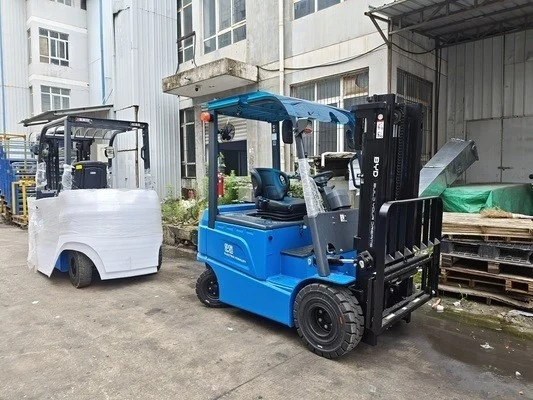
Four-wheel counterbalance electric forklifts are a common general-purpose choice in factories, warehouses, and loading and unloading operations because they can lift loads to height and travel between areas. That does not make them the right answer everywhere. Very narrow aisles, pure horizontal transport over long distances, and order picking at height may call for other equipment categories, and those categories have their own trade-offs. Where a different type is genuinely better suited, the honest approach is to say so rather than force a counterbalance truck into an unsuitable role.
A simple way to test whether the type fits is to write down the five constraints that would stop the truck from doing the job: maximum load at the required load centre, maximum lift height, narrowest aisle, steepest ramp, and longest continuous working period without charging. If the truck meets all five with a sensible margin, the type is plausible. If one constraint fails, the configuration or the type needs to change.
Consider a hypothetical application: a distribution centre receives pallets from road vehicles and puts them away in racking during two shifts. The narrowest aisle, the heaviest pallet, the highest beam, and the break pattern all feed into the battery and charger decision. In that scenario, the buyer should ask whether opportunity charging during breaks is realistic, or whether a spare battery and a defined swap procedure are needed. The answer depends on measured energy use, not on a generic claim about runtimes.
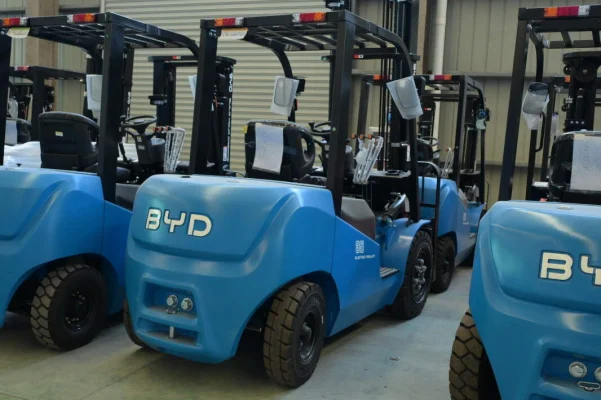
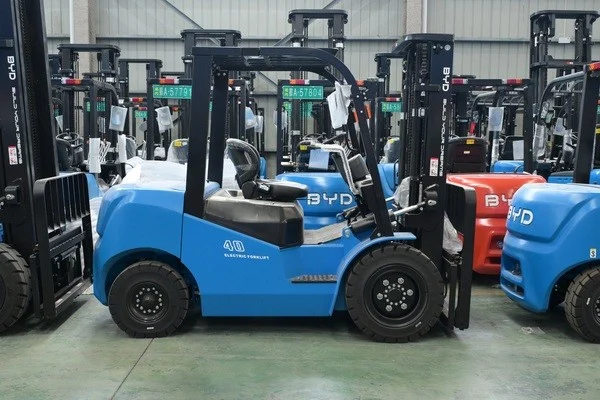
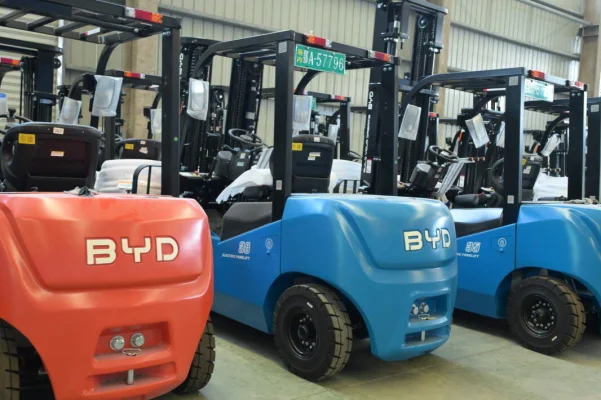
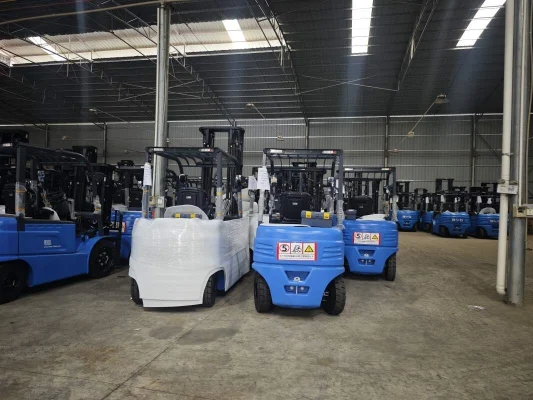
When you request a quotation, provide the load weight and load centre, required lift height, aisle width, floor and ramp conditions, shift pattern, charging location, and any attachment you plan to use. A supplier working from those details can propose a configuration and identify the parameters that still need verification. This site supplies BYD four-wheel counterbalance electric forklifts, including lithium-battery models, and selection support is based on the technical data available for those models rather than on assumed performance.
Frequently Asked Questions
How many types of forklift are there in common industrial use?
Published classifications vary, but common categories include counterbalance trucks, reach trucks, stackers, pallet trucks, order pickers, tow tractors, and automated guided vehicles. The useful question is which category matches your load, lift height, aisle width, and shift pattern.
Can a four-wheel counterbalance electric forklift work across multiple shifts?
Yes, provided the energy strategy matches the duty cycle. Multi-shift work usually requires either opportunity charging during breaks or a battery swap procedure with a charged spare. The correct choice depends on measured energy use and the charging infrastructure available at your site.
Does a lithium battery remove the need to swap batteries?
Not automatically. Lithium batteries generally support opportunity charging well, which can reduce the need for swapping in some operations, but runtime still depends on the truck, the battery capacity, the duty cycle, and the charging profile. Confirm the recommended charging practice with the manufacturer’s documentation.
What should I check before requesting a quotation?
Gather the maximum load and load centre, required lift height, narrowest aisle, floor and ramp conditions, shift pattern, charging location, and any planned attachment. These details let a supplier propose a configuration and flag the parameters that require further verification.