Four-Wheel Counterbalance Electric Forklift Procurement: Clarifying Travel Speed, Ramp Grade and Floor Friction Limits Before Ordering
News 07/11/2026
Travel speed, ramp grade and floor friction are the three figures most often quoted loosely during a four-wheel counterbalance electric forklift purchase. A supplier may state a top speed, a maximum gradeability and a recommended aisle width, yet those numbers rarely describe the same operating condition. Before you place an order, treat each figure as a question to be pinned down: measured under what load, on what surface, at what state of battery charge, and with which attachment fitted. This guide sets out the data a buyer should collect and the points to confirm in writing.
Why a Single Quoted Speed or Grade Figure Misleads
Forklift performance figures are conditional. Travel speed depends on load weight, tyre type, floor condition and whether the truck is accelerating or at steady state. Gradeability depends on the payload, the surface friction and whether the figure refers to a short climb or sustained travel. A brochure number is a reference point, not a guarantee that your operation will achieve it.
Two practical consequences follow. First, compare offers only when the underlying test conditions match. Second, ask the supplier to state the conditions attached to each figure rather than accepting a bare maximum. Where the manufacturer’s technical data does not specify a condition, mark it as unconfirmed and request clarification.
Travel Speed: What to Record Before Ordering
Speed matters less as a headline and more as a constraint on cycle time and safety. On a four-wheel counterbalance electric forklift, the relevant questions are how fast the truck travels loaded and unloaded, how quickly it accelerates and decelerates, and how those figures change across the working shift.
Parameters to request
- Rated travel speed, loaded and unloaded, with the load value stated.
- Acceleration and braking behaviour, including any speed-limiting settings.
- Speed reduction in tight turns or with the mast raised, if the truck provides such functions.
- Any difference between travel modes or power settings.
Site conditions that change the answer
Long indoor runs and short shuttle moves place different demands on a truck. Congested areas, pedestrian crossings, blind corners and loading docks usually justify conservative speed settings regardless of the truck’s capability. Battery state of charge also affects available power; ask how performance is expected to change as the battery discharges, and confirm the charging routine that keeps the truck within its intended duty.
Ramp Grade and Floor Friction: The Linked Limits
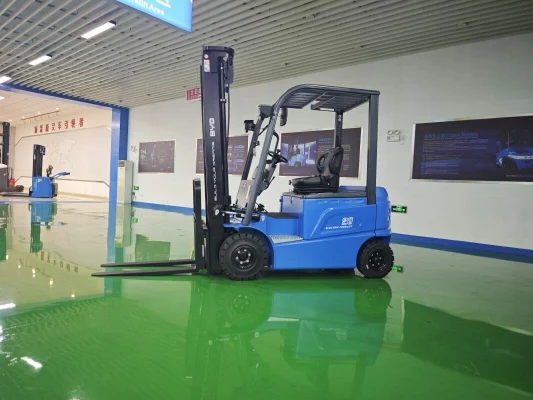
Gradeability is not a property of the truck alone. It is the result of tractive effort, load, surface friction and gradient. A ramp that a truck can climb empty may be unsuitable when carrying a load, particularly if the surface is smooth, wet or contaminated. Buyers should therefore treat ramp grade and floor friction as one combined question.
Information the supplier needs from you
- Maximum ramp gradient on the route, measured rather than estimated.
- Ramp length, and whether the truck stops, starts or turns on the slope.
- Floor materials along the route: sealed concrete, epoxy coating, steel plate, expansion joints, outdoor yard surface.
- Contamination risks such as water, oil, dust or loose material.
- Load weight and load centre at the point of climbing.
Points to confirm in the technical offer
Ask the supplier to state gradeability with a defined load and surface condition, and to identify any assumptions. If your route includes a ramp near the truck’s limit, request a written assessment rather than relying on a general claim. Where the surface friction is uncertain, a trial on your own floor is more informative than any catalogue figure, but arrange it with the supplier and record the conditions.
A Hypothetical Scenario: Matching Figures to a Real Route
Consider a hypothetical warehouse that receives pallets indoors, moves them across a sealed concrete floor and transfers them to a yard across a short ramp. The buyer should map the route and note where the truck travels loaded, where it turns, and where the gradient begins. A truck that meets the indoor speed requirement may still need a lower gear or reduced load on the ramp, and a smooth floor near the ramp entrance may limit traction when damp.
In this scenario, the procurement file should contain the measured gradient, the load at the ramp, the floor finish, the expected number of trips per shift and the charging window. With those inputs, the supplier can propose a configuration and state the conditions attached to its speed and grade figures. Without them, any comparison between offers rests on assumptions that may not hold on site.
Procurement Checklist and Questions to Settle
Use the following as a working checklist when requesting quotations. It is general guidance, not a substitute for the manufacturer’s technical documentation.
| Item | What to provide or confirm |
|---|---|
| Load | Typical and maximum weight, load centre, attachment weight |
| Lift | Required lift height and mast type |
| Route | Distances, aisle widths, doorways, turning points |
| Ramps | Measured gradient, length, position of stops and turns |
| Floor | Surface material, condition, contamination risks |
| Duty | Shifts per day, trips per shift, charging window |
| Acceptance | How speed and grade performance will be checked on delivery |
During acceptance, verify the delivered configuration against the agreed specification and record the conditions under which any performance check is made. If a figure cannot be verified on site, note it as unconfirmed rather than treating it as met. When you are ready to discuss a four-wheel counterbalance electric forklift, share your route data, load and lift height so the selection and configuration can be matched to your operation.
Frequently Asked Questions
Does a higher quoted travel speed mean a faster truck in my warehouse?
Not necessarily. Real cycle time depends on acceleration, braking, congestion, doorways and safety limits. A truck with a high top speed may still be slower on a short, busy route.
Can I use the brochure gradeability figure as a safe limit?
Treat it as a reference only. Gradeability changes with load, surface friction and gradient length. Confirm the conditions behind the figure and assess your actual ramp.
How does floor friction affect the choice?
Low-friction surfaces reduce traction, which affects both climbing and braking. Smooth or contaminated floors may require a different tyre specification or a revised route.
What should I include in a quotation request?
Provide load and load centre, lift height, route layout, measured ramp gradients, floor type and condition, shift pattern and charging arrangements. These inputs let the supplier state performance conditions clearly.