Four-Wheel Counterbalance Electric Forklift Specs: Matching Rated Capacity, Lift Height and Battery Voltage to Your Duty Cycle
News 03/11/2026
Choosing a four-wheel counterbalance electric forklift starts with three numbers that must agree with each other and with the work you actually do: rated capacity, lift height, and battery voltage. A truck rated at a headline load can lose much of that capacity once an attachment, a tall mast, or an off-center load is added. This guide explains how each specification interacts with duty cycle, which figures to request from a supplier, and where the limits of a counterbalance design become visible before you buy.
How Rated Capacity Shifts With Load Center and Attachments
Rated capacity is normally stated at a defined load center, measured from the vertical face of the forks to the center of gravity of the load. When the load center moves outward, the safe working load falls. This is why the same truck carries less with a side-shifting fork positioner, a clamp, or a longer fork than with a plain carriage.
A duty cycle that mixes pallet sizes therefore needs more than one capacity figure. Ask the supplier to show the capacity plate values at the load centers you expect, and to state the derating that applies to each attachment you are considering. If your loads are palletized cartons of uniform size, the calculation is simple. If you handle variable goods, drums, or long items, the worst-case load center governs.
Matching capacity to the duty cycle
- Peak load, not average load. Size the truck to the heaviest load it will lift, plus a margin you can justify from your own records.
- Attachment derating. Confirm the residual capacity once the attachment is fitted; do not assume the base rating survives.
- Load center. Record the actual center of gravity of your typical and heaviest pallets.
- Ground and slope. Uneven floors and ramps affect stability and require the supplier’s guidance on permitted gradients.
Lift Height, Mast Choice, and the Capacity They Consume
Lift height is not a free upgrade. Taller masts add weight and raise the center of gravity, and many manufacturers publish a reduced capacity at full height. When you specify a three-stage or four-stage mast to reach high racking, confirm the capacity at the maximum lift height rather than only at ground level.
Two further dimensions decide whether a tall mast works in your building: the closed mast height, which must clear doorways and overhead obstructions, and the free lift, which determines whether the forks can rise before the mast extends. In buildings with low door frames and high top beams, free lift is often the deciding factor.
Questions to settle before confirming a mast
- What is the highest shelf or rack beam the truck must reach, and what clearance remains above the load?
- What is the lowest overhead obstruction on the travel route?
- Does the capacity plate show a reduced rating at full height?
- Will an attachment change the effective fork height or the load center?
Aisle width and turning radius belong in the same conversation. A four-wheel counterbalance truck is a common general-purpose choice in factories, loading bays, and warehouse transfer, but tight racking aisles can make it the wrong tool. Measure the actual aisle, then compare it with the supplier’s stated dimensions rather than assuming the truck will fit.
Battery Voltage, Charging Rhythm, and Shift Patterns
Battery voltage is usually tied to truck class: smaller counterbalance models commonly use lower-voltage packs, while larger models use higher-voltage systems. The right question is not which voltage is best in the abstract, but whether the pack, the charger, and the charging window match your shift pattern.
For a single-shift operation with a long break, opportunity charging during breaks may be enough. Multi-shift work with little downtime needs a plan: either a larger pack, a spare battery with a swap procedure, or a charging schedule that the supplier confirms is compatible with the battery and the built-in management system. Lithium-ion packs behave differently from lead-acid packs in partial-state charging, so follow the manufacturer’s instructions rather than rules carried over from older equipment.
What to confirm about the energy system
- Nominal voltage and capacity of the pack offered with the truck.
- Charger type, input supply available at your site, and expected charging time.
- Whether opportunity charging is permitted and under what conditions.
- Operating and storage temperature limits, taken from the manufacturer’s documentation.
- Battery management system limits and any alarms the operator should expect.
Do not accept a voltage figure on its own as proof of endurance. Runtime depends on load, lift height, travel distance, floor conditions, and operator behavior. Ask the supplier to explain the assumptions behind any runtime claim and to identify which of those variables you must measure at your own site.
Specification Review Table and Procurement Checklist
The table below organizes the parameters that most often cause a mismatch between a quoted truck and the real job. Treat every entry as a point to verify with documentation, not as a default value.
| Parameter | Why the duty cycle cares | What to request from the supplier | Typical status |
|---|---|---|---|
| Rated capacity at stated load center | Overloading risks stability and structural stress | Capacity plate values at your load centers | Standard specification |
| Capacity with attachment | Attachments reduce safe working load | Derating table or written confirmation | Depends on configuration |
| Lift height and capacity at height | Tall masts can reduce rating | Mast datasheet with height-specific rating | Standard specification |
| Closed height and free lift | Doorway and overhead clearance | Dimensioned drawing | Standard specification |
| Aisle width and turning radius | Determines whether the truck fits the racking | Stated dimensions and site measurement method | Standard specification |
| Battery voltage and capacity | Shift length and charging windows | Pack datasheet and charging instructions | Configuration choice |
| Operating temperature range | Cold stores or hot areas affect battery and hydraulics | Written limits from manufacturer documentation | Requires factory confirmation |
| Tyres, lighting, and operator aids | Floor surface, visibility, and shift hours | Option list with compatibility notes | Optional |
Before requesting a quotation, assemble your own data: heaviest and typical load weights, load center, highest lift, lowest overhead clearance, narrowest aisle, floor condition and any ramps, shifts per day, charging supply available, and any temperature extremes. Then ask the supplier to confirm, in writing, the capacity at your load center and height, the attachment derating, the charging plan, and the temperature limits that apply to the truck and battery.
If your aisle or lift requirements fall outside what a four-wheel counterbalance electric forklift can safely serve, say so early and ask what alternative configuration the supplier can support. A truck that is oversized for the aisle or undersized for the load creates daily risk, and no specification sheet compensates for a poor match.
Frequently Asked Questions
Is a higher battery voltage always better?
No. Voltage is tied to truck class and design, and the useful question is whether the pack and charger suit your shift pattern and charging windows. Confirm runtime assumptions and charging rules with the supplier rather than comparing voltage numbers alone.
Can I add an attachment without changing the rated capacity?
Usually not. Attachments shift the load center and add weight, which reduces the safe working load. Ask for the derated capacity with the specific attachment fitted to your truck.
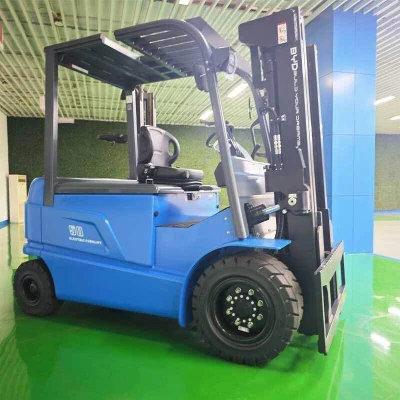
How do I know if a four-wheel counterbalance truck fits my aisle?
Measure the narrowest aisle on the route, including any doorways and turns, then compare it with the supplier’s stated dimensions and turning radius. Do not rely on a general claim that counterbalance trucks suit all warehouses.
What should I do if my loads vary widely?
Size the truck to the heaviest load and worst load center, then check whether the resulting truck still fits your aisles and doorways. Share the full range with the supplier so the capacity plate and attachment choices reflect real conditions.
To move from general specifications to a workable configuration, share your load weights, lift heights, aisle dimensions, and charging arrangements with our team and ask which BYD four-wheel counterbalance electric forklift configuration matches your duty cycle.