Indoor Electric Forklift Sizing: Matching Four-Wheel Counterbalance Capacity and Lift Height to Your Actual Loads and Racking
News 31/10/2026
Choosing an indoor electric forklift starts with two numbers that are often treated as simple checkboxes: rated capacity and lift height. In practice, neither number works in isolation. A four-wheel counterbalance electric forklift rated at 2,000 kg at a 500 mm load center will not safely handle the same 2,000 kg load if the load center moves to 700 mm. Likewise, a truck that lifts to 4,500 mm with a standard mast may not clear the overhead guard or reach the top beam of a racking system that requires 5,000 mm. This guide explains how to match capacity and lift height to your actual loads and racking, using the information you can gather before requesting a quote.
Start With the Load, Not the Truck Rating
The rated capacity on a forklift data plate is a starting point, not a guarantee. It applies to a specific load center and lift height, usually stated by the manufacturer. When your real load differs from those conditions, the safe capacity changes. Before comparing models, collect three details about every load you plan to move indoors.
- Actual weight: Weigh the heaviest loads, including pallets, packaging, and any attachments. Do not rely on supplier estimates alone.
- Load center: Measure the horizontal distance from the vertical face of the forks to the center of gravity of the load. A standard 48-inch (1,200 mm) pallet often produces a load center near 600 mm, not the 500 mm used in many base ratings.
- Load dimensions: Note width, depth, and height. A tall, deep load can shift the center of gravity and reduce stable capacity even if the weight is within the nominal rating.
Write these values down. They become the basis for every capacity question you ask a dealer or manufacturer.
How Load Center and Lift Height Reduce Capacity
Counterbalance trucks stay upright because the load and the truck’s own weight balance around the front axle. As the load center moves forward or the load rises, the overturning moment increases. Manufacturers publish capacity charts that show the safe load at different load centers and, sometimes, at different lift heights. A truck rated 2,000 kg at 500 mm may be rated only 1,500 kg at 600 mm and less at full height. These figures are specific to each model and mast; do not assume a universal derating rule.
Lift height matters in two ways. First, a taller mast adds weight and can reduce residual capacity. Second, at high lift, the load’s stability depends on the mast and carriage design. If your racking requires placing loads at 6,000 mm, confirm that the chosen mast and carriage are rated for that height with your actual load center. Ask for the capacity chart at the maximum lift height you need, not just at ground level.
Use this table as a checklist when reviewing capacity data with a supplier. Replace the example values with the manufacturer’s published figures.
| Load center (mm) | Rated capacity at ground (kg) | Rated capacity at 6,000 mm lift (kg) | Your heaviest load (kg) | Pass or fail |
|---|---|---|---|---|
| 500 | 2,000 | 1,800 | 1,700 | Pass |
| 600 | 1,600 | 1,400 | 1,700 | Fail |
| 700 | 1,300 | 1,100 | 1,700 | Fail |
The example shows a common trap: a load that passes at a 500 mm load center may fail at 600 mm. If your real loads sit at 600 mm, you need a truck with a higher base rating or a different configuration.
Read Your Racking and Aisle Dimensions Before Choosing a Mast
Lift height is not the only racking measurement that affects forklift sizing. You also need the clear height under the rack beams, the beam spacing, and the aisle width. A four-wheel counterbalance electric forklift typically requires a wider aisle than a reach truck or a three-wheel model, because its rear body swings when turning. Measure the narrowest aisle on your route and compare it with the truck’s right-angle stacking aisle, which the manufacturer publishes. If the aisle is too narrow, you may need to reconsider the truck type or the rack layout, not just the mast.
For lift height, measure from the floor to the top of the highest beam where you will place a load. Add clearance for the pallet and any load overhang. Then confirm the mast’s maximum fork height and the truck’s overall height with the mast lowered, because indoor doorways and sprinkler systems can limit travel. A mast that fits the rack but not the door is a common and expensive mistake.
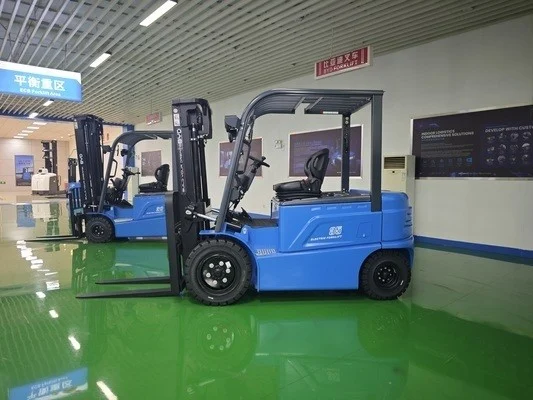
Also check the overhead guard height and the free lift. Free lift allows the forks to rise without increasing the truck’s overall height, which matters in low-clearance areas. If your building has low door frames or mezzanine edges, ask specifically about free lift and the lowered mast height.
Match Power, Floor, and Shift Conditions to the Truck
Indoor electric forklifts are often chosen because they produce no exhaust emissions at the point of use. That does not mean every electric truck suits every indoor environment. Consider these conditions:
- Floor condition: Smooth concrete is typical, but expansion joints, ramps, and dock plates can affect stability and tire wear. Four-wheel counterbalance trucks generally handle these surfaces well, but confirm the floor load rating and any slopes with the manufacturer.
- Battery and charging: Lithium-ion batteries can be opportunity-charged during breaks, which may suit multi-shift operations. However, charging infrastructure, voltage, and available time must be confirmed. Do not assume a battery will last a full shift without checking the manufacturer’s published run time under your duty cycle.
- Attachments: Clamps, rotators, and sideshifters add weight and move the load center forward. Each attachment reduces capacity, and the reduction must be calculated using the attachment manufacturer’s data and the forklift’s capacity chart.
- Environment: Dust, moisture, and temperature extremes can affect electric components. If your indoor area includes cold storage or wash-down zones, ask about the truck’s rating and any required modifications.
These factors do not replace the capacity and lift height checks; they refine them. A truck that meets the load chart but cannot handle the floor or charging schedule is still a poor fit.
Frequently Asked Questions
Can I use the rated capacity on the data plate as my maximum load?
Only if your load center and lift height match the conditions stated on the plate. The plate usually shows capacity at a specific load center, often 500 mm or 600 mm, and sometimes at a specific lift height. If your load is deeper or you lift higher, the safe capacity is lower. Always ask the manufacturer for the capacity chart that covers your actual load center and lift height.
How do I measure lift height correctly?
Measure from the floor to the top surface of the highest rack beam where you will place a pallet. Add the pallet height and any clearance you need to insert and withdraw the forks. Then compare that total with the mast’s maximum fork height. Also check the truck’s overall height with the mast lowered against doorways and overhead obstructions. Do not use the rack’s top beam if you never place loads there; use the highest beam you actually use.
Does a four-wheel counterbalance electric forklift fit narrow aisles?
It depends on the aisle width and the truck’s turning radius. Four-wheel counterbalance trucks generally need more aisle space than three-wheel or reach trucks because the rear swings outward during turns. Measure your narrowest aisle and compare it with the manufacturer’s right-angle stacking aisle dimension. If the aisle is too narrow, you may need a different truck type or a rack layout change. Do not assume a standard four-wheel truck will fit without checking.
What information should I prepare before requesting a quote?
Gather the heaviest load weight, the load center you actually use, the highest lift height you need, your narrowest aisle width, floor conditions, daily shift pattern, and charging availability. Also note any attachments you plan to use. With these details, a dealer can check the correct capacity chart and mast configuration rather than quoting a generic model. If you are considering a four-wheel counterbalance electric forklift from our range, share these values and we can help confirm which configuration matches your indoor operation.