Indoor Electric Forklift Stability Triangle Checks: How Load Center, Lift Height, and Floor Slope Affect Safe Capacity on a Four-Wheel Counterbalance Truck
News 10/11/2026
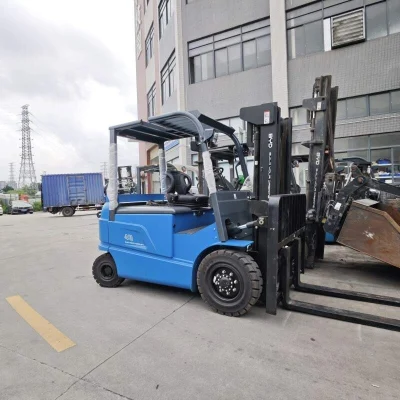
An indoor electric forklift does not tip over because one number on its data plate is wrong. It tips because the load’s actual center of gravity moves outside the stability triangle while the truck is turning, lifting, or sitting on a sloped floor. On a four-wheel counterbalance electric forklift, that triangle is defined by the two front wheels and the pivot point of the steer axle. Every load, every lift height, and every degree of floor slope shifts the combined center of gravity closer to one edge of that triangle. Safe capacity is therefore not a single fixed figure; it is a condition you verify before each lift.
This article explains how load center, lift height, and floor slope interact on a four-wheel counterbalance electric forklift, how to read a capacity chart correctly, and what to confirm with a supplier before you buy or rent. The focus is indoor warehouse and production work where floors are usually level, but ramps, dock transitions, and uneven joints still appear.
What the stability triangle means on a four-wheel counterbalance truck
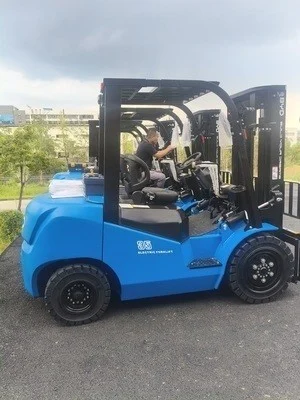
A four-wheel counterbalance forklift steers with its rear wheels. The steer axle pivots, so the rear support effectively acts like a single point rather than two fixed corners. The result is a triangle with the two front wheels as the base and the steer-axle pivot as the apex. The truck stays upright as long as the combined center of gravity of the truck and load remains inside this triangle.
Three things move that combined center of gravity:
- Load weight and load center. A heavier load, or a load whose center sits farther from the fork face, pushes the combined center of gravity forward toward the front-wheel line.
- Lift height. Raising the forks raises the load’s center of gravity, which reduces the margin against tipping, especially during turns and braking.
- Floor slope and dynamic forces. A slope tilts the triangle itself. Turning, accelerating, braking, and lowering a load quickly add lateral and longitudinal forces that effectively move the center of gravity toward an edge.
The practical rule: rated capacity applies only at the stated load center and a defined lift height, usually with the mast vertical and the load lowered. Any deviation reduces the safe working load. The manufacturer’s capacity chart, not the headline number on the data plate, governs what you may lift.
How load center, lift height, and floor slope change safe capacity
Load center: the distance that matters most
Load center is the horizontal distance from the vertical fork face to the center of gravity of the load. Standard ratings are typically quoted at a 24-inch load center with a 48-inch fork length, but you must confirm the actual rating basis on the truck’s data plate and capacity chart. A pallet whose weight is concentrated toward the tips, an oversized carton, or a load that is not pushed back against the carriage will sit at a greater load center than the rating assumes. The capacity chart then shows a lower permissible weight at that greater distance.
Common indoor mistakes include:
- Leaving a gap between the load and the carriage, which increases the effective load center.
- Handling loads deeper than the fork length, so the center of gravity sits beyond the fork tips.
- Using an attachment such as a sideshifter, clamp, or extension that adds weight and moves the load forward. Attachments almost always reduce remaining capacity, and the reduction must come from the attachment supplier’s data, not from guesswork.
Lift height: why the chart has more than one row
Capacity charts often list permitted load at several lift heights and sometimes at several load centers. As the carriage rises, the load’s center of gravity rises, and the truck’s remaining resistance to tipping in a turn or during a sudden stop decreases. A load that is safe at floor level may exceed the permitted value at high lift. If you store pallets at multiple beam levels, check the highest level you actually use, not the average.
Indoor racking usually makes this concrete: a truck rated to lift a certain weight at low height may have a lower permitted weight at the top beam. Confirm the chart values at your maximum lift height with the mast and any attachment you intend to use. If the chart does not cover your combination, ask the supplier rather than extrapolating.
Floor slope: small angles still matter
Indoor floors are rarely perfectly level. Dock ramps, floor drains, expansion joints, and transitions between slabs introduce slope. A slope tilts the stability triangle and adds a gravity component that pushes the truck and load downhill. Turning on a slope while carrying a raised load combines lateral force with the tilt, which is one of the least forgiving situations an operator can create.
Sound practice indoors:
- Keep the load low and the mast tilted back while traveling, and raise the forks only at the pick or place position.
- Avoid turning on ramps and dock plates; travel straight up and down where the layout allows.
- Do not assume a slope is harmless because it looks gentle. If your site has ramps, ask the supplier what slope and surface conditions the truck’s braking and stability are rated for, and confirm the floor’s condition and friction.
Specification checks that actually affect indoor stability
The table below lists the parameters that matter when you evaluate an indoor four-wheel counterbalance electric forklift. It separates what is usually standard, what is optional, and what must be confirmed from the manufacturer’s technical documentation. No values are given here because they depend on the specific model and configuration; your supplier’s data sheet and capacity chart are the authority.
| Parameter or configuration | Why indoor operations care | What to confirm with the supplier | Standard, optional, or to be confirmed |
|---|---|---|---|
| Rated capacity and load center basis | Determines the maximum permitted load at the stated distance from the fork face | Data plate rating, capacity chart rows by load center and lift height, fork length | To be confirmed from the data sheet |
| Capacity at maximum lift height | High racking reduces permitted load | Chart values at your top beam level, with the mast and attachment you will use | To be confirmed |
| Attachment effect on capacity | Sideshifters, clamps, and extensions add weight and shift load forward | Derating figures from the attachment supplier, combined with the truck chart | Optional; derating to be confirmed |
| Turning radius and aisle width | Affects whether the truck can work your aisle layout without tight, destabilizing turns | Measured turning radius, right-angle stack dimensions, aisle width at your rack layout | To be confirmed from dimension drawings |
| Braking and travel behavior | Sudden stops shift load forward | Braking performance under load, recommended operating practices on slopes | To be confirmed |
| Floor and slope conditions | Slope and surface friction affect stability and traction | Rated slope conditions, tire type and tread, floor finish and joint condition | Optional tire choices; site data needed |
| Battery and charging arrangement | Shift length and charging breaks affect how often the truck is available | Battery type, charging method, charging location and ventilation requirements | To be confirmed from product documentation |
Two cautions apply to every row. First, do not treat a headline capacity as valid at every height and load center. Second, do not compare trucks on capacity alone; a truck with a higher rating at a short load center may have a lower permitted load at your actual load center and lift height.
Putting the checks into an indoor selection routine
The following sequence helps you turn these ideas into a purchasing or rental decision. It is general guidance, not a substitute for the manufacturer’s instructions and your site’s safety procedures.
- Map the actual loads. Record pallet weights, load dimensions, and whether weight is centered or offset. Note the deepest load you handle and the fork length you need.
- Map the actual lift heights. Identify the highest beam level at each storage location and whether any attachment is used there.
- Map the floor. Note ramps, dock plates, drains, joints, and any area where the truck turns while carrying a load. Measure or document slopes where they exist.
- Match the capacity chart to those conditions. Find the permitted load at your worst-case combination of load center and lift height, then subtract any attachment derating.
- Check dimensions against the aisle. Confirm turning radius and right-angle stacking dimensions against your aisle width before committing to a model.
- Confirm operating practices. Train operators to keep loads low, avoid turns on slopes, and raise forks only at pick and place. Stability depends on behavior as much as on the data plate.
Suppose, as a hypothetical indoor application, a warehouse stores pallets at three beam levels and uses a sideshifter on every lift. The buyer should collect the pallet weights, the top beam height, and the sideshifter’s derating data, then ask the supplier to confirm the permitted load at that height with the attachment fitted. If the answer is below the heaviest pallet, the options are to reduce the top-level load, change the attachment, or select a different configuration. That is the kind of concrete decision the stability triangle ultimately drives.
If you are evaluating a four-wheel counterbalance electric forklift from BYD, share your load weights, load centers, maximum lift height, aisle width, floor slope conditions, and shift pattern. The supplier can then match those inputs to documented capacity charts and configuration options rather than to a single headline rating.
Frequently asked questions
Does a higher capacity rating always mean a safer truck?
No. The rating is only valid at the load center and lift height stated in the capacity chart. A truck with a high rating at a short load center can have a lower permitted load at your actual load center and top lift height. Compare charts at your real conditions.
Can I lift the rated load with the mast raised and the truck turning?
That combination is exactly what the stability triangle warns against. Turning raises lateral forces, and lifting raises the load’s center of gravity. Keep loads low while traveling, avoid turns on slopes, and raise the forks only at the pick or place position. Follow the manufacturer’s operating instructions.
How much does a small floor slope reduce safe capacity?
There is no universal number. The effect depends on the slope angle, the load, the lift height, and the direction of travel and turning. Rather than estimate, document the slopes on your site and confirm with the supplier what slope conditions the truck is rated to handle, then set operating rules accordingly.
Do attachments change the load I can lift?
Usually yes. Attachments add weight at the carriage and can move the load forward, both of which reduce remaining capacity. The derating must come from the attachment supplier’s data combined with the truck’s capacity chart. Do not assume the original rating still applies.
What information should I give a supplier before buying an indoor electric forklift?
Provide pallet weights and dimensions, load centers, maximum lift height, aisle width and rack layout, floor slope and surface conditions, any attachment you plan to use, and your shift and charging pattern. These inputs let the supplier confirm capacity, dimensions, and configuration against documented specifications.