Key Considerations When Specifying 3.5 ton electric forklift’s Fit Within Your Industrial Operations
News 07/10/2026
Many industrial operations teams evaluate material handling equipment upgrades or additions, and a 3.5 ton electric forklift ranks among popular options supporting mid-range lifting needs. Unlike internal combustion models, these units deliver zero on-site emissions, lower noise output and reduced long-term maintenance costs. But not every facility can accommodate this equipment safely or efficiently. This guide compares key factors to assess fit, outlines common limitations and provides actionable steps to inform your final decision.
Facility Layout and Aisle Width Requirements
The first critical check matches forklift dimensions to your existing facility layout. 3.5 ton electric forklift models typically have wider turning radii and larger overall footprints than smaller 1-2.5 ton electric units, so aisle clearance becomes a primary concern.
Standard vs Narrow Aisle Comparison
Standard counterbalance 3.5 ton electric forklifts require 12-14 feet of clear aisle width to complete full 180-degree turns. Narrow aisle models, built specifically to accommodate tighter storage layouts, cut required clearance to 9-11 feet, but come with reduced maximum lift height and lower maneuverability around loading docks.
Teams must account for additional clearance near racking end caps, loading bays and pedestrian walkways. Even narrow aisle models need extra space when carrying full 3.5 ton loads, as turning radius increases with cargo weight. If your facility uses very narrow aisle (VNA) storage systems, most standard 3.5 ton electric forklift models cannot operate safely, so you will need custom VNA-specific units that come with higher upfront costs.
Lifting Capacity and Load Profile Compatibility
Manufacturers list 3.5 tons as maximum capacity at a specific load center, usually 24 inches for most standard models. This rating changes with lift height and load size, so matching capacity to your typical load profiles prevents safety issues and premature equipment wear.
Center Load vs Offset Load Comparison
Evenly distributed 3.5 ton loads aligned with the forklift’s load center let standard models deliver full rated capacity at 3.5 tons. If your operation regularly handles oversized, uneven or offset loads (such as large crates, lumber bundles or machinery components), effective maximum capacity drops by 10-20% even on models rated at 3.5 tons.
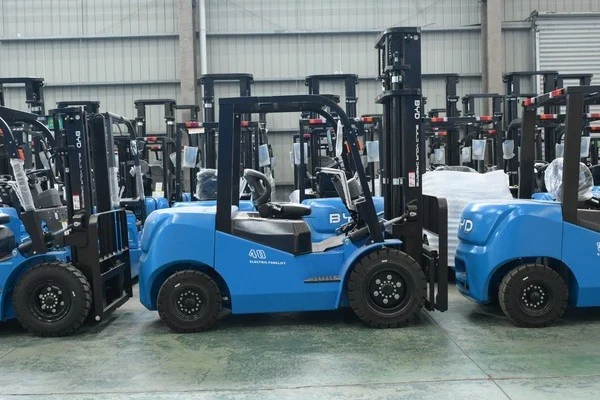
Lifting height also impacts capacity. A 3.5 ton electric forklift that can lift 3.5 tons to 10 feet will only lift 2.5-3 tons to 20 feet, as mast extension shifts the center of gravity forward. Operations needing full 3.5 ton capacity at heights above 15 feet need specialized heavy-duty masts, which add cost and increase overall equipment width.
Power Source and Infrastructure Requirements
3.5 ton electric forklifts rely on large battery banks to deliver sufficient power supporting full-capacity lifting. Unlike smaller electric models, these units require dedicated charging infrastructure that fits within your facility.
Lead-Acid vs Lithium-Ion Battery Comparison
Lead-acid batteries are lower in upfront cost, but require 8-10 hours charging plus 8 hours cooling time before use. Most operations using lead-acid powered 3.5 ton electric forklifts need an extra battery per unit to support multi-shift operations, plus a dedicated, ventilated charging room to prevent gas buildup.
Lithium-ion batteries cost 2-3 times more upfront, but support opportunity charging during breaks, eliminate cooling requirements and fit in smaller dedicated charging stations. They also last 2-3 times longer than lead-acid batteries. Single-shift operations often find lead-acid batteries deliver sufficient value, while multi-shift operations gain more long-term benefit from lithium-ion setups.
Infrastructure checks also include floor load capacity. A fully loaded 3.5 ton electric forklift plus battery adds 7-9 tons of total weight to facility floors. Older warehouses or upper-level storage mezzanines may not support this weight, so you need to confirm floor load ratings before installation.
Operational Cost Comparison
Comparing long-term operational costs helps determine if a 3.5 ton electric forklift fits your budget, compared to comparable internal combustion (IC) models.
Electric vs IC 3.5 Ton Forklift Operating Costs
Electric models have no engine oil changes, filter replacements or fuel system maintenance, so annual maintenance costs run 30-40% lower than comparable IC units. Electricity costs per hour of operation also run lower than propane or diesel fuel costs across most regions.
Upfront costs for 3.5 ton electric forklifts run 15-25% higher than comparable IC models, plus extra infrastructure costs related to charging systems. Facilities with no existing electric forklift charging will need to budget for electrical system upgrades supporting high-power charging.
Frequently Asked Questions
Can a 3.5 ton electric forklift operate outdoors?
Most standard 3.5 ton electric forklifts target indoor use only. Some sealed-cabinet, weather-resistant models can operate in light outdoor conditions such as uncovered loading docks, but they cannot handle heavy rain, snow or rough unpaved surfaces. Full outdoor use typically requires IC-powered units, unless you purchase a specialized all-electric outdoor model with additional weatherproofing.
What is typical service life of a 3.5 ton electric forklift?
With proper maintenance, most 3.5 ton electric forklifts deliver 10,000-15,000 hours of operational use. Battery service life varies: lead-acid batteries last 1,500-3,000 charge cycles, while lithium-ion batteries last 4,000-6,000 cycles.
Do 3.5 ton electric forklifts require special operator training?
All forklift operators need certification specific to electric lift equipment, regardless of capacity. The heavier weight and different handling characteristics of 3.5 ton models require additional training focused on load management, turning clearance and charging safety, compared to smaller electric units.
Is a 3.5 ton electric forklift too large for small warehousing operations? Wait no, fixed: Is a 3.5 ton electric forklift too large for small → Is a 3.5 ton electric forklift too large in small warehousing operations?
It depends on your load requirements and layout. If your operation regularly moves loads between 2.5 and 3.5 tons, and you have sufficient aisle clearance, it can work well even in smaller warehouses. If your average load falls below 2 tons, a smaller 2.5 ton model will cost less and fit better in tighter aisles.
Actionable Conclusion
Start your assessment by mapping your facility layout, confirming aisle clearance and floor load ratings, then match capacity to your most common load profiles. Compare battery options based on your shift schedule, and calculate total upfront and long-term costs before making a final decision. A 3.5 ton electric forklift delivers strong value to operations needing mid-range lifting capacity, lower emissions and reduced maintenance, but only when aligned with your facility’s physical and operational constraints. Skip this option if your facility lacks sufficient aisle clearance, floor load capacity or power infrastructure supporting the unit, and opt instead toward a smaller model or IC-powered alternative that matches your site constraints.