Mast and Overhead Clearance Planning: Fitting a Four-Wheel Counterbalance Lithium Forklift 3 Ton Into Existing Racking and Door Heights
News 02/11/2026
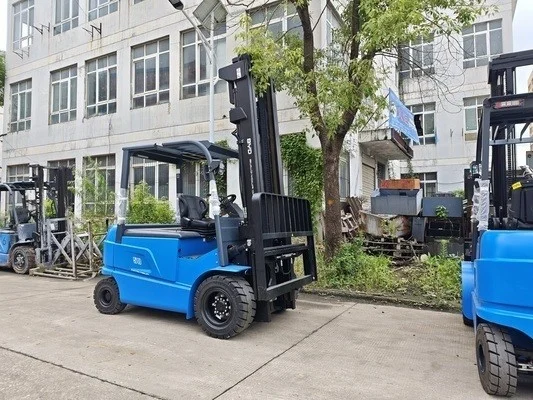
A lithium forklift 3 ton capacity class is often chosen because it matches common pallet loads and trailer work, yet the truck that arrives on site can still fail a simple door or rack check. Overhead clearance is decided by the mast, the carriage, the load guard and the tallest point of the lift path, not by the rated capacity alone. Before ordering, measure the building and the racking, then compare those numbers with the manufacturer’s dimensional drawing of the exact configuration you intend to buy.
This guide covers a four-wheel counterbalance electric forklift, the type this site supplies, and explains how to check mast height against doors, sprinkler lines, rack beams and mezzanine edges. It does not replace a site survey or the manufacturer’s data sheet, and any figures below are placeholders you must replace with verified values.
Why a 3 Ton Rating Says Little About Height
Capacity and height interact. A truck rated 3,000 kg at a stated load centre can lift less when the load centre moves forward, when an attachment is fitted, or when the mast is raised to full height. Mast choice also changes the collapsed height and the free-lift behaviour. A two-stage mast, a three-stage mast and a four-stage mast each produce different lowered and extended dimensions, so two trucks with the same capacity can have very different overhead profiles.
Treat the following as the minimum dimensional set to obtain from the supplier:
- Overall lowered height with the mast fully retracted, including any load guard or overhead guard projection.
- Extended height at maximum lift, and the height at which the inner mast sections start to rise.
- Free lift, meaning how far the forks can rise before overall height increases.
- Overhead guard height, which sets the operator’s head clearance and often the lowest obstruction point.
- Right-angle stacking aisle and turning radius, because a tight aisle may force a different truck or a different rack layout.
None of these should be assumed from a brochure headline. Ask for a dimensioned drawing of the exact model, mast and attachment combination quoted to you.
Checking Doors, Racking and Overhead Services
Start with the route the truck will actually travel, not just the loading bay. A door that clears the mast when the truck is empty may not clear it when the mast is raised, and a raised mast can strike sprinkler heads, light fittings, cable trays, heating ducts or mezzanine soffits. Walk the full route at the highest lift height the task requires and record every obstruction.
Door and gateway checks
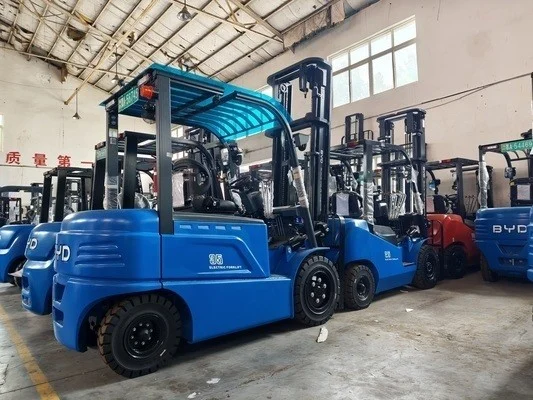
Measure the clear opening width and the clear height, then subtract a working margin. The margin should cover floor unevenness, tyre compression, load deflection and operator visibility limits. Confirm whether the door is a roller shutter, a sectional door or a rapid roll door, because the usable clear height differs when the door is partly open. Also check the threshold and any ramp, since a slope changes the effective height of the mast as the truck tilts.
Racking and lift-height checks
For each beam level, confirm the beam underside height, the beam depth and the clearance needed to place and withdraw a pallet. The truck must be able to lift the pallet above the beam, move forward, lower it and reverse out without the mast or load guard contacting the level above. The top beam level is usually the limiting case. If the truck cannot reach it with adequate clearance, the options are a different mast, a lower top beam, or a different handling method; do not assume a higher-capacity truck will solve a height problem.
Overhead services and structural edges
Sprinkler pipes, fire alarm devices, fans, radiant heaters and roller doors all sit inside the working envelope. Record their heights and horizontal positions, then compare them with the extended mast height plus a safety margin. Where the truck must pass under a service at a raised mast height, mark the floor or fit a height restrictor so the limit is visible to operators.
Matching Mast, Load and Aisle to the Real Task
The table below sets out the parameters that most often decide whether a four-wheel counterbalance electric forklift fits an existing building. The right-hand column is deliberately worded as a question because the correct answer depends on the supplier’s drawings and your site measurements.
| Parameter or configuration | Why it matters in this application | What to confirm with the supplier |
|---|---|---|
| Rated capacity and load centre | A 3 ton rating applies at a stated load centre; longer loads or attachments reduce usable capacity | What is the residual capacity at my actual load centre and lift height? |
| Mast type and stages | Sets lowered height, free lift and extended height | Which mast gives the required lift height with the lowest collapsed profile? |
| Overall lowered height | Determines door and gateway clearance | What is the exact figure including the overhead guard and any fitted options? |
| Extended height and free lift | Determines clearance under rack beams and services | At what lift height does overall height start to increase? |
| Right-angle stacking aisle and turning radius | Determines whether the truck can work the existing aisle layout | What aisle width is required with my pallet size and load length? |
| Battery and charging arrangement | Affects available operating time, charging space and any battery-handling equipment | What charging method and space does the quoted lithium configuration need? |
| Tyres and floor conditions | Affects traction, floor loading and effective ground clearance | Which tyre option suits my floor surface and any ramps? |
Only the manufacturer’s technical documentation can confirm the values in the middle column. Where a figure is missing, write it down as an open item rather than filling the gap with an assumption.
Assumed scenario: a distribution warehouse with older doors
Consider a hypothetical site with a 3 ton pallet load, racking to a moderate height and roller doors on the main route. The planning sequence is the same: confirm the load weight and load centre, confirm the top beam height, confirm the door clear height, then ask the supplier which mast and overhead guard combination satisfies all three at once. If the door is the limiting point, a mast with low collapsed height may be preferable even if it costs more; if the top beam is the limit, the rack layout or the lift height requirement may need to change. This is a planning example, not a record of a specific installation.
Common Planning Errors and How to Avoid Them
- Using the capacity number as a height number. Capacity and lift height are separate specifications; check both against the same drawing.
- Measuring only the door the truck enters through. The return route, charging area and maintenance bay all need checking.
- Ignoring free lift. A truck with low overall height but high free lift can still strike a low beam during a lift.
- Forgetting the load. A tall pallet adds height above the fork carriage, and overhanging loads change the effective envelope.
- Assuming attachments are free. Any clamp, push-pull or side-shift device changes dimensions and residual capacity, so it must be included in the drawing review.
- Leaving floor condition out. Uneven floors, expansion joints and ramps alter the working clearance in practice.
Good practice is to produce a one-page clearance sheet listing the lowest obstruction on each route, the tallest lift point and the truck dimensions quoted. Share it with the supplier and ask them to mark any figure they cannot confirm.
Frequently Asked Questions
Can a 3 ton lithium forklift fit through a standard warehouse door?
It depends on the mast type and the door’s clear height. Obtain the overall lowered height of the exact configuration and compare it with the measured clear opening, allowing a working margin. Do not rely on a general statement that a certain capacity class fits standard doors.
Does a higher-capacity truck solve a low-clearance problem?
Not necessarily. A larger truck may have a taller mast and overhead guard. The clearance question is answered by mast and carriage dimensions, so ask the supplier to compare drawings rather than assuming capacity and height move together.
How much clearance should I leave above a rack beam?
The required clearance depends on the pallet, the load, the mast free lift and the manufacturer’s guidance. Ask the supplier what margin they recommend and confirm it against your measured beam heights and floor conditions rather than adopting a single figure from another site.
What should I send to a supplier when requesting a configuration check?
Send the load weight and load centre, the required lift height, the top beam height, the lowest door and service obstruction on each route, the aisle width, the floor type and any ramps, plus your shift pattern and charging location. The supplier can then propose a mast and options that meet those constraints, or tell you where the building limits the truck.
Before You Order: A Clearance Checklist
Collect the building data first, then request the truck data. At minimum, record the clear height of every door on the route, the height of the top rack beam, the height and position of overhead services, the aisle width and turning space, the floor surface and any slopes, the load weight and load centre, and the charging location. Then ask the supplier to confirm the mast type, overall lowered height, extended height, free lift, overhead guard height, residual capacity at your load centre and lift height, and the aisle width required. Ask which items are standard, which are optional and which need factory confirmation. A four-wheel counterbalance electric forklift can suit many warehouse and loading tasks, but only when the dimensional drawing matches the building. Where the measurements do not fit, report the constraint honestly and discuss alternatives rather than forcing a configuration.