Ramp and Dock Incline Grades: Setting Brake and Traction Expectations When Specifying a BYD Counterbalance Forklift
News 08/11/2026
A ramp or dock incline is not just a slope to cross; it is a point where braking, traction and load stability all change at once. When you specify a BYD counterbalance forklift, the grade you expect the truck to climb or descend should be matched against the machine’s rated gradeability, the load you plan to carry and the surface condition. The practical answer: treat the ramp grade as a design input, not an afterthought, and ask the supplier to confirm rated gradeability at your actual load and travel direction before you commit. A truck that handles a gentle dock apron may behave very differently on a steeper yard ramp with a full load and a wet surface.
Why Grade Changes the Braking and Traction Question
On level ground, a counterbalance forklift’s braking demand is mostly about stopping distance and load retention. On an incline, gravity adds a force along the slope, so the service brake and the parking brake carry more responsibility. The steeper the grade, the more the truck’s ability to hold position depends on brake capacity and on the friction between tires and surface.
Traction follows the same logic. The drive wheels must transmit enough force to move the truck and load uphill without slipping. If the surface is smooth, wet, dusty or coated with fine debris, available friction drops, and the grade a truck can actually climb becomes lower than a dry-surface figure would suggest. This is why a gradeability number should always be read together with the surface and load conditions to which it applies.
Load position matters too. A counterbalance truck is designed to carry a load low and close to the mast during travel. Carrying a raised load up or down a ramp shifts the center of gravity and increases the risk of tip-over, regardless of brake quality. Grade expectations therefore belong alongside load-handling rules, not separate from them.
What to Confirm Before You Accept a Grade Figure
Manufacturers publish gradeability figures, but the conditions behind those figures vary. Rather than assuming a single percentage applies to your site, ask the supplier to state the basis. The following checklist helps you frame the questions.
- Load condition: Is the figure rated at full rated load, at a reduced load, or unladen? Gradeability at rated load is normally lower than unladen gradeability.
- Travel direction: Can the truck climb the grade with the load leading, and can it descend safely with the load trailing? Braking behavior differs between the two.
- Surface: Is the figure based on dry concrete, asphalt, or another surface? Wet or contaminated surfaces reduce usable traction.
- Ramp length and transitions: A short dock apron and a long yard ramp place different demands on the drive system and brakes. Transition lips and joints also affect traction and load stability.
- Speed and stop frequency: A truck that stops and restarts on the slope many times per shift places more heat and wear on brakes than one that crosses once.
Where the supplier’s technical data does not state these conditions, ask directly and keep the answer with your specification records. Do not treat a generic gradeability figure as a guarantee your application will match it.
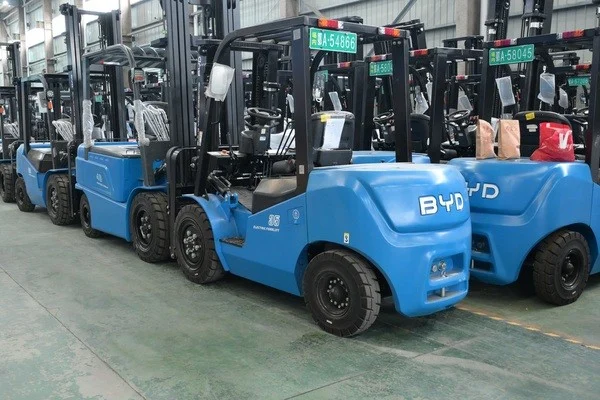
Matching Ramp and Dock Conditions to a Four-Wheel Counterbalance Electric Forklift
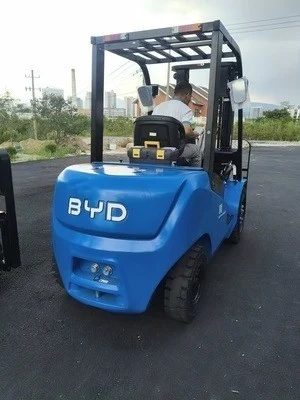
A four-wheel counterbalance electric forklift is a common general-purpose choice in factories, loading docks and warehouse yards, and its suitability on a ramp depends on the specific conditions at your site. The sections below outline how to assess them.
Measure the grade you actually have
Measure the ramp rather than estimating it. Grade is the rise divided by the horizontal run, expressed as a percentage. A ramp that rises 0.5 m over a 10 m run is a 5% grade. Measure at the steepest section, including any transition where the ramp meets the dock or yard, because that is often where traction and load stability are most challenged.
Keep the measurement in your inquiry. A supplier can only match a truck to a grade if the grade is stated clearly, along with the load and surface.
State the load and its center of gravity
Give the supplier the actual load weight and how it is packaged. A load whose center of gravity sits further from the mast reduces the truck’s effective capacity, and that reduction matters more on a slope. If your loads vary, describe the heaviest combination you expect to move on the ramp, not the average.
Describe the surface and the weather exposure
Indoor dock ramps, covered yards and open-air ramps present different traction conditions. Rain, frost, oil films and fine dust all reduce friction. If the ramp is outdoors or exposed to wash-down, say so. The truck’s tires and the surface treatment of the ramp both influence usable traction, and the supplier should know which conditions apply.
Check the braking expectation on the descent
Descending a grade with a load is the direction many sites overlook. The service brake must control speed, and the parking brake must hold the truck when stopped. Ask how the truck is intended to be operated on the descent, including speed limits and whether the ramp has a level landing at the bottom. Site rules should prohibit turning on the slope and carrying a raised load on the ramp.
Confirm the charging and duty pattern
Ramp work often sits inside a larger duty cycle. If the truck climbs the ramp repeatedly during a shift, the energy demand and brake use differ from occasional crossings. Share the number of ramp trips per shift and the shift length so the battery and duty expectations can be discussed alongside the grade question.
Frequently Asked Questions
Can a BYD counterbalance forklift climb a dock ramp with a full load?
That depends on the ramp grade, the load and the surface, so there is no single yes or no. Ask the supplier to confirm rated gradeability at your load and describe the surface conditions behind the figure. If the ramp is steeper than the confirmed rating, reduce the load, change the route, or reconsider the truck specification.
Does a wet ramp change the grade the truck can handle?
Yes. Water, frost, oil and fine dust reduce the friction available at the drive tires, so the grade the truck can climb without slipping can be lower than on a dry surface. Treat published gradeability as a dry-surface reference unless the supplier states otherwise, and manage wet conditions through route rules, surface cleaning and speed limits.
Should the load face uphill or downhill on a ramp?
Follow the operating instructions and site traffic rules. In general, the load should be kept low and the truck driven at reduced speed, and turning on the slope should be avoided. Confirm the intended travel direction with the supplier, because brake and traction behavior differ between climbing with the load leading and descending with the load trailing.
What information should I send when requesting a ramp-specific specification?
Send the measured grade at the steepest point, the heaviest load and its packaging, the ramp surface and exposure, the number of ramp trips per shift, and any site speed or traffic rules. This lets the supplier check the four-wheel counterbalance electric forklift configuration against your actual conditions rather than a generic figure.
Next Steps: Turn the Grade into a Specification
Before ordering, record the measured grade, the load, the surface and the descent conditions, then ask the supplier to confirm the truck’s rated gradeability against those inputs. Keep the confirmation in writing. If any condition is uncertain, such as seasonal ice or a ramp surface that changes with wash-down, state that uncertainty rather than assuming the dry figure applies. A specification built on measured site conditions gives you a clearer basis to judge whether a given four-wheel counterbalance electric forklift suits the ramp, and where operating rules must cover the remaining risk.