Verifying Rated Capacity on a 3 Ton Electric Forklift: Load Center, Mast Tilt, and Attachment Derating
News 06/11/2026
A 3 ton electric forklift does not carry 3,000 kg under every condition. The rated capacity on the data plate assumes a specific load center, usually 500 mm or 600 mm, a vertical mast, and no attachment. Change any of those conditions and the safe working load drops. Verifying capacity means reading the plate, comparing your real load geometry and lift height against the plate assumptions, and applying the manufacturer’s derating information when an attachment is fitted. This article explains how each factor works, what to check on a four-wheel counterbalance electric forklift, and where the limits of a plate rating lie.
What the Rated Capacity Plate Actually Tells You
The capacity plate is a conditional statement, not a single number. It lists the rated load at a stated load center and often includes a capacity chart that reduces the allowable load as the load center moves outward or as the mast carriage rises. On many counterbalance trucks the plate also shows a second rating with the mast tilted forward or backward, because tilt shifts the load’s center of gravity relative to the truck.
Three terms matter when you read the plate:
- Rated capacity: the maximum load the manufacturer permits under the plate’s stated conditions. A 3 ton rating normally means 3,000 kg at the nominal load center and standard mast.
- Load center: the horizontal distance from the vertical face of the forks to the load’s center of gravity. The plate states the value used to establish the rating.
- Derating: the reduction in allowable load when actual conditions differ from the plate assumptions, such as a longer load, a taller lift, or an added attachment.
Do not treat the largest number on the plate as an unconditional limit. A load that fits within 3,000 kg but sits far from the fork face can exceed the truck’s stability margin even though the scale says otherwise.
Load Center and Lift Height: Where Capacity Changes
Load center is the first check. If your pallet’s center of gravity sits farther from the fork face than the plate’s stated load center, the allowable load is lower than the rated figure. The same principle applies when the load is not uniform: an offset or oddly shaped load can move the effective center of gravity beyond what a simple measurement suggests.
Lift height matters too. Many manufacturers publish capacity charts that show a reduced rating at higher lift heights, particularly with a mast extended. The exact reduction depends on the mast type and the truck’s design, so use the chart supplied with the specific model rather than a general rule. If no chart is available, ask the supplier to confirm the allowable load at your maximum lift height before you plan a lift.
Mast tilt adds a further variable. Tilting the mast forward or backward moves the load relative to the truck’s stability base. Some plates include ratings at specified tilt angles; others leave tilt to operating instructions. In practice, keep the mast vertical or tilted back as recommended during travel, and treat any forward tilt with a raised load as a condition to check against the manufacturer’s guidance, not as a routine capacity allowance.
Attachment Derating: Why a Clamp or Rotator Reduces Capacity
An attachment changes the geometry and adds weight ahead of the carriage. A sideshifter, fork positioner, clamp, or rotator moves the load center forward and adds its own mass, so the truck can safely handle less load than the bare-mast rating. The manufacturer or attachment supplier should provide a derating chart or a revised capacity plate that reflects the combination.
Use the revised figure, not the original 3 ton rating. If the attachment supplier cannot provide a derating value, the combination should be treated as unverified until the forklift manufacturer confirms it. Do not estimate derating from the attachment’s weight alone; the forward shift of the load center is often the larger factor.
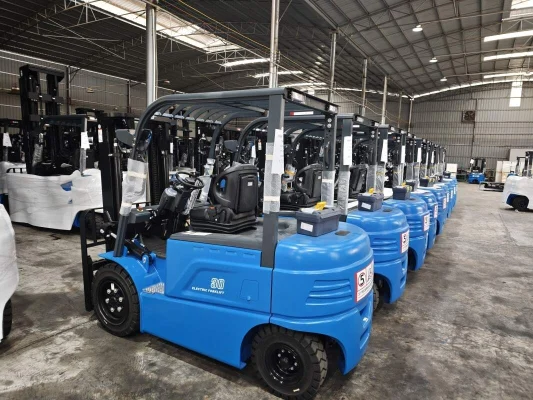
This applies equally to a four-wheel counterbalance electric forklift used with a clamp or a fork positioner. The truck’s stability is designed around a specific carriage and load geometry, and an attachment alters that geometry. A capacity plate that still shows the original rating after an attachment is fitted is not evidence that the original rating remains valid.
A Practical Verification Sequence
The following steps help you confirm capacity before a lift. They are general guidance, not a substitute for the manufacturer’s capacity chart and operating manual.
- Read the plate on the actual truck. Record the rated capacity, stated load center, mast type, and any tilt ratings. Confirm the plate matches the model and configuration in use.
- Measure your load. Determine the weight and the horizontal distance from the fork face to the load’s center of gravity. For a uniform pallet, the center is usually near the middle; for irregular loads, estimate conservatively.
- Compare load center. If your measured load center exceeds the plate value, find the reduced capacity from the manufacturer’s chart. If no chart exists, treat the load as requiring confirmation.
- Check lift height. Compare your maximum lift height with the capacity chart. If the chart shows a lower rating at that height, use the lower figure.
- Account for attachments. If an attachment is fitted, obtain the revised capacity rating from the attachment or forklift manufacturer. Do not use the bare-mast rating.
- Confirm with the supplier. When any value is missing or unclear, ask the supplier to confirm the allowable load under your exact conditions in writing.
This sequence is deliberately conservative. In a hypothetical warehouse scenario, a 3 ton electric forklift rated at a 500 mm load center might handle a 2,800 kg load whose center sits at 600 mm only if the manufacturer’s chart permits it; without that chart, the safe answer is to reduce the load or seek confirmation.
Frequently Asked Questions
Does a 3 ton rating mean the forklift can lift 3,000 kg at any height?
No. The rating applies at the plate’s stated load center and mast condition. Higher lift heights, a longer load center, or an attachment can reduce the allowable load. Check the manufacturer’s capacity chart for your specific model and configuration.
How do I find the load center of my pallet?
Measure from the vertical face of the forks to the point where the load would balance horizontally. For a uniformly loaded pallet, that is usually near the geometric center. For irregular loads, use a conservative estimate or ask the load’s supplier. The plate’s stated load center is the value to compare against.
Can I use the original capacity if I add a sideshifter?
Not automatically. A sideshifter adds weight and shifts the load forward, so the allowable load is typically lower. Obtain a revised capacity rating from the forklift or attachment manufacturer. If none is available, treat the original rating as unverified with the attachment fitted.
What should I do if the capacity chart is missing?
Ask the supplier or manufacturer to provide the chart or confirm the allowable load at your load center, lift height, and attachment configuration. Do not rely on the bare plate number alone when conditions differ from the plate assumptions.
When you request a quote on a four-wheel counterbalance electric forklift, include your actual load weight, load center, maximum lift height, any attachment, and ground conditions. Those details let the supplier confirm a configuration that matches your work rather than a nominal rating that may not apply.