How 2 ton electric forklift Design Characteristics Impact Integration With Automated Warehouse Systems
News 17/10/2026
A 2 ton electric forklift serves as a critical link between goods movement and automated warehouse operations. Its inherent design traits directly determine how smoothly it connects to existing automation infrastructure, from guided navigation systems to warehouse management software (WMS). This guide outlines which design elements matter most, what verification steps warehouse operators need to complete, and what common integration pitfalls to avoid.
Core Design Traits That Influence Automated System Integration
Not all 2 ton electric forklift designs work equally well with automated warehouse systems. The following core traits directly impact integration success:
Overall Footprint & Turning Radius
Automated warehouses rely on narrow aisles and pre-planned navigation paths to maximize storage density. A forklift’s outer dimensions, turning radius, and clearance under low-hanging structures determine whether it can follow pre-programmed routes without collisions. Designs with compact chassis fit existing narrow-aisle racking layouts, while wider chassis require layout modifications that add project cost and downtime.
Communication & Control Interfaces
Modern automated warehouse systems require real-time data exchange between material handling equipment and WMS or warehouse control systems (WCS). Forklifts built with open, standard industrial communication interfaces integrate faster than proprietary locked designs. Some designs support direct integration with auto-navigation sensors, while others require third-party hardware retrofits that add complexity.
Load Consistency & Center of Gravity Design
Automated picking and placing operations require predictable load behavior from the forklift. A 2 ton electric forklift’s rated load capacity matches common automated warehouse pallet weights, but its designed load center directly impacts how it positions loads onto automated storage racks. Designs with fixed load center alignment match most standard automated rack specifications, while adjustable designs require extra calibration to work with automated positioning.
Battery & Power Management Design
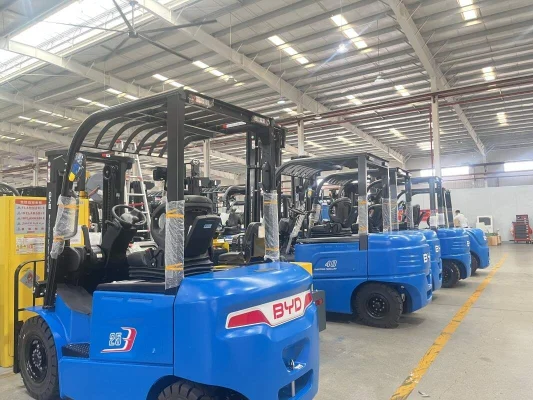
Continuous 24/7 operations common in automated warehouses require consistent power delivery. Forklifts built with fast-swappable battery designs support uninterrupted operations, while built-in charging designs require scheduled downtime that can disrupt automated workflow throughput. Power management systems also need to output state-of-charge data to WCS support automated scheduling of charging tasks.
Key Parameter Comparison & Verification
The table below outlines key parameters relevant to automated warehouse integration, what to check, and what notes apply to each configuration:
| Parameter | Automated Warehouse Relevance | Supplier Verification Step | Configuration Notes |
|---|---|---|---|
| Minimum aisle width requirement | Matches existing racking layout to avoid layout changes | Request dimensional drawing matched to your maximum lift height and load condition | Standard: Listed on product spec; Custom: Confirm with layout testing |
| Supported communication protocols | Enables real-time data exchange with WMS/WCS | Provide your system protocol specification and get written confirmation of compatibility | Open protocols (Modbus, Ethernet/IP) often supported as standard; Proprietary protocols may require custom development |
| Standard load center distance | Ensures accurate load positioning on automated racks | Compare value against your rack system’s required load center specification | Most 2 ton electric forklift models use 500mm as default, but custom values require factory modification |
| Navigation sensor mounting points | Supports installation of automated guidance hardware | Request CAD drawings of mounting locations and confirm load capacity of mounting structures | Mounting points are optional on most base models, confirm availability before order placement |
| State-of-charge data output | Enables WCS automated charging scheduling | Confirm data output format and accessibility to your control system | Basic models may only display data on on-board screen, no remote output available |
Common Integration Compatibility Limitations
Even well-matched 2 ton electric forklift designs can face integration issues when operators overlook these common limitations:
- Proprietary control systems: Some manufacturers lock their control systems, making third-party integration impossible or extremely costly. This limits your ability to connect the forklift to your existing automated infrastructure.
- Dynamic weight shifts: Forklift designs that allow variable load positions can create unexpected weight shifts that throw off automated navigation accuracy, leading to repeated positioning errors.
- Inconsistent power output: Older battery designs without modern battery management systems (BMS) can produce inconsistent voltage that disrupts sensor and communication hardware operation.
- Chassis interference: Non-standard attachments or added accessories can change the forklift’s outer dimensions, leading to collisions with racking or other equipment in pre-planned automated paths.
All these limitations can get avoided through early verification with your supplier and integration partner before placing any order.
Pre-Purchase Confirmation Steps
Follow these clear steps to confirm integration compatibility before finalizing your purchase:
- Share your full automated warehouse system specifications, including aisle dimensions, communication protocols, WMS requirements and average load characteristics with your supplier.
- Request a written compatibility statement that confirms all required design features match your system needs.
- Ask documentation of any required custom modifications, including lead times and additional costs associated with integration-specific changes.
- If possible, arrange a off-site test of the forklift integrated with a sample of your system hardware to identify issues before on-site installation.
- Confirm post-integration support availability from both the forklift supplier and your automation integration partner to address any unforeseen issues.
This step-by-step process reduces the risk of costly rework after installation, and cuts down on project startup time.
Frequently Asked Questions
Can any 2 ton electric forklift get retrofitted to work with automated warehouse systems?
Many base models can get retrofitted with required communication and navigation hardware, but some older or low-cost designs lack the structural mounting points or open control systems needed to support retrofitting. You need to confirm this capability with your supplier before purchasing a base model expecting future automation upgrades.
Do automated warehouse operations require special structural reinforcement on a 2 ton electric forklift?
It depends on your specific operational demands. Continuous automated operations often involve more consistent load cycles than manually operated forklifts, so you should confirm whether your selected model’s chassis and lifting components meet your required cycle life rating. No standard upgrade applies across all models, so this check must happen on a per-model basis.
What design trait causes the most common integration failures?
Mismatched communication interfaces top the list. Many operators overlook this detail early in the purchasing process, and discover compatibility issues only when installation begins. This leads to costly custom development or even replacement of the forklift if the control system cannot support the required protocol.
Does battery type impact integration success?
Battery type indirectly impacts integration through its power output consistency and data output capabilities. Lead-acid batteries often lack integrated BMS that can output state-of-charge data needed by automated charging scheduling, while lithium-ion batteries typically include this data output as standard. This varies by manufacturer, so you still need to confirm this feature with your supplier.