Sizing a BYD Four-Wheel Counterbalance Electric Forklift: Duty Cycle, Load Center and Battery Charging Questions Buyers Should Settle First
News 02/11/2026
Sizing a BYD four-wheel counterbalance electric forklift starts with three questions that are easy to postpone and expensive to get wrong: how hard the truck will work, where the load actually sits, and how the battery will be charged. Answer these before comparing models, and the remaining specifications become much easier to narrow. This guide is written as a procurement checklist, not a product claim; confirm every number against the current BYD technical data and your own operating conditions.
Define the real duty cycle before looking at models
Duty cycle describes how intensively the truck works during a shift. A common mistake is to count only the hours the truck is switched on. Instead, record the hours of actual lifting, lowering, traveling loaded, and idling. Two operations with the same shift length can place very different demands on a counterbalance truck.
Build a simple duty profile from observation or existing truck data:
- Average and peak number of lifts per hour
- Typical travel distance loaded and empty
- Share of time spent lifting versus transporting
- Number of shifts per day and breaks between them
- Seasonal peaks that exceed normal demand
This profile helps you discuss motor and battery configuration with a supplier without guessing. It also reveals whether a single truck or a larger fleet is the better question. If the duty cycle is light and intermittent, a smaller configuration may be adequate; if it is continuous with little opportunity charging, the charging plan becomes central.
Load center and attachment effects
Rated capacity is not a single fixed number. It is tied to a load center, usually measured from the vertical face of the forks to the center of gravity of the load. When the actual load center is greater than the rated value, capacity decreases. Long loads, non-standard pallets, and attachments can all move the effective load center outward.
Before accepting a capacity figure, confirm the load center used in the rating and compare it with your real loads. Also account for the weight of any attachment, because it reduces the net capacity available to the load. If your loads vary, size the truck around the heaviest combination of load and load center that will occur regularly, not the average.
Lift height and mast type interact with capacity as well. A high-lift mast can reduce the capacity available at full height. Ask the supplier to show the capacity chart at the heights you actually use, and verify that the truck can handle the load at those heights, not only at ground level.
Battery and charging questions to settle early
Charging is a workflow decision, not only an equipment choice. Settle these points before configuration:
- Available charging window: between shifts, during breaks, or overnight only
- Charger location and whether trucks can reach it without blocking aisles
- Electrical supply capacity at the charging point
- Whether opportunity charging is needed to cover peak periods
- Plan for battery maintenance and replacement over the truck’s service life
For lithium-ion models, confirm the manufacturer’s guidance on partial charging and operating temperature. Do not assume that any charger or charging pattern is acceptable; the battery supplier’s instructions take precedence. If your operation runs multiple shifts, the charging plan may influence how many trucks you need more than the truck’s rated capacity does.
Site conditions that change the specification
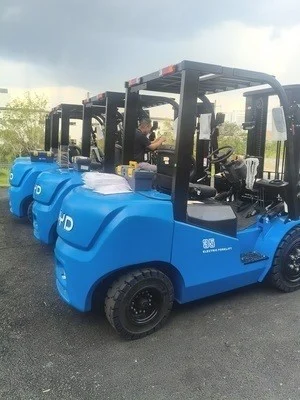
A four-wheel counterbalance electric forklift is a common general-purpose choice in factories, loading areas, and warehouse transfer, but site conditions decide whether a given configuration fits. Check aisle width against the truck’s turning radius and the load length. Confirm floor strength and surface condition, especially where trucks enter from outdoors. Measure ramps and slopes, because grade affects both travel and load handling.
Also consider door heights, overhead obstructions, and the space needed at pick-up and drop-off points. These constraints often eliminate configurations that looked suitable on a capacity chart. Provide the supplier with a dimensioned site plan or a clear description; a short list of requirements is more useful than a vague request.
FAQ: procurement details buyers should confirm
What information should I send when requesting a BYD forklift configuration?
Send your duty profile, maximum load weight, load center, required lift height, aisle and door dimensions, floor and ramp conditions, number of shifts, and charging constraints. This lets the supplier propose a configuration against real conditions rather than a generic model.
Can I compare capacity figures across different brands directly?
Only if the ratings use the same load center, lift height, and attachment assumptions. Otherwise the numbers are not equivalent. Ask for the conditions behind each figure and compare like with like.
How do I verify the truck meets my needs before acceptance?
Agree on the key parameters in writing: rated capacity at your load center, lift height, battery type and charger compatibility, and any site-specific requirements. At delivery, check the data plate and documentation against those agreed points, and confirm that the charging setup matches the manufacturer’s instructions.
What should I do if my duty cycle is uncertain?
Measure it over a representative period, including peak days. If that is not possible, describe the operation in detail and ask the supplier to explain which assumptions the proposed configuration depends on, so you can verify them before purchase.