What Industrial Buyers Should Verify About Four-Wheel Counterbalance Electric Forklift Load Center and Attachments Before Ordering
News 05/11/2026
Load center and attachment fit are two of the most common reasons a four-wheel counterbalance electric forklift arrives on site and then fails to handle the job it was ordered to do. Before you sign a purchase order, confirm how the rated capacity changes when the load sits farther from the carriage, and confirm that the attachment you plan to mount is approved with the truck’s mast, carriage, and hydraulic system. This procurement guide lists the documents, figures, and agreements an industrial buyer should collect during the quotation stage so that capacity, stability, and attachment compatibility are settled before delivery rather than after.
Why Load Center Changes the Capacity You Actually Get
Forklift capacity ratings are tied to a stated load center, usually measured from the vertical face of the forks to the center of gravity of the load. A rating printed on a data plate applies only at that load center and that lift height. When a load is deeper, the same truck can safely handle less weight, because the load’s moment arm grows and stability margins shrink.
Buyers should therefore ask suppliers to state the rated capacity together with the load center, lift height, and mast type it applies to. If your real loads are pallets deeper than the reference load center, or if you plan to use a clamp, rotator, or other attachment that moves the load forward, request a derated capacity chart that covers your actual configuration. Treat any verbal assurance that the truck “will be fine” as unconfirmed until it appears in writing on the quotation or data sheet.
Information to collect during quotation
- Rated capacity, stated load center, and the lift height at which the rating applies.
- Actual load dimensions, weight, and estimated center of gravity, including pallet overhang.
- Attachment weight and its effect on residual capacity, provided by the attachment maker or the truck supplier.
- Any derating chart the supplier can issue for your load center and attachment combination.
- Mast, carriage, and fork specifications, including fork length and spread.
Attachment Compatibility and the Questions to Ask
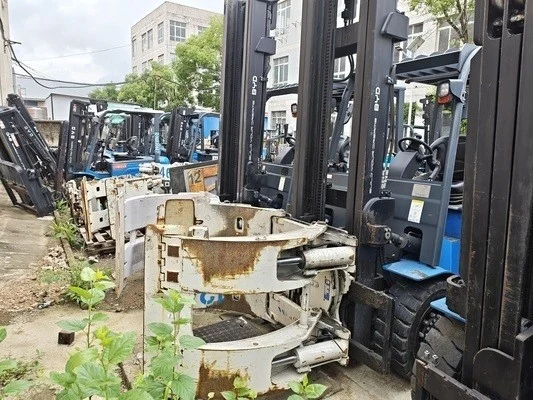
Attachments change more than capacity. They add weight ahead of the carriage, alter overall dimensions, and demand hydraulic flow and pressure that the base truck may not provide. A side-shifting fork positioner, a carton clamp, or a bale clamp each imposes its own mounting pattern and hydraulic requirements.
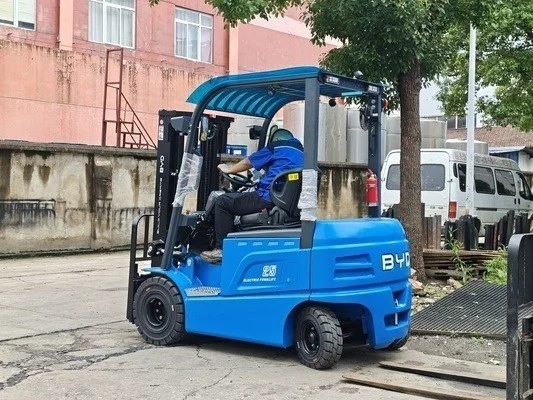
Ask whether the attachment is approved with the specific mast and carriage on the quoted four-wheel counterbalance electric forklift, and whether the hydraulic system includes the valves and lines the attachment needs. Confirm mounting class and carriage width, and ask who is responsible for installation and any warranty implications. Where the supplier cannot confirm compatibility in writing, the configuration remains unverified.
Attachment checklist
- Attachment model, weight, and mounting class, matched to the truck’s carriage.
- Required hydraulic flow, pressure, and number of functions, compared with the quoted truck’s auxiliary hydraulics.
- Effect on residual capacity at your load center, documented by the supplier.
- Added dimensions that affect aisle width, doorways, and overhead clearance.
- Installation responsibility, commissioning checks, and operator familiarization.
Site Conditions That Modify the Rating
Load center and attachments are only part of the picture. Ground conditions, ramps, aisle width, lift height, and duty cycle all influence whether a given configuration suits the task. A truck rated adequately on flat concrete may need a different configuration on a slope or on uneven surfaces, and a high-lift application may require a mast and capacity combination that differs from a low-stack duty.
Provide the supplier with aisle widths, doorway and overhead clearances, floor condition, ramp gradients, and the number of shifts and lifts per shift. These details let the supplier check the proposed truck against the actual duty rather than a generic assumption. Where data is missing, mark it as a point to confirm rather than accepting an estimate.
| Item to verify | Why it matters | Document to request |
|---|---|---|
| Load center and rated capacity | Determines safe load weight | Data sheet or capacity chart |
| Attachment weight and mounting | Reduces residual capacity and changes dimensions | Attachment specification and approval note |
| Hydraulic flow and pressure | Ensures attachment functions correctly | Quoted hydraulic configuration |
| Aisle and overhead clearance | Confirms the truck can operate and lift | Site layout drawing |
| Battery and charging plan | Supports the planned shift pattern | Charging requirements from supplier |
Acceptance Checks and Common Ordering Mistakes
Before accepting delivery, compare the data plate and capacity chart with the ordered configuration, confirm the attachment is the approved model, and check that hydraulic functions operate as specified. Ask the supplier to walk through the residual capacity at your load center so operators understand the limits. Record any deviation from the order in writing.
Common mistakes include ordering an attachment after the truck is specified without revisiting capacity, using a capacity figure that applies to a different load center, and assuming a higher lift height carries the same rating. Each of these can leave a new truck unable to handle its intended loads.
If you are evaluating a four-wheel counterbalance electric forklift, share your load weights, dimensions, lift height, aisle widths, and attachment plans with the supplier so the quoted capacity, mast, and hydraulics can be checked against your real duty. Ask for the supporting charts in writing before you place the order.
Frequently Asked Questions
Does adding an attachment always reduce capacity?
Attachments generally add weight ahead of the carriage and move the load forward, which reduces residual capacity. The exact effect depends on the attachment and must be confirmed by the supplier against your load center and lift height.
Can I use the data plate rating at any lift height?
No. The rating applies at the load center and lift height stated on the plate or chart. Higher lift heights and deeper loads may require a lower capacity, which should be documented rather than assumed.
What should I send with a request quotation?
Provide load weights and dimensions, estimated load center, required lift height, aisle widths, floor and ramp conditions, shift pattern, attachment plans, and charging arrangements. These details let the supplier verify capacity and configuration.
Who confirms attachment compatibility?
Compatibility should be confirmed in writing by the truck supplier or attachment maker, covering mounting class, hydraulic requirements, and any capacity change. Verbal confirmation is not enough evidence to order.