Addressing Counterbalance Forklift Mast Misalignment: Causes and Corrective Adjustments
News 16/10/2026
Counterbalance forklift mast misalignment creates multiple safety and operational issues, including uneven load handling, accelerated component wear, and increased risk of load shift. Proper diagnosis and correction keep operations safe and extend equipment service life. This guide walks through common causes, diagnostic steps, and proven adjustment methods.
Common Causes Of Mast Misalignment
Misalignment rarely develops overnight. Most issues build gradually over time from repeated stress or unnoticed damage. Key causes include the following:
Worn Moving Components
Mast systems rely on roller guide blocks, lift chains, and sliding rails to maintain smooth movement. Over time, guide blocks wear down from constant friction, creating excess play that shifts carriage position. Lift chains stretch unevenly with use, pulling the carriage off center as the mast moves up or down.
Impact Damage
Collisions with loading dock edges, racking, or other site obstacles can bend mast rails or shift mounting points. Even minor impacts that do not stop operation can create permanent misalignment that worsens with regular use.
Chronic Off-Center Loading
Consistent lifting of loads positioned off center pulls the mast gradually out of alignment. Repeated uneven stress stretches components and loosens mounting bolts faster than normal operation.
Incorrect Prior Adjustments
Incomplete or inaccurate past adjustments leave the mast off center from the start. Improper tension adjustment on lift chains is one common source of persistent misalignment.
Pre-Adjustment Diagnostic Steps
Before making adjustments, confirm the location and severity of misalignment with these ordered steps:
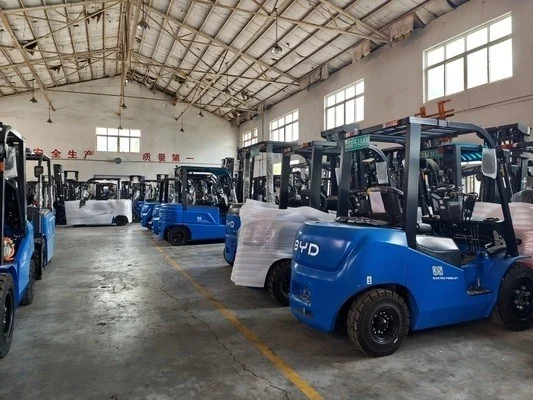
- Park the counterbalance forklift on a flat, level concrete surface. Fully lower the forks, set the parking brake, and disconnect power to prevent unexpected movement.
- Clean all mast rails and visible components to remove dirt, grease, and debris that can block accurate measurements.
- Measure gap between the mast carriage and each side rail at multiple points: top, middle, and full lower position. Record all measurements to identify deviation.
- Inspect all mounting bolts, chain anchors, and guide blocks for visible damage or loose connections.
- Mark areas with the largest deviation to target during adjustment.
This process helps you avoid unnecessary adjustments and focus on areas that actually need correction.
Corrective Adjustment Procedures
Adjustment steps vary slightly across counterbalance forklift models, but core processes align across most equipment. Always reference your specific equipment manufacturer guidelines before starting work.
Even Out Lift Chain Tension
Uneven chain tension is the most common cause of minor misalignment. To correct: loosen the adjustment nuts on each chain end, adjust tension so both chains carry equal load when the carriage is in the lower position, then retighten locking nuts. Move the mast up and down three full cycles, then recheck tension to confirm it stays balanced.
Adjust Guide Rail Position
If misalignment stems from shifted guide rails, loosen the mounting bolts that secure the rails to the main mast frame. Shift the rail position to match the gap measurement you recorded during diagnostics, then torque the bolts to the manufacturer specified value. Recheck gap after tightening to confirm the shift stays in place.
Post-Adjustment Verification
After adjustments are complete, move the mast through its full range of motion five times. Stop at multiple points to remeasure gaps on both sides. Confirm the carriage moves smoothly without binding or pulling to one side. If deviation remains within acceptable manufacturer limits, the adjustment is complete.
When To Replace Components Instead Adjusting
Adjustments only correct misalignment caused by wear or loose connections. In some cases, replacement becomes the only safe option:
- Mast rails show permanent bending or deformation that cannot be corrected through positional adjustment
- Lift chains stretch beyond the maximum adjustment limits listed in manufacturer documentation
- Guide blocks wear down past their minimum allowable thickness, so no positional adjustment can eliminate excess play
- Mounting points on the main mast frame suffer damage that prevents secure holding of guide rails
Attempting to compensate for damaged components through over-adjustment creates safety risks and further damage to surrounding parts.
Frequently Asked Questions
Can I operate a counterbalance forklift with minor mast misalignment?
Even minor misalignment accelerates wear on mast components, tires, and lift cylinders. It also reduces load control accuracy, increasing accident risk. Address any detectable misalignment as soon as you identify it.
How often should I check mast alignment?
Include alignment checks within your routine preventive maintenance schedule. Most operations complete checks after every 100 to 200 hours operation, or immediately after any impact involving the mast.
Do I need special tools to check mast alignment?
Basic checks can use a straight edge and tape measure. High precision diagnostics rely on laser alignment tools, which deliver more accurate measurements. Always follow your equipment manufacturer guidelines on tool selection.
Regular alignment checks and timely adjustments keep your counterbalance forklift operating safely and reduce long term maintenance costs. Always confirm all work aligns with your equipment manufacturer specifications before putting the truck back into service.