Four-Wheel Counterbalance Electric Forklift Spec Sheet Review: Which Load, Lift and Battery Details Deserve Engineering Sign-Off
News 09/11/2026
A counterbalance forklift spec sheet is a sales document and an engineering document at the same time, and the two purposes do not always agree. Load charts, lift heights and battery data often appear as single headline numbers, while the conditions behind those numbers sit in footnotes or are missing entirely. This review walks through the figures that deserve a formal engineering sign-off before a four-wheel counterbalance electric forklift is approved, and it separates what a spec sheet normally states from what must be confirmed against the manufacturer’s technical file.
The working assumption throughout is a general warehouse and factory context: palletized goods, racking or truck-bed loading, mixed shift patterns and an indoor charging area. The same method applies to food, cold-store and logistics operations once the duty cycle is defined.
Start With the Load Chart, Not the Rated Capacity
Every four-wheel counterbalance electric forklift carries a rated capacity, usually quoted at a defined load center and lift height. That single figure is the least useful number on the page until the load chart is checked. The chart shows how capacity falls as the load center moves forward and as the forks rise, and it is the chart, not the headline rating, that governs whether a given pallet can be lifted safely.
Questions the chart must answer
- At what load center and lift height is the rated capacity declared?
- What residual capacity remains at the maximum lift height actually needed?
- How does capacity change when an attachment such as a side-shifter, clamp or fork extension is fitted?
- Does the chart cover the actual mast type and fork length ordered?
Attachments are a common source of error. A side-shifter moves the load forward of the carriage, and that horizontal offset reduces usable capacity. The spec sheet may list the attachment as an option without restating the derated capacity. Engineering sign-off should require the manufacturer’s derated load chart that matches the exact configuration on the purchase order.
This is also where the application must be measured, not estimated. Record the heaviest pallet, its center of gravity, the highest shelf or truck bed the forks must reach, and the fork length required to pick it up cleanly. A four-wheel counterbalance electric forklift that handles the average pallet may still be marginal on the heaviest one at full height.
Lift Height, Mast and Dimensional Fit
Lift height is usually quoted as maximum fork height, but the number that matters is the height at which the load can still be handled within the load chart. A mast that reaches a given height does not automatically carry rated capacity to that height. Confirm both figures together.
Dimensions that decide whether the truck fits
- Overall lowered height: must clear doorways, lift gates and mezzanine entries on the route.
- Extended height: must clear overhead sprinklers, lights, beams and racking cross-members.
- Right-angle stacking aisle: depends on load length, fork length and the truck’s turning radius; measure the tightest aisle on the actual route.
- Free lift: matters where the mast must enter a trailer or low-clearance area before the forks rise.
Ground conditions belong in this section as well. Floor flatness, slope at ramps and dock levellers, and the presence of expansion joints all affect how a counterbalance forklift behaves under load. The spec sheet rarely states a permitted floor gradient, so ask the supplier what the manufacturer specifies and treat any unverified slope as a reason to request written confirmation.
Battery, Charger and Duty Cycle Data
Battery information is where spec sheets most often become vague. A lithium battery may be described by voltage and nominal capacity, but the usable energy, the discharge limits set by the battery management system and the charging profile determine what the truck can do across a shift.
What to verify before approval
- Battery voltage and capacity: confirm they match the truck’s motor and controller specification.
- Charging method: establish whether opportunity charging, full-shift charging or battery exchange is intended, and whether the charger supplied supports that pattern.
- Charging time and available power: check the site’s electrical supply against the charger’s input requirements; this is a facilities question as much as a truck question.
- Operating temperature range: confirm the manufacturer’s stated limits for the truck and battery, including charging and storage, rather than assuming a figure.
- BMS behaviour: ask how the system limits power or charging at temperature extremes and what warnings the operator sees.
Duty cycle is the bridge between battery data and real work. Estimate the number of pallet moves per shift, average lift height, travel distance and the proportion of time spent lifting versus travelling. Without that estimate, any claim about a battery lasting a full shift is unverifiable. Where the shift pattern is demanding, discuss a charging schedule or a second battery arrangement with the supplier rather than relying on a headline run-time figure.
Spec Sheet Review Table: What to Confirm and How
The table below groups the parameters that most often need written confirmation. It does not list values, because those must come from the manufacturer’s technical documentation the specific truck and configuration.
| Parameter | Risk if unclear | What to request | Configuration note |
|---|---|---|---|
| Rated capacity and load chart | Overloading at height or with attachments | Load chart matching the ordered mast, forks and attachment | Attachment derating must be stated explicitly |
| Lift height and free lift | Truck cannot reach shelf or trailer safely | Maximum fork height with residual capacity; free-lift figure | Mast type affects both figures |
| Aisle and turning dimensions | Truck cannot manoeuvre in the tightest aisle | Right-angle stacking aisle and turning radius | Depends on load and fork length |
| Battery and charger | Shift cannot be completed; charger incompatible with site power | Voltage, capacity, charge profile, input power requirement | Charging strategy is a site decision |
| Temperature limits | Operation outside the validated range | Stated operating, storage and charging ranges | Cold-store or outdoor use needs specific confirmation |
| Tyres, brakes and floor | Poor traction or stopping distance on the actual surface | Recommended tyre type and brake specification the floor and slope | Wet or smooth floors change the choice |
Treat every row as a question to the supplier, not as a specification you can assume. Standard-fit, optional and factory-confirmed items should be identified separately on the quotation so that nothing is approved on the basis of a brochure default.
Sign-Off Checklist and Common Mistakes
A practical sign-off record should tie each critical figure to a document. Before approving a four-wheel counterbalance electric forklift, assemble the following:
- Measured load data: heaviest pallet, load center, required lift height and fork length.
- The manufacturer’s load chart the exact mast and attachment combination.
- Route survey: aisle widths, door and overhead clearances, ramp gradients and floor condition.
- Shift profile: moves per shift, travel distance, lift frequency and charging windows.
- Site electrical capacity and charger location, checked against the charger’s requirements.
- Written temperature limits the truck, battery and charger, if the site operates outside normal indoor conditions.
Common mistakes repeat across projects. Buyers compare headline capacity without reading the load chart. They approve a mast height without checking extended height against sprinklers. They accept a battery run-time claim without a duty-cycle estimate. They assume an attachment is included in the rated capacity. They also treat aisle width as a building fact rather than a measured constraint that includes the load overhang.
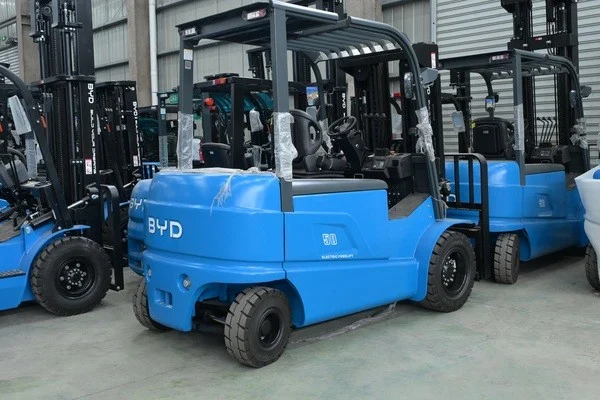
Where a requirement falls outside what a four-wheel counterbalance electric forklift can reasonably do, such as an extremely narrow aisle or a lift height beyond the model’s validated chart, the honest answer is to revisit the layout or the handling method rather than to force the truck into the task. Our sales scope covers BYD four-wheel counterbalance electric forklifts, including lithium-battery models; sharing your actual loads, lift heights, aisle dimensions and shift pattern lets us check which configuration fits and which details still need factory confirmation.
Frequently Asked Questions
Is rated capacity the same as the load I can lift at full height?
No. Rated capacity is declared at a specific load center and lift height. Capacity typically decreases as the load center moves forward and as lift height increases, so the load chart the ordered configuration is the controlling document.
How do I check whether the battery suits my shift?
Estimate the number of moves, average lift height, travel distance and available charging windows, then ask the supplier to confirm the battery and charger combination against that profile. Without a duty-cycle estimate, run-time statements cannot be verified.
Can I use the truck in a cold store?
Only within the temperature limits the manufacturer states the truck, battery and charger. Cold environments affect usable battery capacity, charging and hydraulic behaviour, so request written confirmation of the operating, storage and charging ranges before approval.
What should I send a supplier to get an accurate proposal?
Provide the heaviest pallet and its dimensions, required lift height, aisle widths, floor and ramp conditions, shift pattern, charging arrangements and any attachment needs. These details let the supplier match a configuration and flag the items that require factory verification.