Electric Forklift Procurement: Verifying Counterbalance Load Charts Against Actual Warehouse Attachment Use
News 09/11/2026
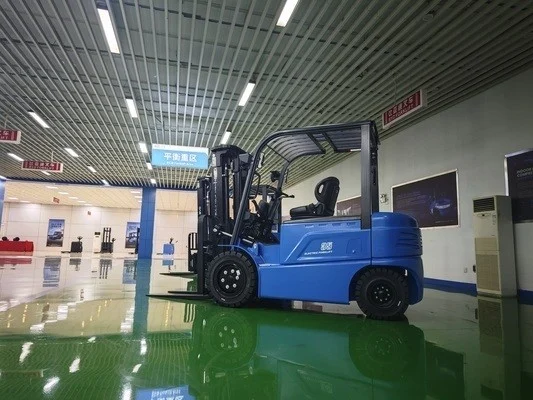
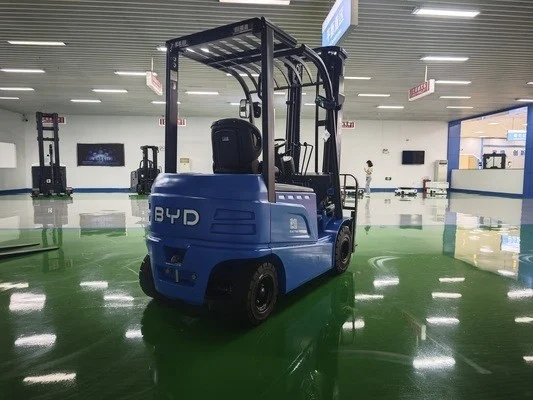
Warehouse teams often discover a gap between the rated capacity printed on a four-wheel counterbalance electric forklift load chart and the load the truck can safely handle once an attachment is fitted. A load chart describes the bare carriage configuration under defined test conditions. An attachment adds weight and shifts the load center forward, so the capacity that applies on paper usually does not apply to the working truck. This procurement guide explains what to request, what to verify, and what to confirm before placing an order. It focuses on four-wheel counterbalance electric forklifts, the configuration this site supplies.
Why a Bare-Carriage Load Chart Does Not Cover Attachment Use
A load chart is a family of capacity values plotted against load center distance and lift height. The figures assume a defined carriage, fork position, and stability condition. When a clamp, push-pull, rotator, or fork positioner is mounted, two things change: the attachment has its own mass, and it moves the effective load center further from the carriage face.
The result is a derating. Most attachment makers publish a capacity rating that is lower than the truck rating, and the combined system capacity must be calculated with the attachment data, not guessed. Two numbers matter most:
- Attachment weight — treated as load carried at the carriage, reducing residual capacity.
- Lost load center — the horizontal distance the attachment adds, which pushes the combined center of gravity forward.
If a supplier cannot provide both values in writing, the load chart cannot be reconciled with the real application. That is a documentation gap to resolve before purchase, not after delivery.
Documents and Data to Request During Inquiry
A credible inquiry package lets the supplier match a truck configuration to your task. Ask for the following items and check that they refer to the same model and attachment combination.
Load chart and derating data
Request the load chart at the actual load center and lift height you plan to use, plus the attachment manufacturer’s capacity rating, weight, and lost load center. Confirm the chart is valid with the attachment installed, not only with a bare carriage.
Attachment interface details
Confirm the carriage class, fork spacing, hydraulic flow and pressure requirements, and whether an additional hydraulic function is needed. A four-wheel counterbalance electric forklift with the wrong valve or flow setting may not operate the attachment as intended, so these details belong in the technical requirements.
Site conditions that affect the rating
Provide the heaviest load, its dimensions, the required lift height, the load center you actually expect, aisle width, floor surface, and any ramps. These inputs determine whether the derated capacity still covers the job. Where a parameter is uncertain, state it as an assumption so the supplier can confirm it.
Battery and shift information
Describe shift length, charging window, and available charging infrastructure. Battery and charger specifications should come from the manufacturer’s technical documentation, not from estimates. Ask how the chosen battery configuration supports the planned duty cycle.
Acceptance Checks and Open Questions Before Ordering
Verification continues after the quotation arrives. Use the following checks to close gaps.
| Check | What to confirm |
|---|---|
| Rated capacity with attachment | The derated value at your load center and lift height, in writing |
| Attachment compatibility | Carriage class, hydraulic flow and pressure, mounting |
| Stability conditions | Floor, slope, and aisle assumptions used in the rating |
| Documentation set | Load chart, attachment data sheet, battery and charger specifications |
| Acceptance test | Agreed method to verify capacity and attachment function at handover |
Three questions are commonly left open and should be answered before signing:
- Does the quoted capacity already include the attachment, or must it be derated further?
- Which load center and lift height were used to produce the quoted figure?
- What happens to capacity if the attachment is changed later?
An honest answer may be that a specific combination needs confirmation from the attachment maker. Treat that as a normal step, not a failure. Avoid accepting verbal assurances that a truck “will handle it” without a documented rating.
To move a decision forward, share your actual load, lift height, attachment type, aisle width, floor and ramp conditions, and shift pattern. With those inputs, this site can help match a four-wheel counterbalance electric forklift configuration and identify which parameters still need confirmation.
Frequently Asked Questions
Can I use the forklift’s published capacity when an attachment is fitted?
Not directly. The published figure assumes a defined bare-carriage condition. Attachment weight and added load center reduce the usable capacity, and the combined value must be calculated from the attachment maker’s data.
What is the load center, and why does it change?
Load center is the horizontal distance from the carriage face to the load’s center of gravity. An attachment moves that point forward, which reduces capacity at a given lift height.
Which documents should accompany a quotation?
Ask for the load chart at your working load center and lift height, the attachment capacity rating and weight, hydraulic requirements, and battery and charger specifications from the manufacturer’s technical资料. Each should identify the exact model and configuration.
How should capacity be verified at handover?
Agree the test method in advance: the load to be used, the lift height, and how attachment function will be checked. Record the result against the documented rating rather than relying on a visual assessment.