How Different Forklifts Type Impact Warehouse Storage Density And Overall Operational Throughput
News 16/10/2026
Different forklift designs bring unique capabilities that directly alter your warehouse storage density and overall operational throughput. Choosing equipment that misaligns with your facility goals can leave you with wasted space or slow inventory movement that cuts into your operational efficiency. Below we break down core impacts across common forklift categories.
Core Impacts Of Forklift Design On Storage Density
Storage density depends heavily on aisle width required for safe forklift operation. Each forklift type has specific space requirements that shape how many storage racks your facility can accommodate:
- Counterbalance forklifts: Most standard counterbalance models require aisles between 3 and 3.5 meters wide to turn and maneuver safely. This wider requirement reduces the total number of storage racks you can install across your warehouse floor.
- Narrow aisle reach trucks: These designs cut required aisle width to 2 to 2.5 meters, opening up extra floor space that you can use to add 10 to 15 percent more storage positions than you can get with standard counterbalance models. They work well with medium-height racking common in most distribution centers.
- Very Narrow Aisle (VNA) turret trucks: These specialized units operate in aisles as narrow as 1.5 meters, and handle racking heights up to 15 meters or more. This design unlocks the highest possible storage density for enclosed warehouses, letting you maximize vertical and horizontal space use.
- Pallet jacks: Manual and powered pallet jacks require the least aisle width, but they only handle low-level storage. They support high-density ground storage, but cannot reach vertical racking space most warehouses use to expand capacity.
Your facility layout also interacts with forklift space requirements. Existing pillars, dock positions and office space can reduce available storage even if you choose a narrow aisle forklift design.
How Forklift Type Shapes Operational Throughput
Operational throughput measures how much inventory your team can move through your warehouse within a given time frame. Forklift design directly impacts throughput through travel speed, maneuverability, load capacity and task suitability:
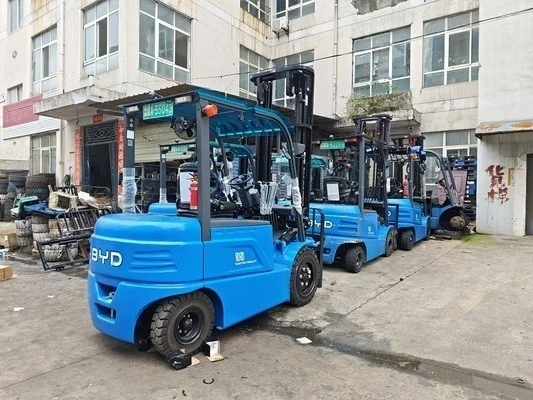
Standard counterbalance forklifts move at higher top speeds than most narrow aisle specialized models. They handle heavy, bulky loads easily, and work across both indoor storage areas and outdoor yard space. Their wider aisle requirement means longer travel distances between storage positions and docks, which adds time to each inventory cycle and slows overall throughput in large facilities.
Narrow aisle reach trucks balance storage density and throughput. They have faster travel speeds than VNA turret trucks, and handle the medium-height racking common in most e-commerce and retail distribution centers. Stand-on rider reach trucks cut cycle time further, as operators can mount and dismount quickly during repetitive picking tasks.
VNA turret trucks deliver maximum storage density, but their lower top travel speeds and specialized maneuvering requirements reduce hourly throughput. These units rely on guide rails or wire guidance systems to navigate narrow aisles, which adds small amounts of time to each movement that adds up across a full work day.
Hand pallet jacks have the lowest throughput, as they rely on operator power or limited motor capacity to move loads. They work well for small-scale loading and unloading, but cannot support high-volume inventory movement.
Frequently Asked Questions
Which forklift type gives the highest possible storage density?
Very Narrow Aisle (VNA) turret trucks deliver the highest storage density for enclosed warehouses with vertical racking. They operate in extremely narrow aisles and reach extreme racking heights, unlocking maximum use of available warehouse space.
Can increasing storage density reduce my warehouse operational throughput?
Yes, most designs that boost storage density require specialized forklifts with slower travel speeds and more maneuvering steps per load. This tradeoff means you need to balance your storage needs and your throughput requirements when selecting equipment.
Do powertrain types affect storage density and throughput?
Internal combustion forklifts have larger frame sizes and require ventilation in enclosed spaces, so they typically need wider aisles than comparable electric models. This requirement reduces overall storage density. Electric models offer more compact designs that fit into narrower aisles, supporting higher storage density and consistent indoor operation.
When selecting a forklift, map your facility aisle dimensions, maximum storage height and daily inventory volume to narrow down options that match both your storage and throughput goals.