Electric Forklift UK Selection: Confirming Counterweight Clearance And Service Access Around Your Loading Bay
News 10/11/2026
Choosing an electric forklift in the UK often starts with load charts and battery questions, but the decision that stops a delivery is usually physical. A four-wheel counterbalance electric forklift must fit the apron, turn inside the yard, clear the door, and still leave enough room around the truck and racking to work safely. This guide explains how to confirm counterweight clearance and service access around a loading bay before you commit to a model, and which measurements to bring to a supplier discussion.
Why the Counterweight and Tail Swing Decide Bay Fit
A counterbalance truck carries its battery and counterweight behind the drive axle. That rear mass is what lets the truck lift a load in front, but it also means the machine is longer than its load centre suggests. When the truck turns, the rear end sweeps outward. In a tight loading bay, that sweep is the dimension that catches barriers, roller shutters, racking uprights and parked trailers.
Manufacturers publish dimensions that help you check this, typically including overall length to the face of the forks, overall width, turning radius and right-angle stacking aisle. Treat these as design figures measured under defined conditions, not as a guarantee that your bay will work. The practical check is to combine the published turning radius with the actual clearances on site, then add a working margin. A truck that only just fits leaves no room to correct a misjudged approach.
Three measurements matter most:
- Apron depth and width: the space between the dock face and the first obstruction behind the truck.
- Rear clearance at full turn: the distance the counterweight needs as the truck pivots.
- Door and threshold geometry: clear opening width and height, plus any ramp or lip at the entrance.
If the bay is shared with trailers, pedestrians or parked vehicles, the usable turning space is smaller than the drawn dimensions. Confirm how the area is actually used across a full shift, not only at its emptiest.
Survey the Loading Bay Before Comparing Models
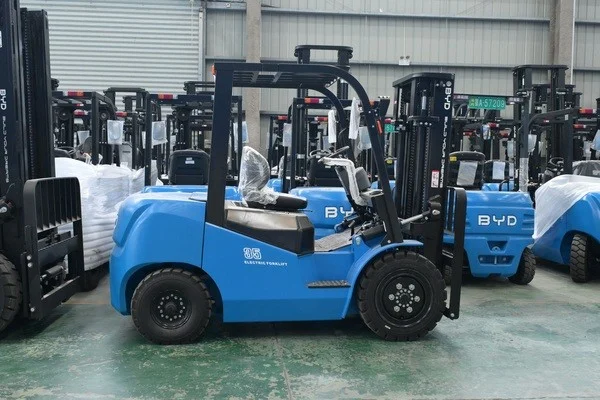
A reliable selection starts with a site survey rather than a brochure. Walk the bay with a tape measure and record conditions that change through the day. The aim is a short list of hard constraints that any candidate four-wheel counterbalance electric forklift must meet.
Measurements to record
- Clear opening width and height of every door the truck will pass through.
- Apron depth from dock face to the nearest wall, rack, gate or bollard.
- Available aisle width where the truck will turn or stack.
- Floor condition, including joints, drains, slopes and any change in level.
- Dock leveller type and rated capacity, if one is installed.
- Overhead obstructions such as pipework, lighting, shutters and sprinkler heads.
Conditions that are easy to miss
Floor loading deserves attention in older UK industrial units. A loaded electric truck concentrates weight on a small contact area, and mezzanine or suspended slabs may have limits that are not obvious. Ask the building owner or a structural professional when the slab condition is uncertain. Similarly, check whether the bay floods, whether grit enters from the yard, and whether the truck will work in a cold store or a damp external canopy, since these affect both traction and battery choice.
Traffic patterns also shape the answer. A bay where trucks reverse out into a shared yard needs more rear visibility and clearance than one with a one-way flow. Record where pedestrians walk, where trailers park, and whether the area is lit well enough to see the counterweight corner at night.
Service Access: Space to Maintain and Charge
Clearance is not only about driving. An electric truck needs space beside and above it for checks, battery care and, where applicable, battery exchange. Plan this at the selection stage, because a bay that works for operation can still fail at maintenance time.
Daily checks and walk-around space
Operators need room to inspect tyres, hydraulic hoses, the mast, chains and the overhead guard before each shift. A truck parked tight against a wall or racking makes these checks awkward and encourages shortcuts. Leave a clear walkway on at least one side and enough headroom to raise the mast or reach service points safely.
Charging and battery handling
Charging position affects bay layout. A lithium-ion truck can often be opportunity-charged during breaks, which may reduce the need for a dedicated battery room, but the charger still needs a suitable power supply, ventilation and protection from impact. Confirm the supply capacity and cable route with an electrician. If the site plans battery exchange instead, allow space and lifting provision that the supplier specifies. Do not assume a charging arrangement is acceptable until the manufacturer’s instructions and local electrical requirements have been checked.
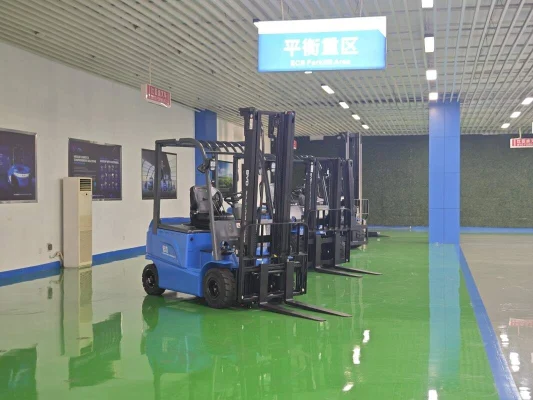
Access to service points
Ask the supplier which panels, filters and connections need routine attention and how much clearance each requires. This is a specification question, not a guess. The answer determines whether the truck can be serviced in place or must be moved to a workshop, which affects downtime and cost.
Turning Clearance, Load Centre and Configuration Choices
Published capacity figures assume a stated load centre, usually the distance from the fork face to the load’s centre of gravity. A load that sits further forward reduces the capacity the truck can safely handle. Before comparing models, confirm the actual load centre of the pallets and stillages you move, then check the capacity at that load centre and at the lift height you need. A truck rated highly at ground level may carry less at full mast height.
Configuration choices can improve bay fit, but each has limits:
| Choice | What it can help with | What to confirm |
|---|---|---|
| Shorter wheelbase or compact chassis | Tighter turning in constrained aprons | Stability, capacity at load centre, ride over uneven floors |
| Higher or lower mast | Door and overhead clearance | Free lift, collapsed height, capacity at height |
| Tyres and floor protection | Traction and floor condition | Indoor or outdoor use, surface type, load rating |
| Battery type and capacity | Shift length and charging routine | Duty cycle, charging supply, replacement plan |
No single change solves every constraint. A compact truck may turn more easily but carry less at a long load centre; a taller mast may clear a door but raise the collapsed height. Set your priorities before comparing options, and ask the supplier to confirm that the proposed configuration meets the capacity you need at the height and load centre you actually use.
When you contact a supplier, share the bay measurements, the load weights and centres, the lift height, the floor and slope conditions, the shift pattern and the charging supply. Those details let the supplier propose a realistic four-wheel counterbalance electric forklift configuration rather than a generic model. If a proposed machine appears to fit only by ignoring one constraint, ask which assumption is being made.
Frequently Asked Questions
How much rear clearance should I allow when a truck turns in the bay?
Start with the manufacturer’s turning radius and add a working margin that reflects how the bay is used. Published figures describe defined test conditions, so measure the actual sweep on site or ask the supplier to confirm the rear clearance at full turn. Where pedestrians or parked trailers share the space, allow more.
Can a standard electric counterbalance truck work in a small UK loading bay?
Sometimes, but the bay dimensions decide it. Apron depth, door opening, aisle width and rear sweep all need checking against the truck’s published figures. A compact configuration may help, but confirm the resulting capacity at your load centre and lift height before accepting it.
What service access should I plan around the charging point?
Allow space to park, connect and disconnect safely, protect the charger from impact, and confirm the electrical supply with a qualified electrician. Check the manufacturer’s ventilation and installation instructions. If battery exchange is planned, include the lifting and handling space the supplier specifies.
Does a lithium battery change the bay layout requirements?
It can change the charging routine, since opportunity charging may reduce the need to remove batteries. It does not remove the need to check the charger location, power supply, ventilation and impact protection. Confirm the details against the manufacturer’s technical information and your site’s electrical arrangements.