What Types of Forklifts Are There: Matching Battery Capacity and Charging Strategy to Multi-Shift Four-Wheel Counterbalance Electric Forklift Work
News 07/11/2026
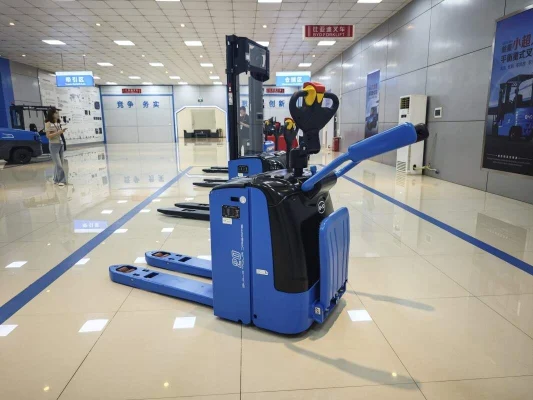
When buyers ask what types of forklifts are there, the answer usually starts with the chassis class: warehouse equipment such as reach trucks and pallet movers, and counterbalance trucks that carry a load outside the front wheels. This article focuses on the four-wheel counterbalance electric forklift, the general-purpose class many factories and loading docks rely on, and on the decision that most often limits multi-shift operation: how battery capacity and charging strategy fit the duty cycle. The central point is simple: a truck that runs three shifts cannot be specified from a single-shift energy estimate. You need the energy drawn per shift, the time available to recharge, and the battery and charger combination that keeps the truck working without over-discharging.
Where Four-Wheel Counterbalance Electric Trucks Fit
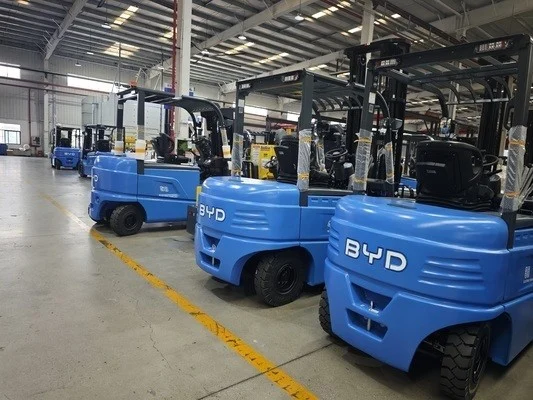
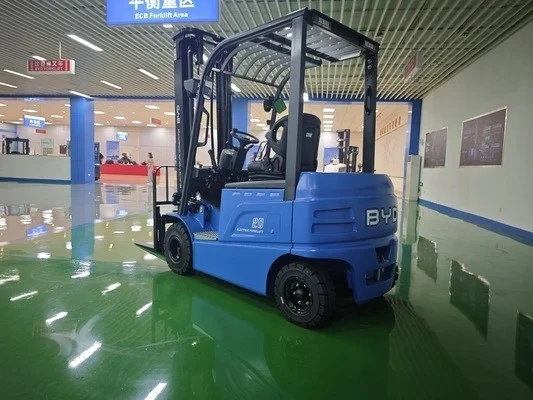
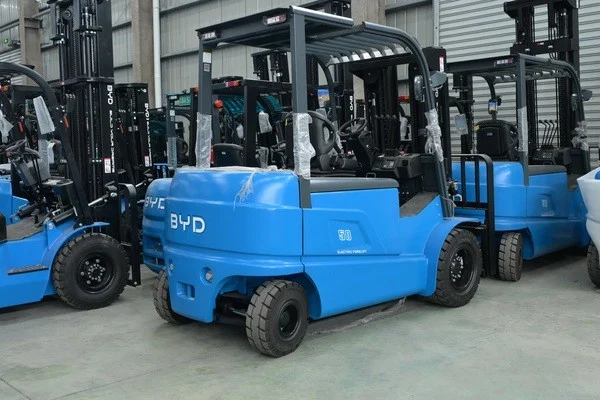
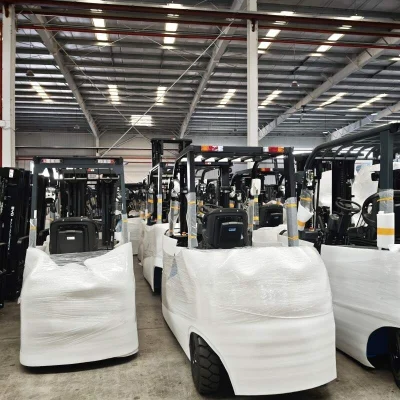
A four-wheel counterbalance electric forklift uses a counterweight behind the rear axle to balance a load carried on forks ahead of the front wheels. That layout lets it pick up a load from the floor, lift it to a rack or trailer bed, and travel with it. Four-wheel models are commonly considered where the ground is firm and level, aisles are wide enough to turn, and the load is handled at moderate heights. Typical work includes trailer loading and unloading, moving pallets between production and storage, and feeding lines.
This class is not a universal answer. Narrow aisles, very high racking, and tasks that are purely horizontal transport at floor level may suit other equipment better. The practical check is the operating envelope: rated load at the actual load center, required lift height, aisle width, floor condition, ramp grades, and the number of hours the truck must run between charges. Ask the supplier to confirm each of these against the specific model rather than a generic class description.
Battery Capacity: Start With Energy per Shift, Not Amp-Hours Alone
Battery capacity is often quoted in amp-hours and voltage, but those figures only become meaningful when paired with the load they must support. A larger amp-hour rating stores more energy at a given voltage, yet the usable energy depends on the discharge limit the manufacturer sets and on how deeply the battery is allowed to cycle. Two batteries with the same nominal capacity can behave differently if one is routinely discharged below its recommended state of charge.
Estimate demand from the work itself. Record the load weight, lift height, travel distance, number of lifts per hour, and shift length. Acceleration, lifting, and climbing ramps draw more current than steady travel. A truck that lifts heavy loads to height all shift will draw more energy than one that moves light pallets along a flat floor, even if both run the same hours. Without measured data, treat any estimate as provisional and confirm it with the supplier using your actual duty cycle.
Questions to bring to a battery sizing discussion
- What is the rated capacity at the load center you actually use, not only at the standard rating point?
- How many hours per shift, and how many shifts per day, must the truck operate?
- What is the maximum lift height and the average lift height?
- Are there ramps, dock plates, or uneven surfaces on the route?
- What ambient temperature range applies in the warehouse and at the charging area?
- How long is the window between shifts when the truck can be charged?
Charging Strategy: Matching Recharge Time to the Shift Pattern
Charging strategy is the second half of the decision, and it is often where multi-shift plans fail. Three broad approaches are common, and each has conditions attached.
| Strategy | How it works | Conditions and limits |
|---|---|---|
| Conventional full charge between shifts | The truck is parked and charged during a long break or overnight | Requires a charging window at least as long as the charger and battery allow; one battery per truck is typical |
| Opportunity charging | Short charges during breaks, lunch, and idle periods | Needs a charger near the work area and a battery and charger rated to accept frequent partial charges; confirm this with the supplier |
| Battery exchange | A depleted battery is swapped for a charged one | Requires spare batteries, lifting or exchange equipment, and space; adds handling steps |
Lithium-ion batteries are often chosen where opportunity charging is planned, because they generally tolerate partial charging better than some older battery chemistries. That is a general material characteristic, not a guarantee about any specific product. The charger, the battery management system, and the manufacturer’s instructions determine what is actually permitted. Confirm charging current, connector type, ventilation, and the temperature range the battery and charger are rated to handle.
An illustrative scenario, not a case study
Suppose a distribution operation runs three eight-hour shifts and wants one four-wheel counterbalance electric forklift to cover all three. The truck handles mixed pallets, lifts to racking, and travels a moderate distance. A single battery charged only overnight would not fit this pattern. The realistic options are opportunity charging during breaks, if the battery and charger are rated to accept it, or a spare battery exchange plan. Which one is cheaper depends on the charging window, the cost of a spare battery, and the space available. These figures must come from the supplier and the site survey, not from a rule of thumb.
Common Specification Mistakes
Most multi-shift problems trace back to a few recurring errors.
- Sizing from one shift. Energy demand is multiplied by the number of shifts, but charging time is not. A battery that finishes one shift comfortably may not complete three without a charging plan.
- Ignoring the load center. Rated capacity falls as the load center moves forward. A truck rated at a nominal figure may not safely lift the same weight on a longer load or at full height.
- Assuming any charger works. Voltage, current, connector, and communication between charger and battery must match. A mismatched charger can be unsafe or can void support.
- Forgetting the charging location. Charging areas need ventilation, suitable power supply, and clearance. A plan that ignores this can stall at installation.
- Treating battery life as a fixed number. Cycle life depends on depth of discharge, temperature, and charging habits. Ask what conditions the manufacturer’s figures assume.
Frequently Asked Questions
Can one four-wheel counterbalance electric forklift cover three shifts?
It can, if the battery and charging plan match the duty cycle. That usually means either opportunity charging with equipment rated to accept frequent partial charges, or a battery exchange arrangement. The decision needs the energy demand per shift and the available charging windows, both confirmed against manufacturer data.
Is a larger battery always the better choice?
Not automatically. A larger battery stores more energy, but it also adds weight and cost, and the truck’s compartment must accept it. The right size follows from measured or supplier-confirmed energy demand, not from choosing the largest option available.
Does opportunity charging shorten battery life?
It depends on the battery chemistry and the manufacturer’s instructions. Partial charging is generally more acceptable with lithium-ion than with some older types, but depth of discharge, temperature, and charger settings all affect service life. Ask the supplier what charging pattern their warranty and guidance assume.
What information should I provide when requesting a configuration?
Share the load weight and load center, maximum and average lift height, aisle width, floor and ramp conditions, shift pattern, charging window, and ambient temperature range. With those details, a supplier can propose a four-wheel counterbalance electric forklift configuration and charging approach and state which parameters still need verification.
Before committing, ask the supplier to confirm rated capacity at your load center, the permitted charging pattern, and the charger and battery pairing in writing. Where data is missing, request the test conditions behind any performance figure. A specification built on verified site conditions is more reliable than one built on headline numbers.