Four-Wheel Counterbalance Electric Fork Lift Truck: What to Verify About Hydraulic System Pressure and Leak Points During Pre-Purchase Inspection
News 09/11/2026
A pre-purchase inspection of a four-wheel counterbalance electric fork lift truck should treat the hydraulic system as a pressure-boundary problem, not a cosmetic one. You are checking two things: whether pressure builds and holds as the manufacturer’s data specifies, and whether fluid stays inside the circuit at every joint, seal, hose and cylinder rod. Neither answer comes from a visual glance alone. Bring the truck’s own technical documentation, a clean dry area to park on, and enough time to run the mast and steering through several full cycles.
This guide covers what to verify, in what order, and which findings are confirmed defects versus conditions that only warrant a closer look. Torque values, relief settings and acceptable leak rates must come from the manufacturer’s service data; do not accept generic numbers from a seller or a forum.
Start With Documentation and a Cold, Clean Baseline
Pressure and leak judgments are only as good as the reference you compare against. Before touching the machine, obtain the hydraulic schematic, the relief valve setting, the recommended fluid grade and the inspection intervals from the seller or the manufacturer’s published technical material. If those documents are missing, treat the hydraulic system as unverified rather than assuming it is fine.
Park the truck on a level, clean, dry floor. A dirty floor hides weeps and makes a fresh drip indistinguishable from an old stain. Wipe the visible hose runs, fittings and cylinder rods dry, then let the machine sit briefly before starting. Any fluid that appears before you operate anything points to static leakage at a joint, seal or reservoir connection.
Check the reservoir level and the fluid condition at the same time. Fluid that is dark, milky or contains suspended particles suggests contamination or water ingress, which changes the question from “where is it leaking” to “what else has been affected.” Record what you see with photographs and the date, so later discussion with the seller relies on evidence rather than memory.
Pressure Checks: What to Verify and How to Interpret Results
Pressure testing is the part most buyers skip, because it requires gauges and a willingness to follow a test procedure. Ask whether a pressure test has been performed, and if so, request the recorded values and the test conditions. A reading without the corresponding conditions is not comparable to a specification.
Confirm the test conditions first
Hydraulic pressure readings depend on fluid temperature, pump speed, load and the point in the circuit where the gauge is connected. Confirm that the test was done at the fluid temperature the manufacturer specifies, with the correct load applied, and at the designated test port. If the seller cannot state these conditions, the number is anecdotal.
Observe behaviour under load, not only at idle
Run the mast through full raise, lower and tilt cycles with an appropriate load, and watch how the system responds. Slow, laboured lifting, a mast that drifts down when the lever is neutral, or a pump that sounds strained under load are symptoms worth investigating. They do not by themselves prove a pressure fault; they define where to look next.
Separate relief, pump and valve symptoms
A relief valve that opens early limits lifting capacity. A worn pump may build pressure slowly or fail to hold it. An internal leak in a valve block can produce similar external behaviour with no visible drip. These causes overlap, so a pressure gauge reading taken at the correct port, compared with the manufacturer’s setting, is the practical way to narrow the list. Without that reading, treat any conclusion as provisional.
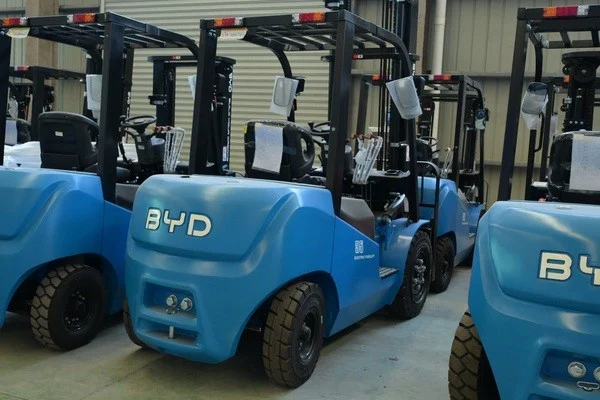
Leak Points: Where to Look and What Counts as a Defect
Leaks on a counterbalance truck concentrate at connections and dynamic seals. Inspect each of these after operating the machine, so pressurised fluid has had a chance to show itself.
- Hose ends and fittings: look at the crimp collars and the threads at every joint. A dry film may be residue; a wet film that reappears after wiping is an active weep.
- Lift and tilt cylinder rods: extend each rod fully and inspect the surface. Scoring, pitting or a persistent film on the rod indicates seal wear or contamination damage.
- Cylinder glands and end caps: check the base of each cylinder where the rod enters and where the barrel closes. Drips here usually mean seal replacement, not a simple tightening.
- Valve block and manifold: inspect the mating faces, plugs and cartridge ports. Fluid collecting under the block after cycling suggests a seal or plug issue.
- Reservoir, filler and breather: check the filler cap seal, the breather and the tank seams. Overfilling and a blocked breather can both push fluid out where it does not belong.
- Steering and brake circuits, where hydraulically assisted: follow the lines to their unions and check the steering cylinder ends.
Distinguish three states. A confirmed leak is a drip or a wet film that returns after cleaning during the inspection. A suspect point is residue with no fresh fluid after cycling. A clean point shows no film after the full test. Only the first justifies a firm repair estimate; the second justifies a follow-up check and a price discussion.
Use a simple observation table
| Observation | What it suggests | Confidence |
|---|---|---|
| Fresh drip after cycling | Active leak at that joint or seal | Confirmed finding |
| Wet film returns after wiping | Weep, possibly early seal wear | Confirmed weep, cause unconfirmed |
| Dry residue, no return | Old spill or past repair | Suspect only |
| Mast drifts with lever neutral | Internal leakage or valve issue | Requires pressure test |
Frequently Asked Questions
Can a hydraulic leak be judged from a parked truck alone?
Only partly. Static leaks at fittings, hoses and reservoir connections may show while parked, but cylinder rod seals and internal valve leakage often appear only under pressure and movement. Cycle the mast and steering several times, then re-inspect the same points.
Is a small weep acceptable on a used truck?
That depends on the manufacturer’s guidance and the price you are paying. A weep is not the same as a drip, but a returning wet film usually signals a seal that will need attention. Ask the seller to identify the source and to state whether it has been assessed against the service data.
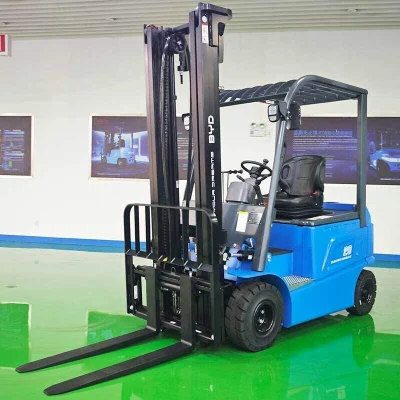
What if the seller has no pressure test record?
Ask whether a test can be arranged at the correct port and fluid temperature before purchase, or treat the hydraulic system as unverified and price the risk accordingly. A verbal assurance that the pressure is fine cannot be checked after the fact.
Should I buy a truck with a known cylinder leak?
A confirmed leak is a repair item, not necessarily a reason to walk away. Obtain a written estimate from a qualified technician, confirm the correct seal kit is available, and decide whether the adjusted price reflects the work. If several leak points are confirmed together, the wider system condition deserves a closer assessment.
When you are ready to compare configurations, share your load, lift height, duty cycle and charging arrangements so the hydraulic and electrical specification can be matched to the actual job. A four-wheel counterbalance electric fork lift truck is a common general-purpose choice across many handling tasks, but suitability still depends on those operating conditions rather than on the model name alone.