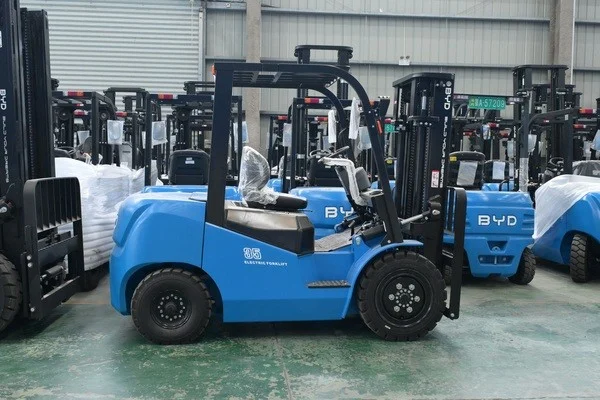
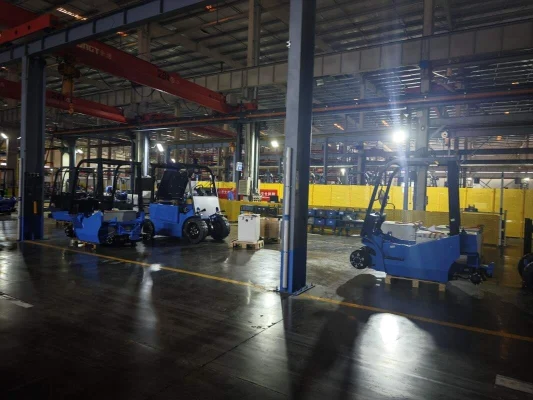
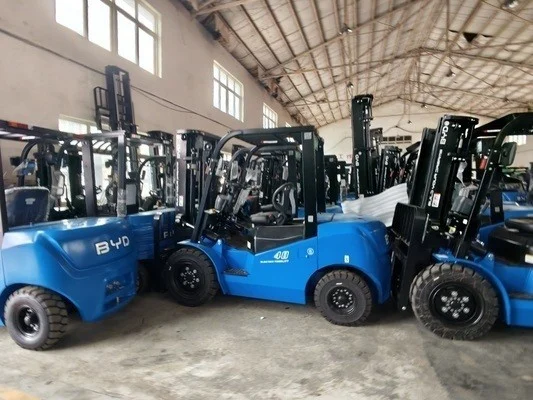
Choosing Different Forklift Types: A Procurement Guide to Duty Cycle, Load Center, and Battery Capacity on Four-Wheel Counterbalance Electric Models
News 03/11/2026
Procurement teams comparing different forklift types often start with a broad category search, then discover that the decisive variables sit inside one category: duty cycle, load center, and battery capacity on four-wheel counterbalance electric models. This guide explains how those three factors shape a specification, what data to collect before requesting a quote, and which points to confirm in writing before acceptance. It focuses on four-wheel counterbalance electric forklifts, including lithium-battery configurations; other truck types appear only where a boundary needs clarification.
Start with the duty cycle: how hard the truck will actually work
Duty cycle describes the intensity and rhythm of work: how many hours per shift, how many lifts per hour, average travel distance, ramp use, and the share of time spent lifting near rated capacity. Two operations with the same load weight can need very different configurations if one runs occasional pallet moves and the other runs continuous trailer loading.
Before comparing models, document a typical shift. Useful inputs include:
- Number of operating hours per shift and shifts per day.
- Peak lifts per hour and typical lift height distribution.
- Travel distances and any ramps or dock levellers.
- Attachment use, such as clamps or push-pull, which changes capacity and load center.
- Ambient conditions: indoor, outdoor, cold storage, or dusty areas.
These inputs let a supplier propose a realistic battery and motor configuration rather than a nominal capacity figure. Where the shift pattern is uncertain, state the range and ask how the proposed configuration behaves at the upper end.
Load center and capacity: reading the data plate correctly
Rated capacity on a four-wheel counterbalance electric forklift is tied to a specified load center and lift height. A truck rated at a given mass at a 500 mm load center may have a lower capacity when the load center moves forward or when the mast is raised. Procurement errors commonly arise when a buyer compares capacity numbers without checking the load center and height at which they apply.
Ask suppliers to provide the capacity chart or data plate information that applies to your actual load dimensions and lift height. If loads are long, wide, or carried with an attachment, the effective load center changes and the capacity must be rechecked. Do not assume that a higher nominal rating automatically suits a longer load; confirm the capacity at the real load center.
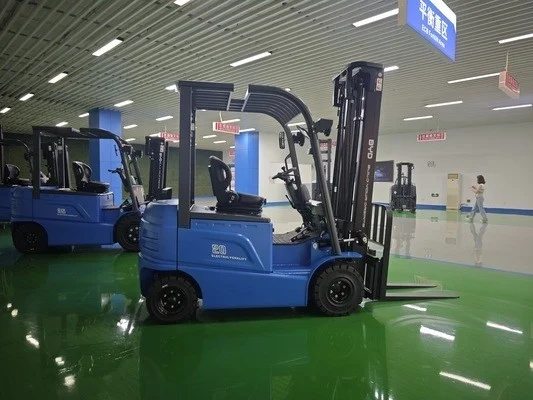
Also clarify how the truck will be used at height. If most lifts are low but occasional high lifts occur, the specification should reflect the highest regular lift height, not the average. The goal is a truck that remains stable and controllable across the full working envelope, not one that only meets the nominal rating on paper.
Battery capacity and charging: matching energy to the shift
Battery capacity determines how long the truck can work between charges and how charging fits the operating schedule. On lithium-battery four-wheel counterbalance electric models, opportunity charging during breaks can support multi-shift operation, but the feasibility depends on charger availability, charging time, and the actual energy consumed per shift. These are site-specific figures; they should be calculated from the duty cycle rather than assumed.
Procurement should collect:
- Required operating hours between charging opportunities.
- Available charging windows and charger capacity.
- Whether battery swapping is planned or charging is done in place.
- Electrical supply available at the charging location.
- Expected battery life and replacement terms, as stated by the supplier.
Where the supplier provides energy consumption figures, ask under what test conditions they were measured. Without verified data, treat run-time estimates as planning assumptions and confirm them during a trial or acceptance test.
Turning requirements into a procurement checklist
A clear request shortens the quoting cycle and reduces the risk of a truck that does not fit the job. The table below summarizes the main items to prepare. It is a general procurement aid, not a substitute for the supplier’s technical documentation.
| Category | What to specify | Why it matters |
|---|---|---|
| Duty cycle | Hours per shift, lifts per hour, travel distance, ramp use | Sets the energy and thermal demands on the truck |
| Load | Weight, dimensions, load center, attachment | Determines the capacity required at the real load center |
| Lift | Regular and maximum lift height, mast type | Affects capacity, stability, and overhead clearance |
| Aisle and floor | Minimum aisle width, floor condition, gradients | Influences truck dimensions and wheel configuration |
| Battery and charging | Run time needed, charging windows, electrical supply | Matches battery capacity and charging strategy to the shift |
| Environment | Indoor/outdoor, cold store, dust, moisture | May require specific protection or configuration |
Use the checklist to frame the inquiry, and ask the supplier to confirm each point against the proposed model’s technical data. If a requirement cannot be met, it is better to learn that before the order than at commissioning.
Acceptance checks and open questions
Before signing off, verify that the delivered truck matches the agreed specification: data plate capacity at the stated load center, mast lift height, battery type and capacity, charger compatibility, and any attachments. Confirm the documentation package and warranty terms in writing. Where performance figures are critical, agree on an acceptance test that reflects the actual duty cycle, and record the conditions.
Remaining uncertainties should be listed explicitly. Typical open questions include the measured run time under the site’s shift pattern, the capacity at the maximum lift height with the actual load, and the charging infrastructure needed to sustain multi-shift operation. These are legitimate items to resolve with the supplier using their technical data; they should not be filled in with assumptions.
To move from general comparisons to a concrete proposal, share your duty cycle, load details, lift height, aisle width, and charging conditions with our team. We can then discuss configuration options on four-wheel counterbalance electric forklifts, including lithium-battery models, within the range of technical information available.
Frequently asked questions
How do I know which duty cycle class my operation needs?
There is no universal classification that fits every site. Instead, describe the shift in measurable terms: hours, lifts per hour, travel distance, ramp use, and the proportion of lifts near rated capacity. A supplier can then assess whether a proposed configuration suits that pattern. If the pattern varies, specify the busiest period, since that is the condition the truck must handle.
Can I compare capacity figures between different forklift types directly?
Not reliably. Capacity ratings depend on load center, lift height, and truck configuration. A figure quoted without those conditions is not comparable. When reviewing quotes, ask for the capacity at your actual load center and lift height, and confirm the data plate values on delivery.
What should I confirm about battery capacity before ordering?
Confirm the nominal battery capacity, the expected run time under your shift pattern, the charging method and charger compatibility, and the conditions under which any run-time figures were measured. If the supplier cannot provide verified figures, plan a trial or acceptance test that reflects your operation.
Are four-wheel counterbalance electric models suitable for outdoor use?
They can be used outdoors where the surface, gradients, and weather protection suit the truck’s design. Suitability depends on the specific model’s ratings and protection features, so check the manufacturer’s technical data for the conditions at your site rather than assuming outdoor capability.