Choosing an Indoor Electric Forklift: Battery Capacity, Charging Time, and Duty Cycle Questions Buyers Should Answer First
News 01/11/2026
An indoor electric forklift purchase usually stalls at the same place: the buyer knows the loads and the aisle, but cannot yet describe the battery, charging routine and shift pattern well enough to request a meaningful quote. Those three items decide whether a four-wheel counterbalance electric forklift can work a full shift without an unplanned stop, so they belong in the first conversation with any supplier.
This guide lists the questions to answer before requesting pricing, the information to ask the supplier to confirm in writing, and the points to check when the unit arrives.
Start with the duty cycle, not the battery
Battery capacity only means something relative to how hard the truck works. Two warehouses can run the same model with very different results because one moves pallets continuously and the other handles a few loads an hour.
Describe the work in terms a supplier can convert into an energy estimate:
- Shift pattern: hours per shift, shifts per day, and days per week. State whether the truck runs through breaks or is parked.
- Handling rate: lifts or pallet moves per hour at peak, plus a typical figure.
- Load weight: the heaviest load and the average load, kept separate.
- Lift height and load centre: the height at which loads are handled and how far the load sits from the fork face.
- Travel distance and floor: route length, aisle width, floor condition and any ramps.
- Attachments: clamps, side shifters or other attachments that add weight or draw power.
A supplier who asks only about load weight is missing most of the picture. An indoor electric forklift working short cycles with frequent lifting draws energy differently from one making long, light runs, and the difference affects both battery size and the charging plan.
Battery capacity questions to settle before quoting
Capacity is stated in ampere-hours at a defined voltage, and usable capacity depends on the discharge limit the supplier sets. Ask these questions and keep the answers with the quote:
- What nominal voltage and rated capacity does the proposed battery carry, and under what discharge conditions is that rating stated?
- What depth of discharge does the supplier recommend before recharging, and what does that mean in usable ampere-hours?
- Does the quoted capacity reflect the attachments and lift heights described in the duty cycle?
- How does the battery management system behave near the low state of charge — does it limit travel speed or lift performance?
- What capacity margin does the supplier recommend above the calculated shift demand, and why?
Do not accept a capacity figure without the conditions attached to it. Rated capacity, recommended depth of discharge and the resulting usable energy are three different numbers, and a quote that blends them makes comparison impossible. Where the supplier has not published test conditions, ask them to state the basis in writing rather than assuming a value.
Charging time, opportunity charging and the power supply
Charging time is not a single number. It depends on charger output, battery state of charge, battery temperature and the charging profile the battery management system allows. Ask the supplier to separate three cases: a full recharge from the recommended low point, a partial top-up during a break, and a recharge from a deeply discharged state.
Then check whether the building can support the plan:
- Available voltage and current at the proposed charging position.
- Whether charging happens in a dedicated area or at the dock, and what ventilation and fire-safety rules apply locally.
- Whether the charger is matched to the battery and included in the quote.
- How many trucks share one charger, and whether the schedule leaves enough window between shifts.
Opportunity charging during breaks can reduce the battery capacity needed, but only if the breaks are long enough, the charger is sized correctly and the battery management system permits partial charging. Treat this as a question to confirm with the supplier, not an assumption to build a budget on.
Specification and acceptance checklist
Use the table below to organise the request. Fill the left column from your own operation and ask the supplier to complete the right column with documented values.
| Item to confirm | What the supplier should state |
|---|---|
| Rated load and load centre | Capacity at the stated load centre, plus any derating at the lift heights you use |
| Battery | Voltage, rated capacity, chemistry, recommended depth of discharge |
| Charging | Charger model, input power requirement, stated recharge times under defined conditions |
| Duty cycle basis | The shift pattern and handling rate the configuration was sized against |
| Delivery and support | Lead time, commissioning steps, warranty terms, spare parts and service arrangement |
At acceptance, verify the model and serial numbers, the battery and charger ratings against the quote, the rated capacity plate, and that the truck performs as described during a trial with your own loads. Record any deviation in writing before signing off.
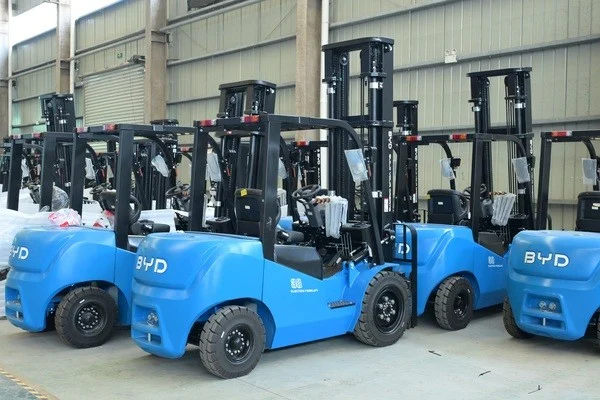
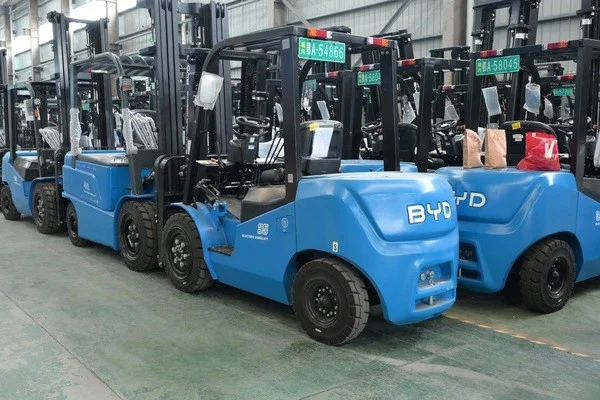
If you are evaluating a four-wheel counterbalance electric forklift, share your shift pattern, heaviest load, lift height, aisle width and charging position with our team; we can then discuss configuration options within the BYD four-wheel counterbalance electric range and identify which parameters still need confirmation.
Frequently asked questions
Can one battery last a full shift indoors?
It can, but only when the battery has been sized against a defined duty cycle and the recommended depth of discharge is respected. Continuous high-rate lifting, heavy attachments or long shifts may require a larger battery or a charging window. Ask the supplier to show the calculation rather than relying on a general claim.
Is a shorter charging time always better?
Not necessarily. Fast charging depends on the battery, charger and management system working together, and frequent fast cycles may not suit every operation. The useful question is whether the charging window you actually have matches the recharge time the supplier states under defined conditions.
What if my loads vary a lot through the day?
Size the truck and battery against the heaviest load at the height and load centre where it is handled, then check that the typical load does not push the truck past its rated capacity. Provide both figures to the supplier so the configuration is not based on an average that hides the peak.
Which documents should accompany a quote?
Ask for the capacity plate data, battery and charger specifications, the duty cycle assumptions used, warranty terms and the service arrangement. A quote without those details is difficult to compare and easy to misread.