Industrial Forklift Load Charts: Reading Capacity Ratings at Height and Load Center
News 02/11/2026
A load chart tells you what a four-wheel counterbalance electric forklift can safely lift at a specific combination of load center, lift height, and attachment. The rated capacity printed on the data plate is only the starting point: it usually applies to a standard load center at a low lift height. As the load center moves outward or the forks rise, the safe capacity falls. Reading the chart correctly is the difference between a routine pick and a stability incident.
This guide explains how to read an industrial forklift load chart, how to convert a real pallet into the numbers the chart expects, and which questions to settle with the supplier before you buy or rent.
What a Load Chart Actually Communicates
A load chart is a capacity derating table. It combines three variables that interact:
- Load center: the horizontal distance from the vertical face of the forks to the center of gravity of the load.
- Lift height: the height of the fork carriage or fork surface, depending on how the manufacturer defines it.
- Attachment: side shifters, clamps, rotators, and fork positioners move the load forward and add their own weight, both of which reduce remaining capacity.
The chart is not a suggestion. It reflects the stability limits built into the truck’s counterweight, wheelbase, and mast. Exceeding it does not usually produce a gradual warning; the risk is a tip-over or a mast failure.
Charts differ between manufacturers and between models, and the same nominal capacity can produce very different curves. Never apply one truck’s chart to another.
Reading the Numbers Step by Step
Step 1: Find the rated capacity and its baseline
Locate the data plate. It states rated capacity and the load center and lift height that capacity assumes. A common baseline is a standard load center at a defined height, but confirm the actual figures on the plate rather than assuming.
Step 2: Measure the real load center
Do not use the pallet footprint. Estimate the center of gravity of the actual load. A uniformly stacked pallet of the same depth has a predictable center; a pallet with an overhanging or offset load does not. For a load 1,200 mm deep, the geometric center is 600 mm from the fork face only if the weight is evenly distributed. Irregular loads require a conservative estimate, and a load center beyond the chart’s range means the truck is unsuitable.
Step 3: Find the lift height row
Read across the chart at the height where the load must be handled, not the height where it travels. If the task requires placing a pallet on the third rack beam, the relevant height is the top of that placement, plus clearance. Capacity at floor level does not apply at height.
Step 4: Apply the attachment derating
If the truck carries a side shifter or other attachment, the chart or a separate attachment plate states the reduced capacity. The attachment’s own weight and its forward offset both count against you. A truck rated at a given capacity with standard forks may have a materially lower rating with an attachment fitted.
Step 5: Compare with a safety margin
Compare the calculated load weight, including pallet and any packaging, against the chart value at your actual height and load center. If the two are close, treat the pick as marginal and look at whether the load can be repositioned closer to the carriage or handled at a lower height.
Where Load Charts Go Wrong in Practice
Most capacity problems come from assumptions rather than arithmetic. Watch these recurring errors:
- Using the data plate figure at full height. The plate value typically applies to a baseline condition, not to every lift.
- Ignoring the attachment. A side shifter is common and its derating is often overlooked.
- Estimating load center from pallet size. The center of gravity of the goods, not the pallet, governs.
- Forgetting the load’s own packaging. Pallets, banding, and containers add weight and can shift the center.
- Mixing truck models. Two trucks with the same nominal capacity can have different charts.
These are general principles. The only authoritative figures are those in the manufacturer’s documentation supplied with the specific truck and attachment.
Matching the Chart to Your Application
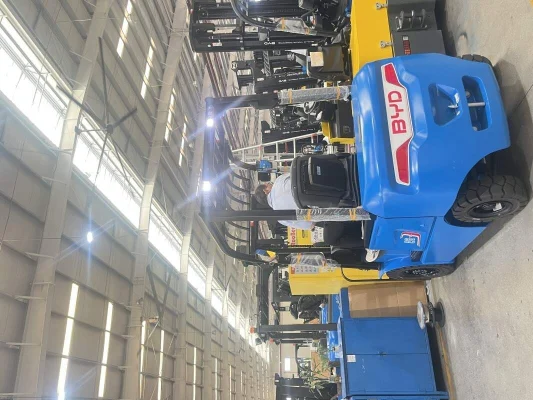
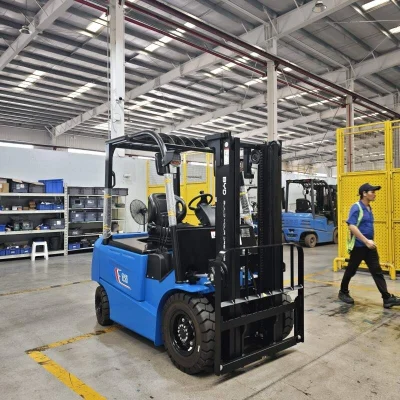
Load charts matter most in warehouses and factories where pallets are stored on racking at height. In those settings, the practical question is not only whether the truck can lift the weight at floor level, but whether it can do so at the rack beam height with the load center your pallets produce.
Consider a hypothetical application: a distribution warehouse storing uniformly stacked pallets on three-level racking, with a side shifter fitted to the truck. The purchasing team should confirm the actual load center of the pallets, the required placement height, and the attachment’s derated capacity before selecting a model. If the required height and load center push the remaining capacity below the pallet weight, a different mast or attachment configuration may be needed, or the racking layout may need review. The same logic applies to a manufacturing plant moving heavy dies or fixtures, where load centers are often larger than a standard pallet.
Also weigh the operating conditions that interact with capacity: aisle width and turning radius, floor condition and slope, and the duty cycle. A truck operating near its limit all shift is working harder than one with margin. Charging arrangements and shift patterns affect how consistently the truck is available, but they do not change the chart.
| Item to verify | Why it matters | What to ask the supplier |
|---|---|---|
| Rated capacity and its baseline load center and height | Sets the starting point for all derating | Provide the data plate and load chart the specific truck |
| Actual load center of your loads | Determines which chart column applies | Confirm how the chart defines load center and height |
| Required lift height | Capacity falls as height increases | Provide capacity at your placement height, not just floor level |
| Attachment type and weight | Reduces remaining capacity | Provide the attachment derating plate or chart |
| Mast and fork dimensions | Affects height and load handling | Confirm dimensions against your racking and doorways |
| Aisle and turning requirements | Affects whether the truck fits the layout | Provide turning radius and aisle guidance |
Frequently Asked Questions
Does the rated capacity apply at every lift height?
No. Rated capacity is normally tied to a baseline load center and height. Capacity generally decreases as load center increases or lift height rises. Use the chart the specific truck and attachment.
How do I measure load center a pallet?
Find the center of gravity of the loaded pallet, measured horizontally from the vertical face of the forks. Uniform loads are easier to estimate; irregular or offset loads need a conservative estimate. If the result falls outside the chart’s range, the truck is not suitable that task.
What happens if I exceed the chart?
Exceeding the chart reduces stability margin and can lead to tip-over or structural damage. The chart is a limit, not a target. If a load exceeds capacity at the required height, reposition the load, reduce the height, or use a truck with a higher rating.
Do attachments change the capacity?
Yes. Attachments add weight and move the load forward, so the remaining capacity is lower than with standard forks. The attachment documentation or a separate plate should state the derated figure.
Can I use one chart all my trucks?
No. Charts are model-specific and can differ even when nominal capacities match. Keep the correct chart with each truck and attachment combination.
Before You Buy: A Practical Checklist
Collect these details before requesting a configuration:
- Actual load weight, including pallet and packaging.
- Load center of your typical and heaviest loads.
- Required placement and travel heights.
- Attachment type and its derating data.
- Racking, aisle, doorway, and floor conditions.
- Shift pattern and charging arrangements.
Ask the supplier the data plate and load chart the specific truck and attachment, capacity at your actual height and load center, and confirmation of mast and fork dimensions against your layout. These are the facts that determine whether a four-wheel counterbalance electric forklift fits the job. If the required height or load center falls outside the truck’s chart, say so honestly and review the layout or the task instead of forcing the truck beyond its limits.