Lithium Ion Forklift Battery Sizing for Four-Wheel Counterbalance Electric Forklift Load Charts and Duty Cycles
News 01/11/2026
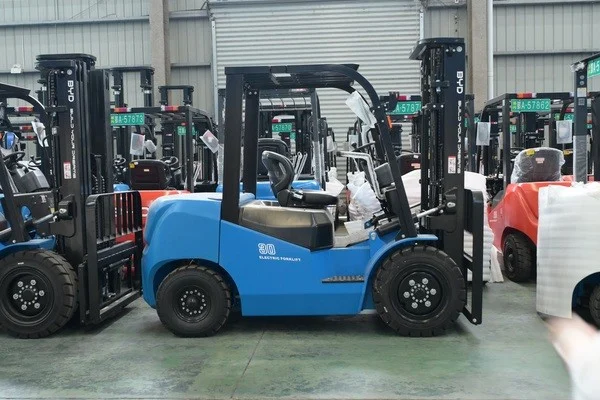
Choosing a lithium ion forklift battery starts with two questions that are easy to answer incorrectly: what does the load chart actually permit, and what does a shift demand from the battery? A four-wheel counterbalance electric forklift can be ordered with several battery capacities, and the right one depends on the loads you lift, the heights you reach, how far the load center sits from the carriage, and how hard the truck works between charges. Oversizing adds cost and weight; undersizing shows up as voltage sag, shortened run time, and premature derating. This guide explains how to connect load chart limits and duty cycle estimates so the battery capacity you request matches the work the truck performs.
Read the Load Chart Before Choosing Battery Capacity
The load chart is the first document to check, because it defines what the truck can safely lift at a given load center and lift height. Battery weight is part of the counterbalance calculation, so a capacity change can change the chart itself. Never treat the rated capacity on the data plate as a single number that applies everywhere.
What the chart tells you
A typical chart lists rated capacity at a stated load center, then reduces capacity as the load center moves outward or the mast reaches higher. If your pallet places the center of gravity beyond the rated load center, the allowable load drops. The same principle applies when you handle attachments or non-standard loads. Ask the supplier to confirm the chart that applies to the exact mast, carriage, and battery configuration you intend to buy.
Why battery weight matters
Lead-acid and lithium ion batteries of similar nominal capacity can differ in mass and dimensions. A lighter battery may reduce counterweight effect, while a heavier one may exceed the compartment or axle limits. Confirm the approved battery weight range and compartment dimensions with the manufacturer’s technical资料 rather than assuming that any capacity fits any truck. Where documentation is incomplete, request the specific figures and test conditions before committing to an order.
Match Battery Capacity to the Real Duty Cycle
Duty cycle describes how the truck is used, not how long it sits in the aisle. Two operations with identical loads can draw very different energy if one lifts to six meters continuously and the other shuttles pallets at floor level. Build an honest picture of a shift before sizing the battery.
Inputs to collect
- Number of shifts and hours the truck is actually moving or lifting
- Average and maximum load weight, plus the load center
- Lift height distribution: how often the mast reaches full height
- Travel distance and surface conditions, including ramps
- Attachment use, which changes both load capacity and energy draw
- Ambient temperature and any cold-storage operation
- Charging window, charger availability, and opportunity charging plans
Turning inputs into an estimate
Energy use rises with load weight, lift height, travel distance, and the number of lift cycles. Rather than guessing a single run-time figure, list the operations in a table and note which ones dominate. A truck that lifts heavily loaded pallets to racking all shift has a different profile from one that unloads trailers and travels long distances empty. Share this profile with the supplier so the recommended battery capacity and charging strategy reflect the actual pattern. Without measured data from your site, treat any run-time number as an estimate to be confirmed.
Charging Strategy, Weight Limits, and Configuration Trade-offs
Battery capacity and charging behavior are linked decisions. A larger battery can extend run time, but it may also raise cost, change weight, and require a different compartment or charger. A smaller battery paired with opportunity charging during breaks can suit multi-shift operations, provided the charger, electrical supply, and battery management system support that pattern.
Questions to settle with the supplier
- Which battery capacities are approved this truck and mast combination?
- What is the permitted battery weight and compartment size?
- Does the proposed charger match the battery and the available power supply?
- What charging windows exist between shifts, and where will the truck park?
- Does the load chart change with the selected battery?
- What documentation confirms capacity at the intended load center and lift height?
Also consider the operating environment. Extreme cold can affect available capacity and charging behavior, so cold-storage or outdoor winter use should be discussed explicitly. Where the truck works in narrow aisles, verify that the chosen configuration still meets the aisle and clearance requirements. These checks belong in the quotation stage, not after delivery.
An illustrative scenario
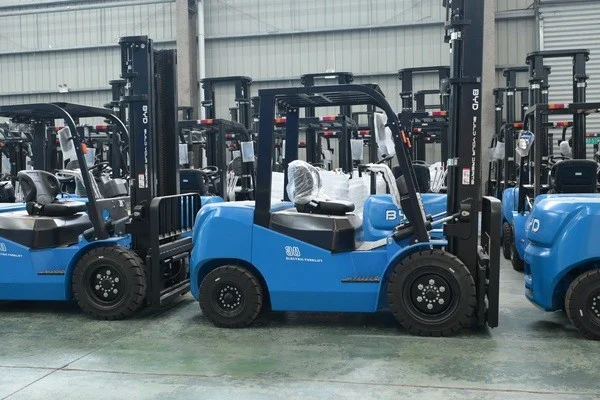
Consider a hypothetical warehouse that receives pallets at floor level and puts them away at moderate height, running one main shift with a short break. The operation may suit a mid-range capacity with a charging window between shifts. A second hypothetical site lifting dense loads to high racking across two shifts may need a larger capacity or an opportunity-charging plan. These are planning examples, not measured results; your own load chart and duty cycle data decide the final specification.
Frequently Asked Questions
Can I replace a lead-acid battery with a lithium ion forklift battery of the same nominal capacity?
Nominal capacity alone is not enough. Check battery weight, dimensions, compartment approval, charger compatibility, and the load chart that applies to the new configuration. The manufacturer’s technical documentation should confirm whether the swap is permitted.
Does a bigger battery always mean longer run time?
Generally a larger capacity supports longer operation, but actual run time depends on load weight, lift height, travel, temperature, and how the truck is driven. Confirm expected performance with the supplier using your duty cycle rather than relying on a single headline figure.
How does the load center affect battery sizing?
The load center determines allowable load at a given lift height. If your loads sit farther from the carriage, the chart may reduce capacity, which can influence the truck and battery configuration you need. Always size against the chart that matches your real loads.
What information should I prepare before requesting a quotation?
Provide load weights and load center, lift heights, aisle widths, floor and ramp conditions, shift pattern, charging windows, and available electrical supply. These details let the supplier recommend a four-wheel counterbalance electric forklift configuration and battery capacity that fit the work.