Mast Free-Lift and Overhead Clearance: Screening Different Forklifts Type Against Container and Racking Constraints
News 30/10/2026
Overhead clearance often decides whether a forklift can work inside a container or under a rack beam. Mast free-lift—the height a carriage and fork can rise before the mast channels extend—directly affects this. When comparing different forklift types, free-lift and collapsed mast height are screening criteria, not afterthoughts. This article explains how these dimensions interact with container doors and racking, and how to apply them to four-wheel counterbalance electric forklifts, the type this site supplies.
Why free-lift and collapsed height matter in confined spaces
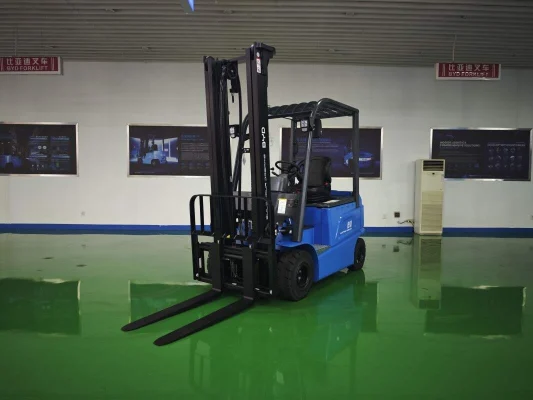
A forklift mast has two height figures that matter before lifting: collapsed height (overall height with forks down) and free-lift height. Free-lift is the vertical travel available before the inner channels start to rise. A mast with little or no free-lift may need to extend its channels to reach a low shelf or container floor, increasing overall height early in the lift cycle.
In a container, the door header limits entry height. Under a rack beam, the beam underside limits how high the carriage can go before the mast itself must extend. If free-lift is too low, the operator may have to raise the forks higher than the available clearance just to engage a pallet. The result is either a blocked approach or a mast that cannot fit.
These are geometric constraints. They can be checked from manufacturer dimension sheets before a unit is specified. No trial lift is needed to see whether a given mast profile fits a given opening, provided the dimensions are accurate.
Container entry: door height, floor level, and mast profile
Standard freight containers have a door opening lower than the internal ceiling. A four-wheel counterbalance electric forklift entering a container must pass under the door header with the mast collapsed. Inside, the mast must still have enough free-lift to place or pick a pallet at floor level without the channels contacting the ceiling.
Three dimensions should be confirmed from the mast data sheet:
- Collapsed height with the specified fork carriage and forks.
- Free-lift height at the rated capacity and load center.
- Overall height at maximum fork height, which matters if the container is loaded to the top tier.
Container work also involves floor strength, threshold ramps, and ventilation if the truck is electric. These are separate from mast geometry but affect whether a counterbalance truck is suitable at all. A four-wheel counterbalance electric forklift is a common general choice for loading and unloading at dock level, but the final decision depends on the actual container specification and the site’s operating rules.
If the container is loaded or unloaded from a raised dock, the approach angle and dock leveler capacity also need checking. Mast free-lift does not solve a floor or ramp limitation.
Racking interfaces: beam clearance and free-lift sequencing
In a warehouse, the critical point is often the underside of the first beam or the lowest shelf. A mast with sufficient free-lift can raise the forks to the beam level without extending the channels above the beam. A mast with low free-lift may force the channels up, and the resulting overall height can exceed the clearance to the next beam or the ceiling.
Use a simple screening sequence:
- Measure the clear height under the lowest obstruction at the pick or place position.
- Compare that height with the mast’s free-lift figure.
- Check the collapsed height against any aisle entry restriction.
- Confirm the rated capacity at the actual load center, because free-lift and capacity are linked to carriage and mast configuration.
This sequence does not replace a site survey. It does show whether a given mast type should be excluded early. Different forklift types have different mast profiles, and a model that works in one aisle may not fit another with a lower beam.
For four-wheel counterbalance electric forklifts, mast options vary by manufacturer and model. The relevant figures must come from the supplier’s technical data, not from general assumptions about mast types.
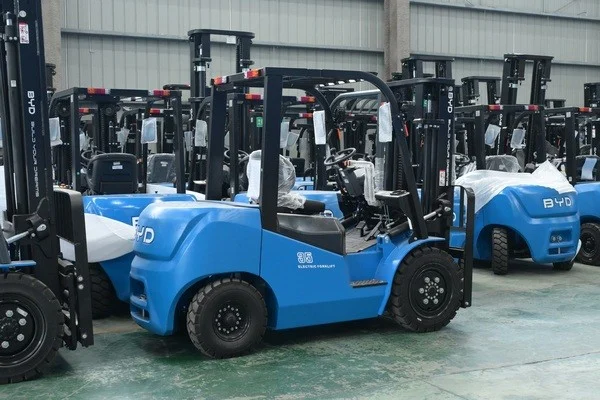
Applying the screen to different forklift types
When the task is to compare different forklift types against container and racking constraints, keep the comparison on measurable dimensions. The table below shows the kind of data to collect. It is a template, not a set of catalog values; enter figures from the actual supplier data sheets.
| Check | What to record | Why it matters |
|---|---|---|
| Collapsed height | Overall height with forks down, specified carriage | Container door entry and aisle obstructions |
| Free-lift | Height before channels extend, at rated load center | Low-level picking under beams or container ceiling |
| Overall height at top lift | Maximum fork height plus mast extension | Top-tier racking and ceiling clearance |
| Capacity at load center | Rated capacity at the actual load center | Free-lift and capacity depend on mast and carriage |
| Right-angle aisle width | Manufacturer’s aisle requirement | Whether the truck can turn inside the rack layout |
A four-wheel counterbalance electric forklift is the default type discussed here. Other forklift types may have different mast geometry, but this article does not recommend them as site products. When a container or racking constraint rules out a counterbalance truck, the correct next step is to re-examine the load, the rack layout, or the handling method—not to assume another type will fit without its own dimensional check.
For a hypothetical application, consider a low-clearance rack bay where the beam underside is close to the collapsed height of a standard mast. A mast with greater free-lift may allow the forks to reach the pallet without extending the channels; a mast with less free-lift may not. This is a geometry example, not a tested case. The actual answer depends on the specific mast dimensions and the measured clear height.
If the application involves a container with a low door header, check the collapsed height first. If the collapsed height exceeds the door opening, the truck cannot enter regardless of free-lift. If the collapsed height fits but free-lift is insufficient, the operator may still be unable to work at floor level without raising the channels. Both checks are necessary.
To narrow the options, gather the actual load weight, load center, lift height, aisle width, floor condition, and charging arrangement. These inputs let a supplier match a four-wheel counterbalance electric forklift configuration to the site. This site supplies that type, and selection should be confirmed against the available technical data and the site’s operating conditions.
Frequently asked questions
What is mast free-lift in simple terms?
It is the height the forks can rise before the mast channels begin to extend. A mast with more free-lift can work at low levels without increasing overall height as early.
Can any four-wheel counterbalance electric forklift enter a standard container?
No. Entry depends on the collapsed height relative to the container door opening, and on the mast profile. The container specification and the truck’s dimension sheet must be checked together.
Does free-lift affect capacity?
Free-lift is tied to the mast and carriage configuration, and capacity is rated at a specified load center. A mast option that provides more free-lift may have a different capacity rating. Use the manufacturer’s data for the exact configuration.
How do I screen different forklift types against racking?
Measure the clear height under the lowest beam at the work position, compare it with the free-lift figure, and check the collapsed height and aisle width. Exclude any type whose dimensions do not fit before considering other features.